How to Build an Immersive Anime World: Geography, Power Systems, Culture, and Visual Identity
Your world isn't the backdrop — it's the pressure system that makes every conflict feel inevitable
Every anime world that sticks with you has the same quality: it feels like it existed before the story started and will keep existing after it ends. The rules are consistent. The culture has texture. The geography puts real limits on what characters can do and where they can go. The power structure creates pressure that explains why conflict is inevitable rather than convenient. That quality isn't magic — it's construction. And it's learnable.
This guide walks through the six foundational layers of anime world-building — geography, power systems, culture, factions, tone, and visual identity — with concrete examples across fantasy, sci-fi, slice-of-life, and dystopian genres. Whether you're building a sprawling isekai continent or a single high school neighborhood, these are the decisions that make a world feel real.
👉 Start Building Your Anime World Visually with AutoWeebYour world is a pressure system, not a setting — it should make conflict feel inevitable.
The most common world-building mistake is treating the world as decoration: a place where plot events happen. A city named because the plot needs a city. A forest that exists because the characters need to travel through something. A school that's there because the protagonist is a teenager.
The worlds that resonate work differently. They're pressure systems. Every element — the geography, the power rules, the social structure — conspires to create conditions where your protagonist's specific flaws and desires will be maximally tested. The world doesn't describe your story from the outside. It generates your story from the inside.
Before designing any specific element, ask one question: what does this world need to be, structurally, to make my protagonist's conflict inevitable? Answer that first. Every design decision after that has direction.
Geography shapes tone, limits movement, and determines where power collects.
Physical geography isn't just landscape art. It's a constraint system that determines who can go where, who controls what, and what kinds of stories are even possible. A walled city creates different stories than an open frontier. An archipelago creates different power dynamics than a single contiguous landmass. A world with impassable mountain ranges creates information asymmetry — factions don't know each other fully, which generates suspicion, myth, and conflict.
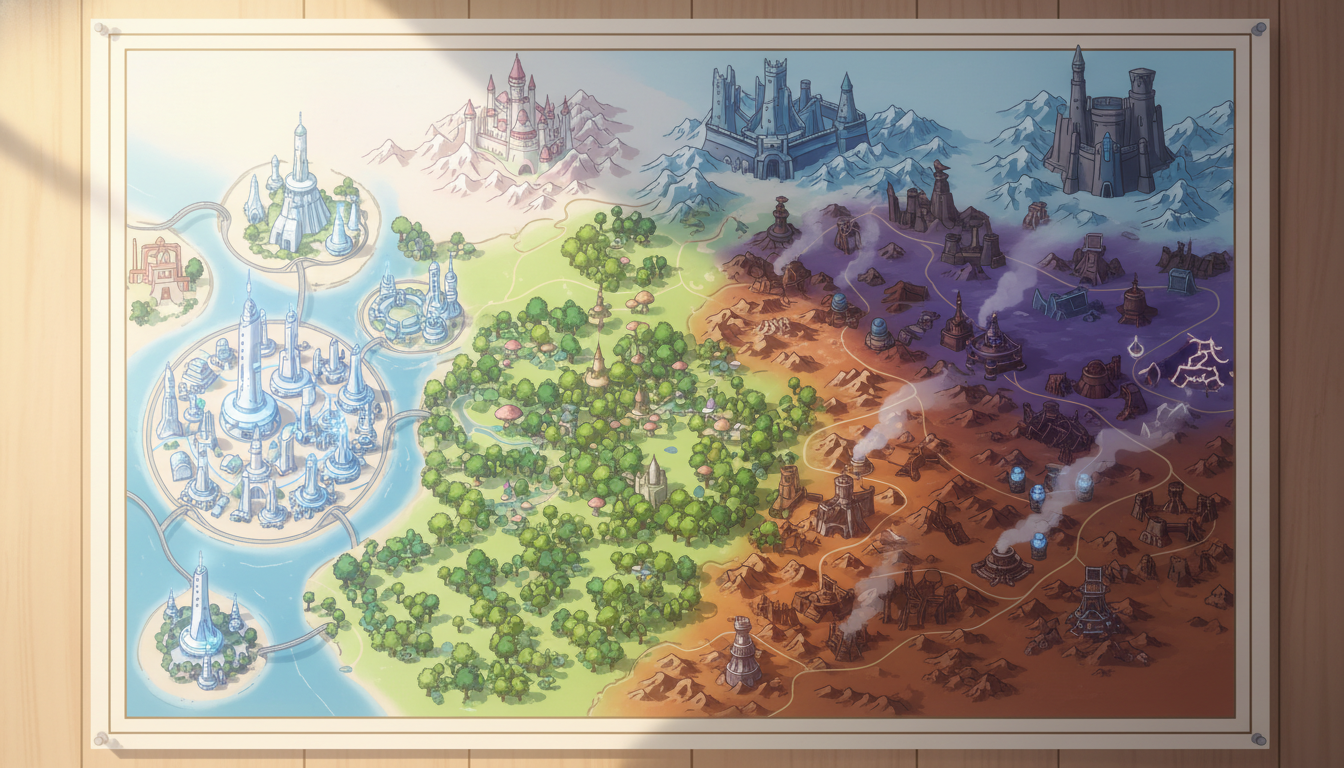
In a fantasy anime world, consider what the terrain rewards. Mountains shelter isolated clans who develop distinct cultures and resist central authority. Rivers are trade routes, which means economic power follows water. Fertile plains attract settlement and empire-building, so the political center of a fantasy world is usually on a plain — and the resistance comes from the margins. Geography as politics is one of the oldest storytelling tools and still one of the most effective.
Geography in sci-fi and dystopian worlds functions vertically rather than horizontally.
When your world is a dense megacity or an orbital station, the axis of geography shifts. In a cyberpunk or dystopian setting, the question isn't which direction characters travel — it's which level they occupy. Upper floors, sky bridges, and sealed corporate towers belong to the powerful. Basements, tunnels, and maintenance corridors belong to everyone else. Vertical geography is one of the cleanest visual shorthand tools in anime: you can show a character's status simply by showing where they stand. The cramped underground of a resistance cell. The glass-walled penthouse of the faction that controls the water supply.
In a slice-of-life world, geography contracts to the personal scale: the commute between home and school, the specific bench at the river where conversations happen, the corner konbini that marks the edge of the protagonist's daily world. Slice-of-life geography works through familiarity and meaning — the places aren't grand, but they're precise, and the precision makes them emotionally resonant.
Power systems define what your world rewards, punishes, and makes people desperate enough to die for.
A power system is more than a magic system or a combat mechanic. It's the answer to: what does this world treat as scarce and valuable? Control that resource, and you control everyone who needs it. Everything interesting about factions, alliances, betrayal, and sacrifice follows from that scarcity.
In a fantasy world with elemental magic, scarcity might be the ability to use it at all. If only one in a thousand people is born with fire affinity, those people become weapons, symbols, and objects of both reverence and fear. That scarcity generates an entire social order without you having to invent one: institutions that find and train them, governments that conscript them, black markets that sell access to their services, and protagonists who were born with a rare ability they never asked for and don't know what to do with.
In a sci-fi world, the scarce resource might be information, energy, clean water, or breathable air. In a dystopian world it's usually legal status or physical safety. In a slice-of-life world the "scarcity" is subtler but still real: social acceptance, a college recommendation letter, a spot on the starting lineup, someone's genuine attention. The stakes scale to the world's register, but the structural function is the same.
Three questions that every power system needs to answer before your first scene.
First: who has it, and who doesn't? The gap between those two groups is where your conflict lives. Second: how do people get it, lose it, or have it taken? The mechanics of acquisition and loss determine what your characters are willing to do. Third: what does having it cost? The most interesting power systems in anime impose a real price — exhaustion, shortened lifespan, emotional numbness, permanent physical change. A power that costs nothing creates a protagonist who accumulates without choosing. A power that costs something creates dilemmas. Dilemmas create character.
Culture and factions give your world memory — the history that explains why people are the way they are.
Culture is the accumulated response of a group of people to their circumstances. If a community lived for generations in fear of a predatory monster, their culture will encode vigilance, communal defense, and suspicion of outsiders. If a city was built on trade, its culture will value cleverness, negotiation, and social flexibility over martial virtue. Culture isn't just costumes and food — it's a set of values and survival strategies that evolved for specific reasons.
Factions are culture in conflict. Two groups with different values competing over the same resource or territory is the engine of almost every story at scale. The most effective anime factions aren't simply good and evil. They're groups that each have a reasonable answer to a real problem, but whose answers are incompatible. The faction that believes order is the only protection against catastrophe versus the faction that believes freedom is worth the risk. Neither is wrong. Both are dangerous to the other.
In a fantasy world, this might be two clans with competing claims to a sacred site, each with genuine historical grievances. In a cyberpunk world, it might be a corpo security force and a street-level resistance cell who both believe they're protecting the people caught in between. In a slice-of-life world, it shrinks to a student council and a club fighting over budget allocation — but the same dynamic of competing legitimacies applies.
Tone is a design choice, and visual identity is how tone becomes something you can see.
Tone is the emotional atmosphere of your world — the register in which events are experienced. A fantasy world with a warm, golden-hour tone (think Howl's Moving Castle) handles death, loss, and conflict differently than a fantasy world with a cold, high-contrast tone (think Berserk). Same genre, completely different emotional contract with the audience.
Decide your tone early, because it governs dozens of downstream decisions: color palettes, lighting conditions, the speed of scenes, the kind of humor that's allowed, how much is left ambiguous, and how villains are drawn. A high-contrast dark fantasy world should have villains with sharp silhouettes and desaturated skin. A warm slice-of-life world should have villains who are complicated and human, lit the same way as everyone else.
Visual identity is tone made concrete through color, architecture, and the way light works.
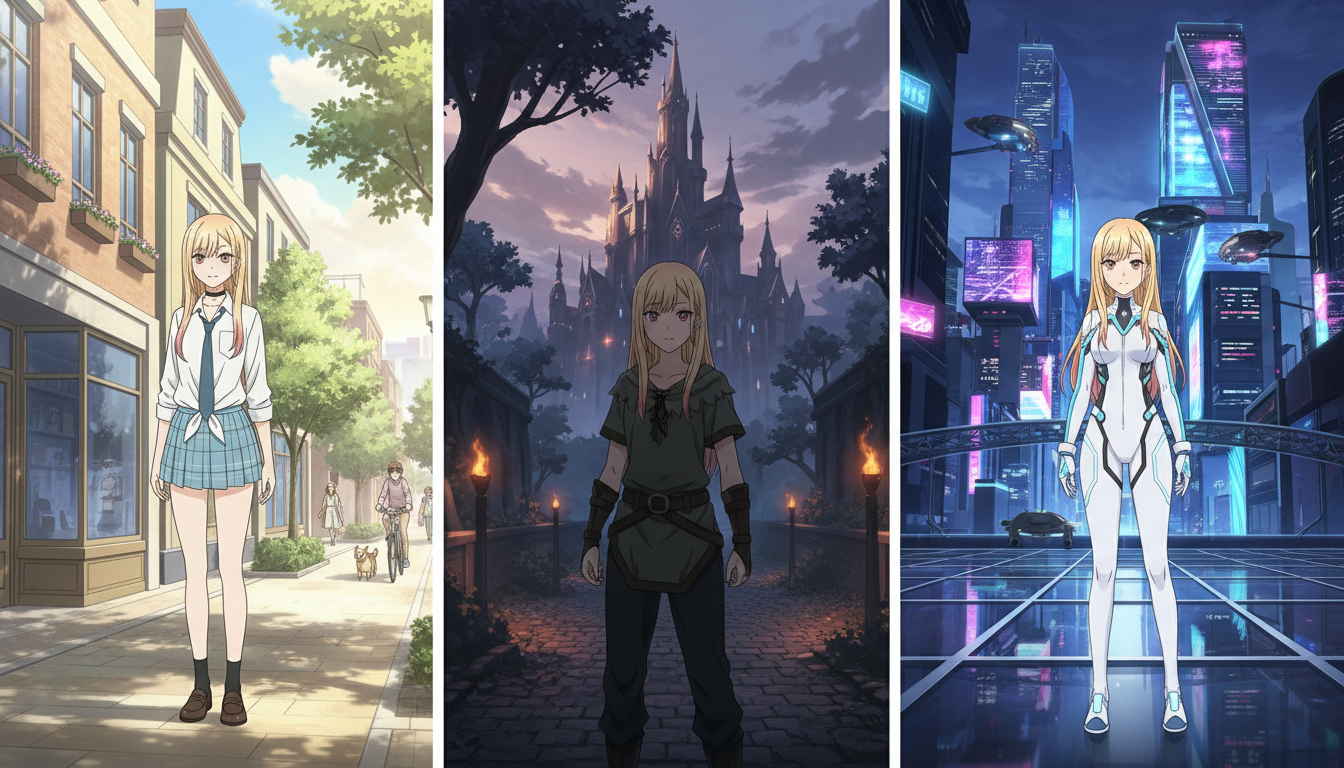
Each genre has a visual vocabulary that communicates tone before a character opens their mouth. Slice-of-life worlds use soft natural lighting, warm wood interiors, seasonal color cues, and lived-in spaces with personal objects. Dystopian worlds use hard artificial light, brutalist geometry, institutional gray-and-orange color schemes, and spaces that are either under-maintained or aggressively clean in ways that feel inhuman. Fantasy worlds anchor visual identity in climate and culture: the warm sandstone of a desert kingdom, the dark iron and blue fog of a northern fortress, the luminescent forest of an ancient elven territory.
Sci-fi uses chromatic contrast as a power marker. Corporate and government spaces are white, silver, and blue-lit with clean lines. Underground and resistance spaces are amber-lit, textured, layered with repurposed technology. The colors tell you who built the space and who had to work with what was left.
Genre-specific starting points: the core tensions that anchor four major anime world types.
Fantasy: the world has rules older than any living person, and breaking them has consequences.
A strong fantasy anime world feels ancient. It has precedents, legends, and ruins that suggest depth beyond the story's timeframe. The core tension is usually between those who inherit and maintain old power (kingdoms, noble houses, religious institutions) and those who exist outside or beneath that inheritance. Your protagonist in this world typically starts with less than they're owed and has to decide whether to work within the system, dismantle it, or find a third option the system didn't account for.
Starting point for a fantasy world: pick one ancient catastrophe that reshaped the world and still echoes in current politics. Pick one type of power that everyone wants and not everyone can have. Pick two factions with incompatible claims to legitimacy. Build geography that forces those factions into contact.
Sci-fi: someone built this world intentionally, and their intentions weren't neutral.
Sci-fi worlds are artificial in ways fantasy worlds rarely are. Someone decided how the city was structured, who controls the infrastructure, what the law covers and ignores. The tension lives in the gap between the stated purpose of an institution and what it actually does. A corporation that claims to provide clean water also controls who gets it. A government that claims to protect citizens also survives on their compliance. Your protagonist in this world is usually someone who gets close enough to see that gap clearly, and can't unsee it.
Starting point for a sci-fi world: pick one technology that changed everything and is now too embedded to remove. Pick one institution that controls it. Pick one community that was displaced or harmed when that institution grew. Your story lives in how those three pieces still rub against each other.
Slice-of-life: the world is ordinary, but ordinary things have weight.
Slice-of-life world-building is an exercise in specificity and restraint. The world is not exceptional — that's the point. But specificity creates texture that generic "high school town Japan" never achieves. What does the protagonist's neighborhood smell like in late August? What's the specific view from the classroom window that they've memorized without meaning to? What's the one shop that's been closed for two years and nobody mentions?
The core tension in slice-of-life is usually the passage of time and the proximity of change. The third-year students know they're almost gone. The summer is ending. The club is one vote away from being dissolved. Ordinary life in anime slice-of-life carries weight because the world is built with enough precision that you can feel what's going to be lost.
Dystopian: the world's logic is internally consistent, and that's what makes it terrifying.
The most effective dystopian anime worlds are frightening not because they're chaotic, but because they make sense from the inside. Someone built them to solve a real problem. The rules exist for reasons that seemed reasonable at the point of origin. The horror is in how far those reasonable rules were taken, and in how many people accepted that escalation because they benefited from it or were too frightened to resist.
Starting point for a dystopian world: identify the one social fear that the society organized itself to eliminate (crime, disease, class conflict, ideological dissent) and trace out what it built to do that. Then identify who gets defined as the problem. Your protagonist is either someone defined as the problem, someone who enforces the solution and starts to question it, or someone who benefits from it and is about to lose that status.
AutoWeeb accelerates worldbuilding by making your decisions visual before they're final.
One of the most useful things you can do in early-stage worldbuilding is test whether your world feels right before you're committed to it. Written descriptions can mislead you — a character who sounds right in text can feel completely wrong once you can see them. A world that seems tonally coherent in your notes can produce confusing visuals when you try to render it.
AutoWeeb's anime character creator lets you generate visual versions of your world's inhabitants with specific art style prompts. If you're building a warm fantasy world, test that warmth by generating characters with the Ghibli-adjacent style settings. If you're building a high-contrast dystopian city, run characters through a cyberpunk aesthetic and see whether the visual register matches the emotional one you had in your head. "Pale-haired enforcer, sharp silver uniform, cold blue light, precise posture, isolated expression, sci-fi corporate aesthetic" tells you something about your faction's visual identity that three paragraphs of prose description can't.
Once you've settled on a character design, AutoWeeb's photo packs place that character into curated world environments — isekai towns, festival streets, urban city life, beach episodes, and more. This is world-testing in visual form: does your character feel right in this kind of space? Does the combination of character design and environment produce the tone you intended? Finding those mismatches early, before you're invested in either the character or the setting, saves enormous time.
For creators building stories with multiple characters across different factions or eras, the character sheet system lets you lock in each character's visual identity and keep them consistent across every scene you generate. Your rebel faction and your imperial guard can be rendered distinctly and consistently — and the visual contrast between them becomes part of your world's storytelling.
👉 Build Your Anime World and See It Come to Life with AutoWeebFrequently asked questions about anime worldbuilding.
How much of my world do I need to build before I start writing?
Less than you think. You need enough to understand what your protagonist is up against and why. The geography the first act takes place in. The power system as it affects your protagonist directly. The faction or social pressure that's creating your central conflict. Everything else can be discovered during writing and filled in as needed. Over-building before writing is a form of productive avoidance — it feels like work because it is work, but it delays the actual story indefinitely. Build what the first act needs, then write the first act.
How do I make my world feel original when everything seems to have been done already?
Originality in worldbuilding rarely comes from inventing a new type of magic or a new civilization structure. It comes from combining familiar elements in ways that produce novel tensions, and from the specific way your protagonist moves through and responds to your world. A healer in a warrior society isn't a new premise. A healer in a warrior society who genuinely believes the society's values and is destroying herself trying to earn recognition through the wrong metrics — that combination of world and protagonist psychology is much harder to find. The world creates the external conditions. The protagonist's specific internal architecture determines whether those conditions produce something that feels seen and real.
Do I need a full map before I start worldbuilding?
A map is a tool, not a requirement. Some creators find that drawing geography helps them understand the spatial logic of their world before they write in it. Others find that over-committing to a map early forces plot decisions in directions the story doesn't want to go. A rough sketch indicating relative positions — here's the capital, here's the borderlands, here's the contested region — is enough to begin. The detailed map can come later, after you understand what the story actually uses.
How many factions is the right number for an anime world?
Two factions is the simplest structure and the easiest to write cleanly. Three factions is where most interesting political complexity lives — two against one, temporary alliances, triple-crossing, and the way a third party can shift the balance between the other two entirely. Beyond four or five major factions, most beginners lose track of whose interests are whose, and the audience often does too. Start with two or three. Add more only when the story has earned the complexity.
Can I combine genres in one world?
Yes, and some of the best anime worlds do exactly that. Fullmetal Alchemist is fantasy and dystopian simultaneously. Attack on Titan moves through horror, military action, and political thriller across its run. The key is tonal consistency: the world's emotional register should stay coherent even as genre elements shift. A world that is warm and slice-of-life in its domestic scenes can have dark political thriller elements — as long as both registers feel like they belong to the same world. When genre combinations fail, it's usually because the tonal registers are so different that they undercut each other. Define your world's core emotional temperature first, then decide how far from that temperature the genre elements can drift without breaking immersion.
What's the difference between world-building for a short story versus a full series?
Scope and depth. A single-arc story or short film needs the world to be deep in exactly the areas the story enters, and can be completely undeveloped everywhere else. A multi-season series needs more infrastructure: enough factions, geography, and power mechanics to sustain multiple arcs without contradicting itself. The practical difference is in how much time you spend building versus writing. For a short story, build only what you'll use. For a series, build an extra layer beyond what you'll use in the first arc — enough that the world feels larger than the story currently occupying it, because that sense of depth is what makes a world feel real.
How do I make sure my world's rules stay consistent once I'm deep in writing?
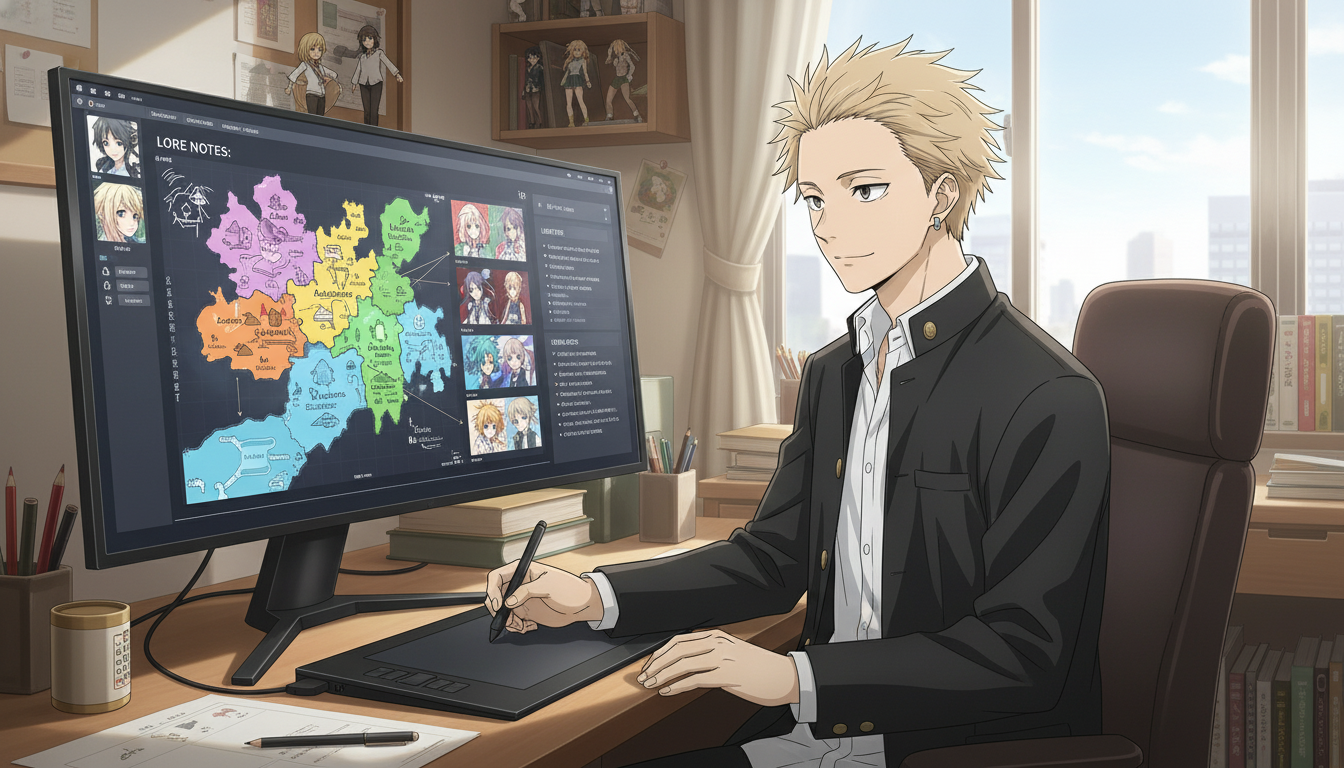
Keep a live document — a lore sheet or world bible — where you record every decision you make about the world as you make it. Not a finished reference document, just a running log. Power system mechanics, faction names and stated goals, geography decisions, cultural details you've introduced. Consistency failures almost always happen because a creator forgot a decision they made three months earlier and made a contradicting one. The lore sheet doesn't prevent creativity; it prevents contradictions that break the audience's trust in the world's internal logic.
If you're building characters to inhabit the world you've designed, the guide to creating your own anime story covers protagonist architecture, conflict structure, and first episode design in depth. For getting your characters into specific anime environments visually, the photo packs guide walks through how to place any character into a fully realized anime world.
Related Blog Posts
Photo to Anime That Actually Looks Like You: A Guide for Black People
How AutoWeeb preserves dark skin tones, natural Black hair, and Afrocentric features in every conversion
Turn your photo into anime while preserving your dark skin tone, natural hair, and features. AutoWeeb's photo to anime AI is built to represent Black people authentically.
Photo to Anime That Actually Looks Like You: A Guide for Hispanic and Latino People
How AutoWeeb preserves warm olive skin, dark hair, and Latino features in every conversion
Turn your photo into anime while preserving your warm skin tone, dark curly hair, and Latino features. AutoWeeb's photo to anime AI represents Hispanic people authentically.
How to Create AI Anime Without ComfyUI
You don't need to be a software engineer to make anime with AI
Create AI anime without ComfyUI, Python, or any technical setup. A step-by-step guide to making anime characters and scenes with AutoWeeb, no coding required.

How to Create Anime Fight Scenes with AutoWeeb and Seedance 2
From character design to animated combat: the complete workflow
Learn how to create cinematic anime fight scenes using AutoWeeb and Seedance 2. Character sheets, scene design, video prompts, and how to assemble a complete fight sequence.
Explore AutoWeeb
Jump into the tool that fits your creative step.
AI Anime Video Generator
Animate storyboard shots into cinematic clips with Seedance 2 and consistent characters.
Anime Character Creator
Design original characters with consistent sheets across every scene.
AI Anime Image Generator
Generate cinematic anime stills anchored to your character library.
Turn Photo Into Anime
Upload any photo and watch AI turn it into stunning anime art in seconds.
AI Anime Location Generator
Create a location set once, then generate reference images from every angle.
AI Anime Storyboarding
Describe your idea, pick your characters, and let AI draft the script and scenes.
AI Anime Prompt Agent
Turn a rough idea into a cinematic Seedance 2 prompt with the AI Director.