Best AI Anime Video Prompts for TikTok: Hooks, Transitions, and Viral Visual Moments
A tactical guide to writing short-form AI anime video prompts optimized for TikTok engagement, pacing, and the visual moments that stop scrollers cold.
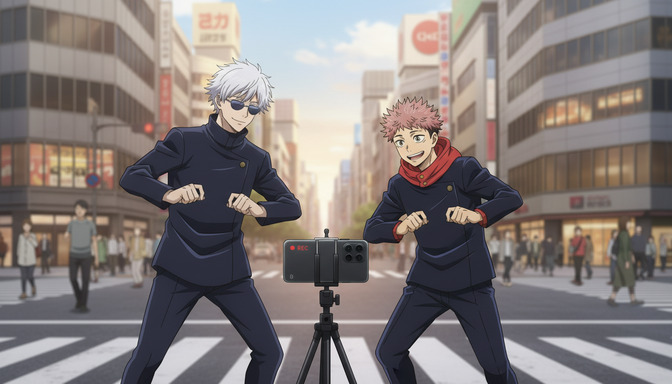
TikTok doesn't reward the same things that make a cinematic anime video great. Long atmospheric establishing shots, slow emotional builds, and careful lighting transitions are the right tools for a 10-minute episode. For a 15-second clip competing against everything else in someone's For You Page, they're death. Short-form AI anime video prompts require a completely different set of priorities: immediate visual impact, clean pacing beats, transitions that create forward momentum, and at least one frame strong enough to make someone share it.
This guide is a tactical breakdown of how to write AI anime video prompts specifically for TikTok. Every section is built around what the platform actually rewards: attention captured before the third second, motion that feels intentional rather than generated, and visual moments that land hard enough to end up in someone else's edit.
Why TikTok anime prompts need their own approach.
A three-second attention window changes every prompting decision. The visual that takes longest to process — a wide establishing shot, a slow atmospheric pan, a character walking into frame from a distance — is the one that loses TikTok viewers the fastest. On TikTok, the first frame has to pay off before most viewers consciously decide whether to stay.
This doesn't mean short-form AI anime content can't be ambitious. It means the ambition has to live in one compressed visual moment rather than across a long sequence. The clip that gets shared is almost always the one where something striking is visible before the first second ends: a character in mid-motion, an unexpected camera angle, a lighting effect that reads instantly. The craft lives in engineering that moment deliberately rather than hoping it appears somewhere in a generic generation.
The other difference is pacing. Long-form anime can afford beats that breathe. TikTok clips need a structural rhythm that's perceptible even at 1.5x speed, because a large share of viewers will be watching at exactly that rate. Prompts that treat the short-form clip as a miniature movie produce content that feels slow even when it isn't. Prompts that think in beats — hook, escalation, payoff — produce content that feels fast even when the actual runtime is 20 seconds.
The hook prompt: writing for the first two seconds.
The hook clip is the one that runs before anything has been established. It needs to deliver a strong enough visual that a stranger with no context stays. On TikTok, the prompts that produce reliable hooks share three properties: the character is already in motion, the camera angle is unexpected or dramatic, and the lighting immediately sets a tone. Neutral medium shots of characters standing still lose TikTok every time.
Motion in the first frame.
Prompts that begin mid-action outperform prompts that set up action. This is the single biggest structural difference between long-form and short-form anime prompting. Instead of building to a moment, start inside it.
Weak hook prompt: an anime boy walking through a city street. Strong hook prompt: a teenage boy with black windswept hair and gold eyes, already mid-sprint, coat snapping hard to the left, low angle from ground level looking up as he passes over the camera, Jujutsu Kaisen art style with bold outlines and high-contrast shadows, city street at midnight with neon reflections on the wet asphalt, cold desperate urgency in his expression.
The second prompt starts inside the action. The viewer's eye has somewhere to go immediately.
Camera angles that stop the scroll.
Low angle looking up, Dutch tilt, extreme close-up on the eyes, over-the-shoulder with a dramatic background reveal: these are the camera positions that register as visually interesting before the viewer has processed why. Neutral eye-level medium shots don't create that reaction. For TikTok hook clips specifically, commit to one dramatic camera angle and name it explicitly in the prompt.
Example: a girl with red-streaked white hair and pale silver eyes, both hands raised as crackling blue energy spreads from her fingertips outward, extreme low angle from below looking almost straight up at her face against a storm-lit sky, Demon Slayer art style with saturated electric blue and deep slate gray, barely contained power, expression blank except for a slight tightening at the jaw.
The camera position here is doing structural work. It makes the character look enormous before the viewer has read a single word of caption.
Pacing structure for short-form anime clips.
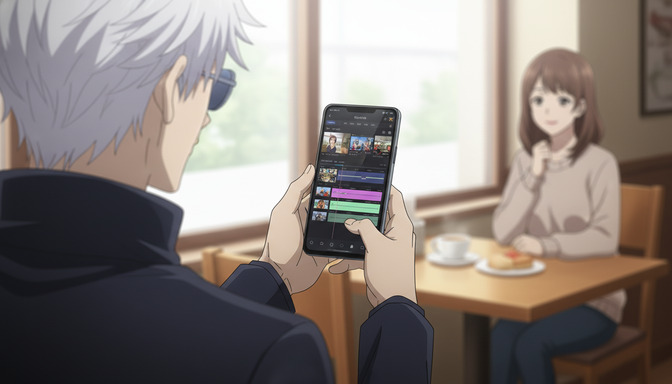
The most reliable TikTok anime clip structure runs in three beats: hook, escalation, payoff. Each beat is a distinct prompt with a specific job. Trying to fit all three beats into a single prompt produces one clip that does none of them cleanly.
Beat 1 (0-3s): the hook clip.
Maximum visual impact, minimum setup. The viewer should not need context to feel the energy of this clip. Character mid-motion, dramatic camera angle, high-contrast lighting. This clip ends on an unresolved frame — the character still in motion, the action not yet landed — so the viewer keeps watching.
Beat 2 (3-12s): the escalation clip.
This clip answers the question the hook clip asked without fully resolving it. If the hook was a character sprinting toward something, the escalation shows what she's running toward, adds an obstacle, or reveals the stakes. The escalation clip can be slightly slower — this is where you can afford a push-in, a reveal pan, or a moment that adds emotional weight.
Example escalation prompt (following the sprint hook): a teenage boy with black windswept hair and gold eyes skidding to a stop at the edge of a rooftop, both arms out for balance, looking down at the city a hundred meters below, static medium shot pulling back slowly, Jujutsu Kaisen art style, the city below glittering with cold neon light, expression shifting from urgency to something quieter and more resolved, dawn gray light with pale yellow beginning at the horizon.
Beat 3 (12-20s): the payoff clip.
The payoff is the visual moment that earns the share. It needs to land hard: a single striking frame or action that makes the previous two clips feel like they were building toward exactly this. For action content, it's the impact moment. For emotional content, it's the expression change or the reveal. For aesthetic content, it's the most striking frame in the sequence.
Payoff clip prompt example: close-up on the teenage boy's eyes as he turns and leaps off the rooftop, gold eyes calm, a faint smile, the city streaking past below, slow-motion push-in on his face as he falls, Jujutsu Kaisen art style, golden morning light catching his hair, expression of pure reckless resolve.
The payoff lands because the previous two beats established why this moment matters. Structure does that work. A single disconnected clip of someone jumping doesn't have the same weight.
Transition prompts that create forward momentum.
Transitions on TikTok aren't about polish. They're about keeping the viewer moving through the content without noticing they've been kept. The transitions that work best in AI anime content share one property: they're motivated by something in the clip itself, not imposed on top of it.
Motion-matched transitions.
Write the end of one clip and the start of the next so they share a direction of motion. If the hook clip has the character lunging forward toward camera, the next clip starts with a character element moving forward, continuing the visual momentum. In your prompt for the second clip, match the motion direction explicitly: continuing forward movement, tracking shot from behind as she lands in a new location.
Light-flare cuts.
Prompts that end on an overexposed frame or a bright light source create a natural hard-cut point. Write the final beat of a clip with: a sudden burst of white light filling the frame from the upper left or blinding sunlight as the door opens, washing out the frame. These provide a built-in transition out that an editor can cut on cleanly, or that reads as intentional even without a cut.
Zoom-to-black and speed-ramp language.
TikTok anime content that uses speed changes mid-clip performs strongly when the speed change is written into the prompt rather than added in post. Include explicit speed language: the motion slows dramatically as she reaches the apex, each detail sharp for one held beat, then snaps back to full speed. This creates the kind of visual rhythm that feels intentional and makes a clip feel choreographed to audio even before music is added.
Viral visual moments and how to prompt for them.
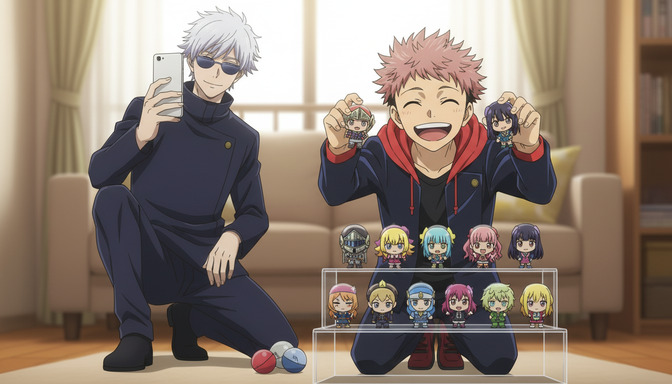
Viral TikTok anime content clusters around a small set of visual archetypes. These aren't arbitrary. Each one has a built-in emotional register that's legible without context, plays well in a small screen format, and creates a shareable single-frame moment that works as a screenshot.
The power activation moment.
An anime character activating a power or ability is one of the highest-performing visual archetypes on TikTok. The prompt needs three things: a clear energy effect with a specific color, a dramatic camera angle (usually low), and an emotional state that reads on the face even at reduced resolution.
Example: a girl with platinum blonde twin tails and dark violet eyes, both arms thrust forward, cherry-blossom-pink energy erupting from her palms in a radial burst, debris and wind pressure visible around her, extreme low angle looking up, Demon Slayer art style, saturated pink and deep black, barely restrained intensity, expression fierce and focused, harsh overhead light with pink ambient fill from the energy.
The reveal pan.
A camera pan that reveals a character or setting that wasn't visible in the first frame is one of the most reliable engagement mechanics in short-form anime content. The sense of discovery transfers to the viewer. Write the reveal explicitly: slow pan right from an empty corridor to reveal a figure leaning against the far wall, arms crossed, waiting — the pan continues to settle on a medium shot of her face.
The look-to-camera moment.
A character breaking the fourth wall and looking directly into the camera creates an immediate intimacy that performs reliably on TikTok. The prompt needs the look timed right: she slows, glances sideways, then turns to look directly into the camera — the pan finishes on a close-up of her face meeting the viewer's eye, expression calm but weighted.
The unexpected scale contrast.
A clip that reveals the scale difference between a character and their environment creates visual surprise that earns a rewatch. Write the scale contrast into the camera language: pull back from a close-up of her standing on top of a wall to reveal she's on the outer edge of a massive castle battlement, the valley below stretching for miles, the camera continuing to pull back until she's a small figure in the corner of the frame.
Complete TikTok anime prompt templates you can use now.
These are full, copy-usable prompt templates built for TikTok specifically. Swap in your character description, art style, and color preferences.
The action hook (3-second opener).
[character description], already mid-motion, [specific physical action], extreme low angle looking up from ground level as [character] passes overhead, [named art style] with [color palette], [single emotional state], [lighting source and color temperature] — no wind-up, no setup, starting at peak motion.
The power reveal (8-second single clip).
[character description] standing still, expression blank, then [energy type] erupting from [body part] as [character] raises [hand/arm/both arms], the effect expanding radially, debris and wind pressure responding, camera starting at a neutral medium and pushing in hard toward the face as the energy peaks, [named art style], [energy color] and [shadow color], [emotional state — controlled, desperate, reckless], [light source] overwhelmed by [energy color] ambient fill.
The emotional payoff close-up (final beat).
Extreme close-up on [character]'s face, eyes [color], expression [specific emotion] — [one physical tell that expresses the emotion], very slow push-in over three seconds, no motion except a slight [breath / eye movement / lip press], [named art style], [lighting: source, color, direction], silence in the frame, one held beat before cut.
Frequently asked questions about AI anime video prompts for TikTok.
What makes an AI anime video prompt work specifically for TikTok versus other platforms?
TikTok rewards immediate visual payoff, clear motion, and a single high-impact frame within the first two seconds. Prompts that start mid-action, use dramatic camera angles, and specify lighting that creates contrast perform significantly better than prompts built for gradual atmospheric setup. The platform also rewards clips that work at 1.5x speed, which means pacing has to feel intentional rather than just slow enough to follow.
How long should each AI anime clip be for TikTok?
Individual clips of 3-8 seconds work best when stitched into a three-beat structure. A single clip trying to cover a full narrative arc across 20 seconds usually loses viewers in the middle. Generate separate prompts for hook, escalation, and payoff, then assemble them. This gives you more control over pacing, transitions, and where the energy peaks.
Do I need to use a specific anime art style for TikTok content?
You don't need a specific one, but you need to name one. AI models without a style reference default to a generic "anime aesthetic" that reads as low-effort to TikTok viewers who are already saturated with that look. Named styles like Jujutsu Kaisen, Demon Slayer, Ghibli, or Cyberpunk Edgerunners create an instant visual reference that signals craft. Pick one per clip and commit to it — don't blend two named styles in a single prompt.
What's the most common mistake creators make when prompting anime content for TikTok?
Starting with a static or slow-building shot. The instinct to establish a scene before putting the character in motion is correct for long-form content and harmful for short-form. TikTok viewers decide whether to stay within two seconds, and a character walking into frame or an establishing shot of a location doesn't give them a reason to. Start inside the action, or start on the character's face in a visually striking moment.
Can I use the same character across multiple TikTok clips?
Yes, and consistency is a major advantage for building a TikTok audience. Keep the character description identical across every prompt: hair color and length, eye color, and the most recognizable clothing or accessory. Consistency turns individual clips into episodes, and episodic content builds followers. AutoWeeb's character locking feature maintains visual consistency across clips without requiring you to re-enter the full description each time.
What camera movements get the most engagement on TikTok anime content?
Low angle looking up, slow push-in toward the face, and tracking shots from behind are the three highest-performing camera positions in short-form anime content. They create visual dynamism, make characters feel powerful or intimate, and hold viewer attention without requiring the viewer to consciously notice the camera. Dutch tilts perform well for tension and unease but should be used sparingly or they lose their effect.
How do I prompt for visual moments that get shared or dueted?
Shareable moments usually have one of three properties: they contain a single frame that works as a screenshot and communicates something visually striking without context; they create a sense of scale, power, or emotional intensity that feels larger than the clip's runtime; or they end on an unresolved beat that makes the viewer want more. Prompt for a specific moment within the clip that could stand alone as a still, then build the rest of the clip around earning that moment.
Should I write prompts to sync with audio or sound trends?
Write the visual motion first, then fit audio to it. Trying to reverse-engineer visual prompts from audio timing creates clips where the motion feels arbitrary. Strong AI anime clips on TikTok are generated visually and then matched to audio in post. If you want specific motion beats to sync with audio drops, include explicit speed-change language in the prompt: motion slows to near-still for one beat then snaps back to full speed. Those natural rhythm breaks are easier to sync to audio than continuous motion.
For the foundational seven-part prompt structure that applies across all AI anime video formats, the best AI anime video prompt formula guide covers every layer with real examples. If you're building longer content that draws from TikTok clips, the guide to turning an idea into a full AI anime video shows how to structure a complete multi-scene project from the same hooks and beats you're already generating for short-form.