How to Choose the Best Anime Art Style for AI Anime Generations
Eight distinct visual traditions, what each one communicates, and how to specify any of them precisely in a prompt.
Art style in anime is not aesthetic decoration applied on top of a scene. It is a communication system. When a viewer encounters a scene rendered in shoujo style, they infer within the first second a set of expectations about emotional register, narrative stakes, and intended audience. That inference arrives before story context, before character names, before a single line of dialogue. For AI anime generation, this means that the style you specify does not describe how the scene looks. It determines what the scene means and who it is for. This guide covers eight major anime visual traditions, what each communicates, who each reaches, and how to call any of them reliably in a prompt.
Shonen: kinetic energy, high stakes, and the broadest mainstream reach.
Shonen is the visual language of Dragon Ball, Naruto, My Hero Academia, and Demon Slayer. It is the most widely recognized anime aesthetic globally and carries the strongest set of genre expectations: dynamic action poses, exaggerated physical effort, speed lines and impact effects, saturated color palettes, and characters whose emotional states are communicated through extreme facial expression rather than subtle body language. The style skews toward a male audience historically, but its mainstream penetration means virtually any viewer associates it with excitement, determination, and physical stakes.
Emotionally, shonen style amplifies. It takes a punch and makes it look like the floor of the universe just cracked. It takes a determined face and makes it look like the last thing a villain will ever see. This amplification is not excess: it is the register the style requires to communicate its emotional targets, which are courage, rivalry, growth, and the physical expression of will. For AI generations, shonen style is the correct choice for battle scenes, training sequences, rivalry moments, tournament settings, and any scene where physical intensity is the point.
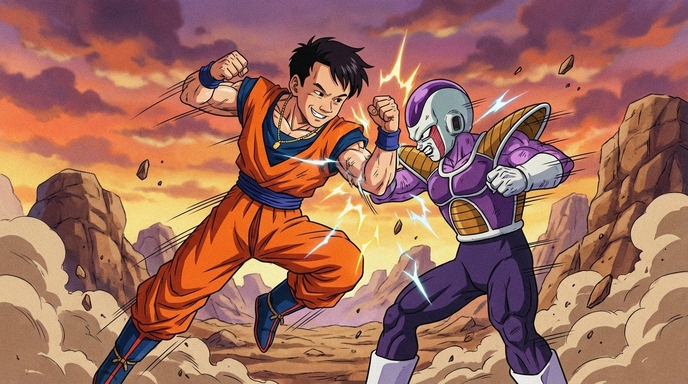
Shonen battle scene prompt: shonen anime art style, two fighters mid-exchange, both airborne, the impact point between their fists generating a visible shockwave and electric energy discharge, speed lines radiating from the collision, both characters' expressions locked in fierce determination, the background a dramatic sunset sky in deep saturated orange and purple over rocky desert formations, the color palette pushed to high saturation throughout, the line weights clean and bold, the energy effects rendered with the kinetic clarity of a Bones or Ufotable production.
Shoujo: emotional interiority, expressive beauty, and romantic resonance.
Shoujo is the visual tradition of Sailor Moon, Fruits Basket, Cardcaptor Sakura, and Nana. Where shonen externalizes emotion through physical action, shoujo internalizes it through visual atmosphere: large luminous eyes that carry emotional weight, soft or delicate linework, floral and light-particle environmental effects, and color palettes that shift from pastel warmth to dramatic jewel-tones depending on the emotional register of the scene. The style traditionally targets a female audience but has deep cross-demographic appeal because of the emotional honesty it projects.
Shoujo style's most distinctive quality is the degree to which the visual environment responds to character emotion. When a character is overwhelmed, petals fall. When a moment is tender, the light goes soft and gold. When the stakes rise, the shadows deepen and the linework sharpens. This environmental responsiveness makes shoujo uniquely suited for romantic scenes, emotional revelations, character transformation sequences, and any generation where the primary intent is feeling rather than action.
Shoujo romantic scene prompt: shoujo anime art style, two characters standing close together in a softly lit garden at twilight, large expressive eyes reflecting the last of the daylight, rose petals drifting past them from a nearby bush, the linework delicate and slightly ornate especially in the hair and fabric details, a soft bokeh background of warm amber and dusty rose, the color palette built around soft coral and cream with rose-gold accents, the overall tone tender and emotionally charged, rendered in the classic style of mid-period Toei magical girl animation.
Seinen: realism, moral weight, and content that earns adult trust.
Seinen is the style of Berserk, Vinland Saga, Monster, Vagabond, and the quieter urban realism of works like 20th Century Boys. It targets adult male audiences, but its defining characteristic is not subject matter: it is the degree of visual restraint it applies to communicate complexity and weight. Proportions are more realistic. Expressions are subtler. Color palettes are cooler and more muted. Violence, when it appears, has consequence rather than spectacle. Everyday scenes have the texture of actual urban life rather than an idealized version of it.
For AI anime generation, seinen style is correct for character studies, morally ambiguous scenarios, psychological tension, and any scene where the emotional target is complexity rather than intensity. The style signals maturity to the viewer immediately: a seinen character sitting on a train in a muted coat reads as a person with a past, not a protagonist waiting for a quest. That weight is the style's most useful quality and the reason it transfers powerfully to AI portrait and scene generation.
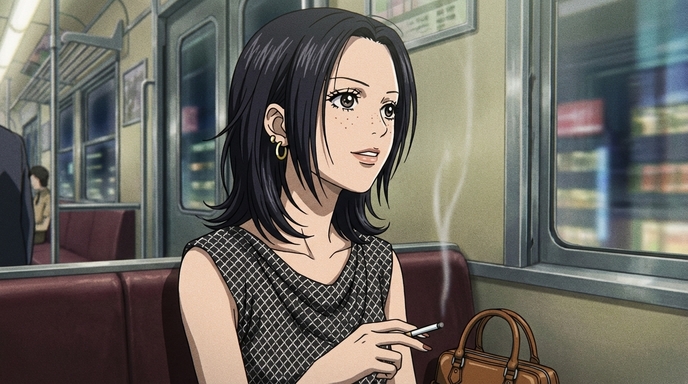
Seinen urban character portrait prompt: seinen anime art style, a young woman sitting alone on a late-night subway train, realistic proportions, dark shoulder-length hair, wearing a sleeveless black dress, holding a cigarette with smoke drifting upward, looking toward the window with a contemplative expression that neither asks for nor explains itself, the ambient lighting from overhead fluorescents muted and slightly greenish, the background bokeh suggesting other commuters and the streaked lights of the tunnel, the palette muted and cool, the linework clean but unglamourized, rendered in the style of mature urban Japanese manga with full cinematic gravity.
Chibi: humor, warmth, and instant approachability.
Chibi is the style of exaggerated miniaturization: heads large relative to bodies, simplified features, round proportions, and an emotional range that skews toward comedy, warmth, and cuteness. It originates as a comedic register in longer works, where chibi versions of characters appear to deflate tension or signal a tonal shift, but it exists as a complete standalone aesthetic in merchandise, stickers, profile pictures, and short-form content. The style communicates approachability and humor by design: nothing in chibi proportions can be threatening or cold.
For AI generation, chibi style excels at character merch concepts, birthday and celebration content, social media avatars, reaction images, and any use case where the emotional register should be immediately warm and accessible. A chibi version of a complex or intimidating character becomes endearing. A chibi version of the viewer becomes shareable. The style reduces emotional distance and increases engagement in contexts where that trade-off is useful.
Chibi character portrait prompt: chibi anime art style, a small round-proportioned character in a school uniform, head roughly half the total body height, large sparkly eyes with simple but expressive features, arms slightly stubby and reaching forward in a cheerful pose, the palette bright and clean with saturated pastels, simple rounded linework with no harsh angles, the background a soft gradient of pale yellow and white with small decorative stars, rendered in the style of official chibi merchandise art from a major anime franchise.
Slice-of-life: everyday authenticity and the emotional texture of ordinary moments.
Slice-of-life as an anime visual style is defined by what it does not do: it does not exaggerate for drama, it does not amplify for action, and it does not idealize beyond a gentle warmth. The style is the visual home of K-On!, Barakamon, Yotsuba, and Usagi Drop. Proportions are natural. Linework is clean but unheroic. Color palettes are warm and slightly soft without being stylized. The environmental detail is high because the setting is the point: a classroom window at noon, a convenience store at 11pm, a family kitchen on a Sunday morning. These details carry emotional weight in slice-of-life precisely because they are recognizable.
For AI anime generation, slice-of-life style is the right choice for scenes of domestic intimacy, friendship, routine, and quiet emotional connection. It works well for personal content: a portrait of yourself or someone you know rendered in a visual style that feels warm and real rather than dramatic or fantastical. The style bridges the gap between anime aesthetics and human authenticity, which is why it translates particularly well in photo-to-anime generation when the source material is everyday life rather than a posed or costumed subject.
Slice-of-life scene prompt: slice-of-life anime art style, two friends sitting across from each other at a small cafe table, one leaning on their hand listening, the other mid-sentence with a warm expression, afternoon light coming through large windows and pooling on the wooden table surface between them, a coffee cup and a half-eaten pastry in frame, the color palette warm and natural with soft golden ambient light, the linework clean and understated, the overall rendering in the style of a quiet scene from a Kyoto Animation production where nothing dramatic is happening and that is exactly the point.
Cyberpunk: neon-lit futures, societal tension, and genre-coded cool.
Cyberpunk anime style draws from Akira, Ghost in the Shell, Cyberpunk Edgerunners, and the broader retrofuturist visual tradition. Its defining features are high-contrast neon lighting against dark environments, detailed industrial and urban architecture, character designs that mix technological augmentation with organic humanity, and a color palette built around electric greens, magentas, blues, and the dark teal-blacks of night cities. The style carries a specific ideological weight: it belongs to stories about power, surveillance, identity, and resistance, which means even a portrait generated in cyberpunk style inherits those associations.
For AI generation, cyberpunk style is the correct choice for futuristic city scenes, hacker or mercenary character portraits, neon bar or club environments, and any generation where the visual intention is genre-coded cool with an undercurrent of tension. The style works especially well for social media content aimed at gaming and tech-adjacent audiences, profile pictures for users who want the anime aesthetic with an edge, and atmospheric scene generation where the environment is as much the subject as the character.
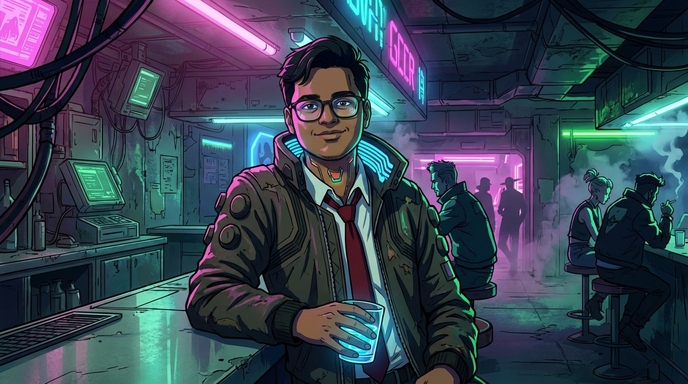
Cyberpunk character scene prompt: cyberpunk anime art style, a young man with dark hair and glasses leaning at a bar counter in a neon-lit underground club, wearing a worn bomber jacket over a collared shirt, holding a glass with a relaxed confident expression, behind him rows of neon signs in pink and green casting colored light across exposed brick and cable conduits, other figures visible in the atmospheric haze of the mid-ground, the color palette dominated by deep teal-black with sharp neon accents in pink and green, rendered in the style of Trigger studio cyberpunk with high production value and graphic design precision.
Fantasy: world-building ambition and genre-spanning visual range.
Fantasy anime style does not describe a single aesthetic the way shonen or shoujo does. It describes a set of visual ambitions: elaborate environments, non-human characters and creatures, magic as a visible force in the world, costume and armor design that communicates world-building depth, and a light quality that feels mythic rather than naturalistic. The style ranges from the pastoral warmth of Studio Ghibli to the dark grandeur of Overlord to the hand-drawn otherworldliness of Made in Abyss. What unites them is the commitment to a world that operates on different rules from the contemporary one, rendered in a way that makes those rules feel real.
For AI generation, fantasy style rewards specificity more than any other on this list. A generic "fantasy anime" prompt produces something competent and forgettable. A prompt that specifies the era-analogues of the world (feudal, baroque, bronze age), the magic system's visual language (runes, elemental effects, light constructs), the environment's biome and time of day, and a style reference from a specific production will produce something with genuine world-building coherence. Fantasy is also the most versatile style for character design: it can incorporate elements from multiple other styles without losing coherence because the world-building frame justifies the combination.
Fantasy character scene prompt: fantasy anime art style, a young sorceress standing at the edge of a stone cliff overlooking an ancient valley city at dusk, her robes layered and detailed with embroidered patterns that glow faintly with contained magical energy, the valley below rendered with the architectural specificity of a lived-in pre-industrial civilization, the sky a deep twilight gradient from amber at the horizon to violet-blue overhead with the first stars appearing, her expression calm and purposeful, the linework detailed and the lighting dramatic with warm orange from below and cool blue from above, rendered in the style of Production I.G high-fantasy animation with full environmental depth.
Painterly: prestige texture and the cinematic register of art-house anime.
Painterly anime style is the aesthetic of Makoto Shinkai films, Nausicaä, The Tale of Princess Kaguya, and A Silent Voice's more emotionally extreme sequences. It is defined by visible brushwork or texture in the backgrounds, light that behaves with atmospheric physics rather than stylized clarity, color that shifts and bleeds like paint rather than holding sharp digital edges, and a level of environmental detail that makes the world feel like it was observed rather than designed. Characters in painterly productions often retain cleaner linework than their backgrounds, which creates a layered depth: the figure is precise, the world they inhabit is lush and textured.
For AI anime generation, painterly style produces some of the most visually sophisticated outputs but requires the most precise prompting to avoid outputs that are merely blurry rather than genuinely textured. Specify the light source and its physical behavior, the atmospheric conditions of the scene, and the specific visual reference that establishes the quality of rendering you want. Painterly style is the correct choice for scenes where the environment is emotionally significant, for landscape-dominant compositions, for flashback or dream sequences, and for any generation where the target is something that looks like it could be a theatrical still.
Painterly anime landscape scene prompt: painterly anime art style, a girl standing alone on a hillside above a town at the moment before a summer storm arrives, the sky a layered watercolor gradient from pale gold to deep bruised violet, visible brushwork in the cloud formations and the tall grass around her feet, the distant town rendered with the atmospheric depth of a Makoto Shinkai production where every building has interior light and environmental haze, the girl's figure clean and precise against the textured world behind her, the light pre-storm and slightly green-gold, the whole scene communicating the held-breath quality of a moment just before something changes.
How to match art style to your generation's intent.
The clearest way to choose a style is to ask what your viewer should feel in the first second of looking, before they read any context. If the answer is excitement or physical stakes: shonen. If the answer is emotional warmth or romantic feeling: shoujo. If the answer is weight or complexity: seinen. If the answer is warmth or humor: chibi or slice-of-life. If the answer is genre-coded cool or tension: cyberpunk. If the answer is wonder or mythic scale: fantasy. If the answer is beauty and atmospheric depth: painterly.
Style also shapes audience. Shonen generates the widest mainstream recognition. Shoujo and slice-of-life perform best in social contexts where emotional connection is the goal. Seinen and painterly carry the strongest prestige signal. Cyberpunk reaches gaming, tech, and streamer demographics. Chibi converts broadly for merchandise, stickers, and avatar use cases. When the audience and the emotion align, the style has done its job before the content even registers.
For most AI anime generations, the style specification should come first in the prompt: name the tradition, name a specific production reference if you have one, then build the scene inside that frame. The model uses the style instruction to calibrate every subsequent decision about line weight, color, lighting, and proportion. A style named at the end of a long prompt competes with all the specific details that came before it. Named first, it sets the context everything else fills.
For a full system that places art style alongside lighting, camera angle, color grading, and atmosphere in a layered prompt, the guide on the ultimate AI anime prompt formula covers how all these layers interact in order. For how color grade and palette choice interact with art style to produce emotional coherence, the guide on color grading for AI anime picks up where style selection ends.
Frequently asked questions about anime art styles for AI generation.
What is the most recognizable anime art style for general audiences?
Shonen is the most universally recognized anime art style. Productions like Dragon Ball, Naruto, and My Hero Academia have been distributed globally for decades, which means the shonen visual vocabulary, dynamic poses, saturated color palettes, bold linework, and kinetic energy effects, is legible to viewers with no deep anime background. If the goal of a generation is immediate recognition and broad appeal, shonen is the safest starting point.
What anime art style works best for profile pictures and social avatars?
Chibi and slice-of-life perform best for profile pictures because both styles prioritize character warmth and approachability over drama or complexity. Chibi reads as cute and immediately engaging at small sizes. Slice-of-life portraits read as genuine and relatable. For users who want a more stylized or cool-coded avatar, cyberpunk or seinen both produce profile images with strong visual identity. The worst style for profile pictures is painterly: the background detail that makes painterly style beautiful in a full scene competes with the subject at portrait crop.
Can I mix two anime art styles in a single prompt?
Yes, but the styles need to be compatible in their visual logic. Shonen and cyberpunk combine well because both use high saturation and bold graphic design. Shoujo and slice-of-life combine naturally because both prioritize emotional warmth and soft palettes. Painterly and fantasy combine well because both are environment-dominant and reward atmospheric depth. Combinations that conflict, like chibi and seinen, or painterly and shonen, require a clear specification of which style governs the character and which governs the environment, otherwise the model will average between them and produce something that belongs to neither tradition.
What is the difference between slice-of-life and shoujo anime style?
Shoujo is a demographic and visual tradition with specific formal qualities: large expressive eyes, ornate or flowing linework, environmental effects that mirror character emotion, and a palette that shifts dramatically with the emotional register of the scene. Slice-of-life is a genre and tonal orientation: warm, naturalistic, emotionally grounded, and focused on the texture of ordinary experience. The two overlap frequently because many slice-of-life anime target the shoujo demographic, but they are distinct. A slice-of-life anime aimed at a male audience, like Barakamon or Yotsubato, does not use shoujo visual conventions. In prompting, specify both if you want both: "shoujo anime art style, slice-of-life tone and setting" gives the model both the visual tradition and the tonal register.
What anime art style is best for fantasy world-building scenes?
Fantasy anime style is the obvious choice, but the specific register within fantasy matters. For epic scope and mythic grandeur, specify a reference like "Production I.G high-fantasy" or "classic Ghibli environmental fantasy." For darker or more gothic fantasy, specify "dark fantasy anime style with Berserk linework and muted cinematic palette." For whimsical or colorful fantasy, "isekai anime style with bright saturated world-building environments" produces a different result. Fantasy is not a monolithic style: naming the tone and a production reference within the genre delivers far more specific results than naming the genre alone.
How do I prompt a painterly anime art style reliably?
The most reliable method is a combination of three elements: a style reference that establishes the quality of rendering (Makoto Shinkai, Hayao Miyazaki, Naohisa Inoue), a specific light source and atmospheric condition (pre-storm overcast light, golden late-afternoon, deep blue twilight), and an explicit instruction for background texture versus character rendering ("backgrounds painted in loose expressive brushwork with visible texture, character in the foreground rendered with cleaner linework"). Without a style reference, painterly prompts often produce outputs that are blurry or atmospheric rather than genuinely textured. Without the light specification, the model defaults to generic daylight. The combination of all three produces outputs with the full depth of the style.
Which anime art style generates the best results for action scenes?
Shonen is purpose-built for action scenes and produces the most consistently strong results: speed lines, impact frames, energy effects, and kinetic posing are all part of its core visual vocabulary. For stylized action with a more graphic sensibility, cyberpunk anime style produces strong action scenes set in urban or mechanical environments. For slower, weightier action with psychological tension, seinen style handles combat with consequence more effectively than shonen's spectacle-forward approach. The choice depends on whether the action scene needs to feel exciting, cool, or serious, which maps directly to shonen, cyberpunk, and seinen respectively.
Related Blog Posts
How to Create Long Shots in AI Anime
The prompting structure that places your character fully inside a world — and why most long shot attempts drift into medium shots or get swallowed by the environment.
Learn how to prompt long shots in AI anime — frame the full character, build the environment as co-subject, use negative space, and let AutoWeeb's prompt analysis catch what's missing.
Best AI Anime Lighting Prompts: Cinematic Soft, Neon, and Emotional Scenes
How the right light source transforms an ordinary anime scene into something that actually feels like something — and the exact prompt language to get there.
The best AI anime lighting prompts for every mood: soft sunlight, golden hour, cyberpunk neon, moody rain, candlelight, and volumetric light. Templates included.
How to Add Atmosphere to AI Anime Prompts (Rain, Fog, Magic, Smoke)
The environmental effects that turn a technically correct anime scene into one that actually feels like being inside it.
Learn how to add atmosphere to AI anime prompts: rain, fog, cherry blossoms, snowfall, smoke, sparks, magical particles, and full weather systems. Prompt templates included.
How to Create Motion Blur Lines in AI Anime
The prompting structure that makes movement feel fast, forceful, and impossible to look away from.
Learn how to prompt motion blur lines in AI anime for images and video. Direction, intensity, secondary effects, and how AutoWeeb's prompt analysis catches what's missing.
Explore AutoWeeb
Jump into the tool that fits your creative step.
AI Anime Video Generator
Animate storyboard shots into cinematic clips with Seedance 2 and consistent characters.
Anime Character Creator
Design original characters with consistent sheets across every scene.
AI Anime Image Generator
Generate cinematic anime stills anchored to your character library.
Anime Filters
Upload any photo and apply AI anime filters to turn it into stunning anime art in seconds.
AI Anime Location Generator
Create a location set once, then generate reference images from every angle.
AI Anime Storyboarding
Describe your idea, pick your characters, and let AI draft the script and scenes.
AI Anime Prompt Agent
Turn a rough idea into a cinematic Seedance 2 prompt with the AI Director.