How to Create a Bird's-Eye View Shot in AI Anime
The prompting structure that makes your scene look like it was captured from the sky — for both still images and video.
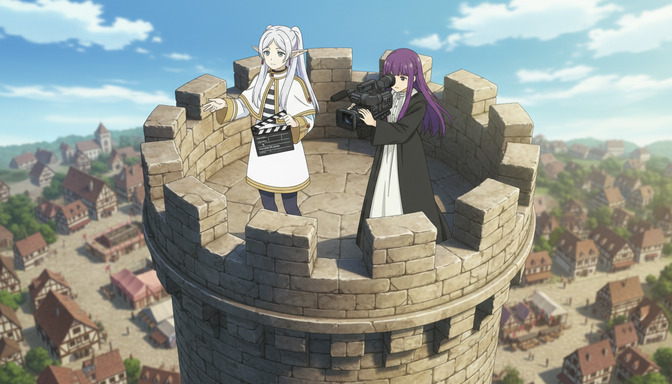
The bird's-eye view shot is the most purely cinematic angle in anime. It doesn't belong to any character's perspective. It belongs to the story itself. When Attack on Titan cuts to a straight-down view of the city with titans converging from every street, you're not seeing through anyone's eyes — you're seeing the shape of the catastrophe. When Made in Abyss uses steep overhead shots during the descent, the characters shrink into the abyss and the abyss becomes the subject. When Demon Slayer frames a rooftop battle from directly above, the geometry of the fight — who has the angle, who is surrounded, who is exposed — becomes legible in a way it couldn't be from ground level. The bird's-eye view reveals what the characters themselves cannot see.
Getting this shot to work in AI anime prompts requires more than adding "from above" to your existing prompt. The camera position changes everything: how the character relates to the environment, how scale reads, how light falls from overhead, and what compositional elements replace the face and expression that normally anchor a shot. This guide covers five steps for both still image and video prompts, with concrete prompt examples throughout.
👉 Try AutoWeeb and Generate Cinematic AI Anime Bird's-Eye View ShotsStep 1: Name the shot type and specify the exact angle of descent.
"Bird's-eye view" is the most recognizable term for this shot, and it's the most reliable instruction for AI anime models. But bird's-eye view exists on a spectrum from a steep diagonal overhead — the camera positioned well above the scene and looking sharply downward at an angle — to a true top-down view where the camera is directly perpendicular to the ground and the floor becomes the entire background. These are meaningfully different shots, and the model needs to know which one you want before it can build the composition.
A steep overhead angle still shows vertical elements: building facades, tree trunks, characters' faces tilted slightly upward, the sides of objects. A true top-down view eliminates all of that. Rooftops are flat planes. Characters are small figures viewed from the crown of the head. The ground or floor becomes the dominant visual texture of the frame. Specifying the angle at the start of the prompt prevents the model from defaulting to a mid-point that has the ambiguity of neither.
Steep overhead example: bird's-eye view shot from steeply above, looking down at a steep angle at a lone silver-haired girl standing in the center of a cobblestone plaza, the camera positioned roughly forty-five degrees above and behind her, her face slightly visible as she looks upward, the plaza's radial stone pattern spreading outward from her feet in all directions.
True top-down example: top-down overhead shot, camera positioned directly above looking straight down, a red-cloaked warrior standing at the center of a circular clearing in a dark forest, viewed from directly above the crown of their head, the circular clearing visible as a ring of pale light against the surrounding dark tree canopy.
High diagonal example: bird's-eye view from high above, camera angled roughly sixty degrees downward, a crowded market street visible below, a purple-haired girl in a white coat visible among the crowd, the tops of market stalls and the patterns of the crowd filling the lower frame, rooflines and building tops visible at the frame edges.
Naming the angle precisely prevents the model from splitting the difference. "Bird's-eye view" alone invites interpretation. "Bird's-eye view, camera directly overhead, looking straight down" removes it.
Step 2: Define the scale relationship between the character and the environment.
In most shot types, the character is the largest or most visually dominant element in the frame. In a bird's-eye view, that relationship inverts. The environment becomes the primary visual mass — the city grid, the forest canopy, the battlefield, the crowd — and the character is a small figure within it. How small matters. A character who fills a quarter of the frame in a bird's-eye view reads differently than a character who is a dot visible among hundreds. Both are bird's-eye view shots. The scale relationship is what the shot is actually saying.
Specify the character's apparent size relative to the frame explicitly. This is one of the places where adding a description of the surrounding environment pays the most. If the prompt just says "bird's-eye view of a character," the model has no basis for deciding whether the character is the size of a fingernail or a third of the frame. The environment you describe and how you size it relative to the character anchors the scale.
Isolation at scale: bird's-eye view looking straight down at a vast snow-covered battlefield, a single black-clad swordsman visible as a small dark figure at the very center of the frame, surrounded by open white space stretching to all frame edges, his shadow a thin line below him in the pale winter light, the emptiness of the field communicating his solitude.
Character surrounded: overhead bird's-eye view shot looking steeply down, a white-haired fighter at the center of the frame, six armored soldiers positioned in a tightening ring around her visible from above, the geometry of the encirclement clear from this angle in a way it would not be from ground level, torchlight casting short shadows from each figure outward.
Character as part of crowd: true top-down overhead shot of a dense festival crowd, a girl in a distinctive red yukata visible near the center of the composition, identifiable by the color against the muted tones of the crowd surrounding her, the crowd extending to all frame edges, the scale communicating that the festival is enormous and she is one small presence within it.
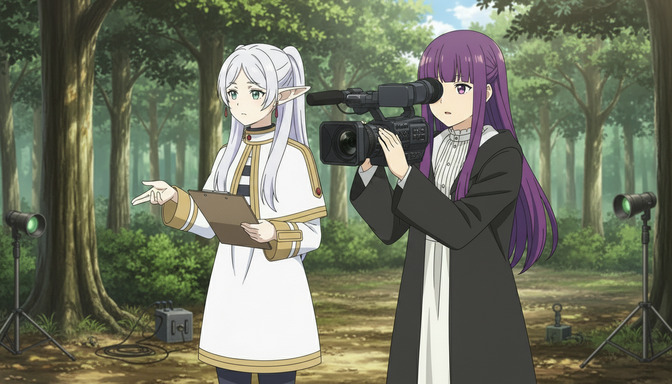
Step 3: Use depth, atmosphere, and ground texture to replace the face as the frame's visual anchor.
In a standard shot, the character's face carries the emotional and visual weight of the composition. The eyes give the viewer a place to focus. In a bird's-eye view, the face is often invisible or reduced to a small upturned point below the camera. Something else has to anchor the frame. In most strong bird's-eye view shots, that anchor is the ground or environment's texture and pattern: the cobblestone geometry of a plaza, the rooftop mosaic of a city, the forest floor visible between tree trunks, the mud and ash of a battlefield. Specifying this texture explicitly is what produces a bird's-eye view with visual substance rather than an undifferentiated flat surface.
Atmospheric depth also becomes more legible from above. Fog or haze at low altitude, visible from a high vantage point, produces a soft layer of distance between the camera and the scene. Smoke rising from fires below, cloud cover at eye level with the camera above it, rain visible as a fine texture on a wet street below: all of these elements require the camera to be elevated to be visible, and all of them immediately communicate height.
Ground texture anchor: bird's-eye view looking straight down at an ancient stone plaza, its circular radial pattern of dark and pale stone tiles clearly legible from above, a lone figure in blue standing at the exact center of the circle, the geometry of the stone filling the entire frame except for the small figure and their shadow.
Atmospheric height: high bird's-eye view shot, camera positioned well above the city, a thin layer of blue-gray morning mist at rooftop level visible from above, the city's tiled rooftops emerging from the mist below, a small orange-haired figure visible on one rooftop, the elevated vantage making the mist read as a horizontal plane between the camera and the buildings.
Battlefield texture: overhead bird's-eye view of a ruined city street from high above, the street filled with debris and overturned vehicles forming visible channels and obstacles legible only from this angle, two small figures visible below, the destroyed environment its own composition of fractured geometry and ash.
If you're using AutoWeeb's character tools, bird's-eye view shots work best when the character's distinctive color palette does the identification work that their face normally does. A character in a specific color combination can be legible even as a small figure if their costume color contrasts clearly with the environment below them.
Step 4: Set the lighting to read correctly from overhead.
Light behaves differently from above. At eye level, the direction of light coming from a side window, a campfire, or a streetlamp tells you something about where the character is and what time of day it is. From a bird's-eye view, the primary light source is almost always from above, which means it hits the tops of objects and casts short shadows downward. A noon sun from directly above produces almost no visible shadow at all, making the scene feel exposed and relentless. A lower sun at an angle produces longer shadows that radiate outward across the ground plane, and those shadows become strong compositional elements in a top-down frame.
Specifying shadow length and direction in bird's-eye view prompts is one of the most reliable ways to communicate time of day and add visual depth to what would otherwise be a flat overhead composition. Long shadows also subtly communicate height: the taller an object, the longer its shadow visible from above, and a crowd of people with long individual shadows reads as a late afternoon crowd more clearly than any color of light can communicate alone.
Noon exposure example: bird's-eye view straight down, harsh noon sunlight from directly overhead, minimal shadows, a lone figure casting a small shadow directly beneath themselves, the stone plaza lit evenly and mercilessly, the overhead light creating a flattened exposed quality as if the character has nowhere to hide.
Golden hour shadows example: overhead bird's-eye view, late afternoon light at a low angle, long shadows stretching from all figures across the ground plane in the same direction, a girl standing at the center with her shadow extending dramatically to her left, the warm gold light hitting the tops of the surrounding buildings and the far edges of the cobblestones.
Night overhead example: bird's-eye view of a city street at night, streetlamps visible as small light sources below, each lamp casting a circle of amber light on the pavement around it, the space between the lamps dark, a figure moving through the pools of light below, their form illuminated briefly by each lamp as they pass.
Overcast diffused example: overhead bird's-eye view under heavy overcast sky, no directional shadows, even cool light from above, a forest clearing visible below with a small figure at the center, the flat light giving the scene a still and watchful quality, every element in the frame equally legible with no single light source dominating.
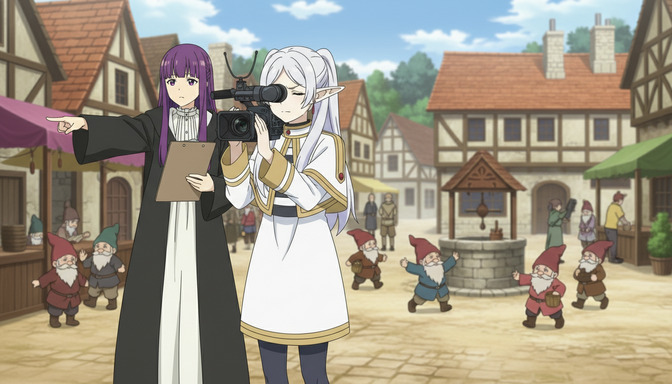
Step 5: Direct the camera's motion for video prompts.
Bird's-eye view shots in anime video work through three primary camera movements: a slow aerial descent that begins overhead and moves downward toward the subject, a static overhead hold that lets the scene breathe from a fixed high position, and a slow overhead rotation that turns the ground plane below like a compass. Each of these movements communicates something different, and specifying which one you want is as important as specifying the shot angle.
A slow aerial descent is the most dramatic option. The camera begins in a true bird's-eye position and moves downward over the clip's duration, the scene growing larger and the character growing from a small figure to a recognizable person. It's the movement of the world revealing itself as the story arrives at its subject. A static overhead hold lets the viewer read the composition without the camera commenting: the geometry, the scale, the isolation or the crowd, all readable from a fixed position. A slow rotation overhead is the most stylized choice, and the most useful for establishing location: the camera circles the scene while maintaining its altitude, revealing the full 360-degree layout of the environment below.
For Seedance 2 video prompts, specify the starting altitude, the direction and speed of movement, and what the camera should reveal or arrive at. Aerial descent prompts work best when you describe both the starting frame — what the shot looks like at the beginning of the clip — and the ending frame, giving the model a clear destination for the movement.
Aerial descent example: bird's-eye view slowly descending toward a rooftop over the full clip duration, beginning with the entire city block visible from high above, descending until a silver-haired girl sitting on the rooftop fills a third of the frame by the end of the clip, the city shrinking to context as the camera arrives at her level, late afternoon light casting her shadow long across the rooftop tiles.
Static overhead hold example: true top-down overhead shot, static camera, a dense forest clearing visible below, a red-clad figure standing motionless at the center of the clearing, the trees surrounding the clearing unmoving, a single shaft of light visible as it slowly shifts position over the clip duration as the sun moves, no camera movement throughout.
Overhead rotation example: bird's-eye view slowly rotating clockwise overhead over the full clip, camera maintaining altitude while the scene below rotates, a medieval town square at the center of the rotation with figures moving through it below, the rotation revealing the full layout of the square, the surrounding streets, and the buildings beyond, the rotation completing roughly ninety degrees over the clip duration.
For shorter clips, the static overhead hold with one element of motion in the frame, a figure walking through the scene below, a slow spread of fire, a crowd parting, produces cleaner results than a moving camera. Aerial descent works well for clips of five seconds or more, where the model has enough frames to execute the change in altitude without compressing the movement.
👉 Start Generating AI Anime Bird's-Eye View Shots on AutoWeebFrequently asked questions about bird's-eye view shots in AI anime.
What is a bird's-eye view shot in anime and when should I use it?
A bird's-eye view shot positions the camera high above the scene, looking down at a steep angle or directly overhead. In anime, it's used for moments when the story needs a perspective no character holds: the full shape of a battle that no participant can see, a city's scale relative to the small figures moving through it, the geometry of a trap closing around a character, a moment of solitude made visceral by showing how small a person is within a vast space. Use it when the point of the scene is the relationship between a character and their environment rather than the character's expression or action in isolation. It's the shot that says: this is bigger than any one person looking at it.
What is the difference between a bird's-eye view and a high angle shot in anime prompting?
A high angle shot places the camera above the subject and tilts downward, but the camera isn't nearly overhead. The character is still clearly visible, their face is often legible, and the effect is one of reduced stature or vulnerability — the viewer is literally looking down on them. A bird's-eye view takes this further: the camera is positioned so far above that the character's face disappears or becomes a minor element, and the environment or ground plane becomes the dominant visual field. In AI anime prompts, "high angle shot" produces a camera perhaps at chest or head height above the subject. "Bird's-eye view" or "overhead shot" reliably produces the elevated overhead perspective where the character is visually small relative to the environment. Use "high angle" for power imbalance between characters. Use "bird's-eye view" when the environment itself needs to speak.
Why does my AI anime bird's-eye view shot come out looking flat or ambiguous?
Flatness in bird's-eye view prompts usually has one of three causes. The first is an unspecified angle: "bird's-eye view" without clarifying whether the camera is directly overhead or at a steep diagonal leaves the model to interpret, and the default interpretation is often neither convincingly overhead nor convincingly elevated. Add a specific angle description. The second is a missing ground texture: without a described ground plane, the model has no visual surface to render below the character, and the shot loses its sense of height. Describe the floor, plaza, rooftop, forest clearing, or battlefield explicitly. The third is an undifferentiated environment: the character is described in detail but the surrounding environment isn't, so the model anchors on the character and forgets the altitude. Describe the environment at the same level of detail as the character, or more.
How do I make a character recognizable in a bird's-eye view shot when their face isn't visible?
Color, costume silhouette, and position in the frame are the three tools that replace facial recognition in overhead shots. A character in a specific, distinctive color combination — a red coat against gray stone, a white uniform among dark-clothed figures, a single yellow umbrella in a crowd — is immediately identifiable even as a small top-down figure. Silhouette elements that read from above also help: long hair visible as a shape from the crown, a distinctive hat or hood, a weapon carried in a particular way. Position in the frame does additional work: a character at the precise geometric center of a circular formation, or the only figure standing while others kneel, draws the eye through compositional logic. Name all three in your prompt: the character's identifying color, any silhouette elements visible from above, and where they stand in the composition.
Can I use a bird's-eye view shot to show a crowd or battle scene in AI anime?
Yes, and this is one of the strongest use cases for the bird's-eye view angle. From above, a crowd becomes a pattern: the distribution of figures, the channels and clusters they form, the directions people are moving. A battle scene becomes legible as geometry: who surrounds whom, where the lines of conflict run, which side holds the high ground. Prompt the crowd or battle as a described pattern rather than a list of individuals. "A dense crowd filling the street below from edge to edge, a girl in a red yukata at the center identifiable by her color" gives the model a crowd composition with a focal point. "Six armored soldiers in a closing ring around a single white-haired fighter, the encirclement geometry clearly visible from directly above" gives the model a battle composition that uses the overhead angle's unique ability to show spatial relationships. The key is describing the pattern, not just the participants.
How do I prompt a bird's-eye view shot for AI anime video with a smooth aerial descent?
For a smooth aerial descent in Seedance 2 video prompts, specify the starting altitude, the destination, the speed of descent, and what the camera reveals as it descends. The most reliable structure is: starting frame description (what the camera sees at the beginning, at maximum height), the movement instruction (slowly descending over the clip duration), and the ending frame description (what the camera should show when it arrives). Keep the descent speed slow. A fast aerial descent in a short clip often compresses the distance so much the movement reads as a jump cut rather than a smooth approach. For a five-second clip, a descent that covers roughly half the distance to the subject produces a clean approach. If you want the character's face to be legible at the end of the descent, specify that the clip ends just above close-up range, not at the full bird's-eye height, as the endpoint. For more on directing camera movement in AI anime video, the guide on best camera movements for AI anime video prompts covers the full range of aerial and ground-level options.
Does a bird's-eye view shot work for indoor scenes in AI anime?
It works, but it requires describing the architectural elements that become visible from above. An indoor bird's-eye view eliminates the sky and replaces it with the ceiling, or if the camera is inside and above, with the visual plane of the room's floor and furniture layout. The compositional logic is the same as outdoors: the floor becomes the dominant visual surface, objects and people are viewed from above, and the environment's geometry — the arrangement of tables, the pattern of floor tiles, the layout of corridors visible from above — carries the composition. Specify the ceiling height and whether the camera is near the ceiling looking down, or positioned as if the ceiling doesn't exist. "Bird's-eye view inside a large cathedral, camera positioned as if just below the vaulted ceiling looking straight down, the long nave visible as a receding rectangle below, two small figures visible near the altar at the far end" gives the model a clear architectural overhead composition. For exterior shots at scale, the guide on how to create an extreme long shot in AI anime covers the complementary technique of placing characters within vast exterior environments.
The bird's-eye view is the shot that gives the story permission to be bigger than any single character's field of vision. It's a perspective that belongs to the narrative, not the characters, which is why it feels authoritative every time anime deploys it. For the opposite compositional approach, where the camera gets so close to the subject that the world outside the frame temporarily ceases to exist, the guide on how to create a close-up shot in AI anime covers the full five-step prompting structure. And if you're working the full range of angles from the same scene — combining the bird's-eye establishing shot with ground-level character shots — the low angle shot guide covers the opposite vertical extreme, where the camera looks up rather than down.
Related Blog Posts
How to Turn an Idea into an AI Anime Video
From premise to storyboard to finished short — a step-by-step guide to transforming a raw story idea into a structured AI anime video using scene prompts, pacing, and AutoWeeb's storyboarding feature.
Learn how to turn a story idea into an AI anime video with scene prompts, pacing, and AutoWeeb's storyboard tool. Step-by-step guide with examples and FAQ.
Best Camera Movements to Use in AI Anime Video Prompts
Dolly, pan, tilt, tracking shot, zoom, overhead, close-up — how to use cinematic camera language to direct AI anime videos like a professional cinematographer.
Learn how to use camera movement language like dolly in, pan, tilt, tracking shot, zoom, overhead shot, and close-up in AI anime video prompts for cinematic results.
How to Make AI Anime Fight Scenes Look Professional
Choreography, camera angles, speed, impact effects, and emotional stakes — the complete prompting guide for AI anime fight scenes that hit like the real thing.
Learn how to prompt AI anime fight scenes with choreography, camera angles, speed lines, impact effects, and emotional weight. Includes AutoWeeb prompt analysis tips.
AutoWeeb Is the AI Anime Video Maker for Beginners: No Drawing or Editing Skills Needed
You don't need to sketch a single frame or touch a timeline editor — AutoWeeb handles the creative production so you can focus on the story.
AutoWeeb is the AI anime video maker for beginners with no drawing or editing skills needed. Upload a photo, pick a style, and generate anime videos in minutes.
Explore AutoWeeb
Jump into the tool that fits your creative step.
AI Anime Video Generator
Animate storyboard shots into cinematic clips with Seedance 2 and consistent characters.
Anime Character Creator
Design original characters with consistent sheets across every scene.
AI Anime Image Generator
Generate cinematic anime stills anchored to your character library.
Turn Photo Into Anime
Upload any photo and watch AI turn it into stunning anime art in seconds.
AI Anime Location Generator
Create a location set once, then generate reference images from every angle.
AI Anime Storyboarding
Describe your idea, pick your characters, and let AI draft the script and scenes.
AI Anime Prompt Agent
Turn a rough idea into a cinematic Seedance 2 prompt with the AI Director.