How to Create the Rule of Thirds for AI Anime Composition
The grid that turns a random-feeling scene into one that looks intentionally framed — for both image and video prompts.
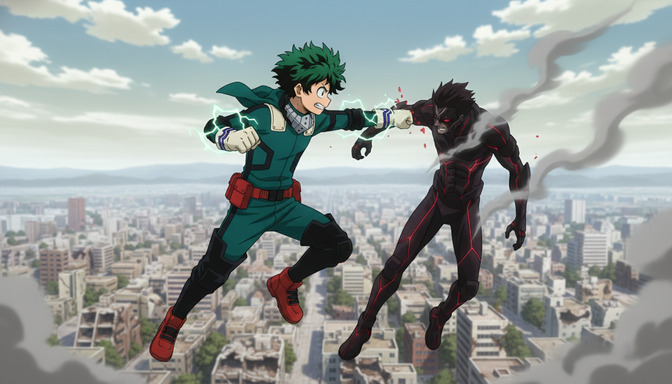
The rule of thirds is the most transferable principle in visual storytelling. It works in photography, in cinema, in illustration, and it works in AI anime prompts. The idea is simple: divide the frame into a three-by-three grid of equal sections. The lines where those sections meet create four intersection points, called power points. Place your subject at one of those intersections, or along one of those lines, and the composition acquires a tension and balance that centered placement rarely produces. Two characters placed at opposing power points don't just share a frame — they're in conversation with each other through the geometry of the shot.
AI anime models don't automatically apply the rule of thirds. Without explicit instruction, they default to centering subjects, which produces balanced but flat compositions. Getting the rule of thirds into your prompts requires describing position in the frame directly: where a character stands relative to the frame edges, where the horizon line falls, what the left or right third of the frame contains. This guide covers five steps for both still image and video prompts, with concrete examples throughout.
👉 Try AutoWeeb and Generate Compositionally Precise AI Anime ScenesStep 1: Name the grid and describe where on it your subject sits.
The model needs to know that you're thinking in thirds. Mentioning the rule of thirds by name in your prompt works with most AI anime models as a shorthand instruction. But it works better when combined with an explicit position description, because "rule of thirds" alone doesn't tell the model which power point you want your subject at, or whether you're anchoring to a line rather than an intersection.
The four power points on a rule-of-thirds grid correspond to positions in the frame: upper-left, upper-right, lower-left, lower-right. In practice, the most useful distinction is whether you're placing the subject on the left vertical third or the right vertical third, and whether the camera reads left-to-right (subject on the left, environment on the right) or right-to-left (environment on the left, subject on the right). Both are valid. Left-to-right placement tends to feel like the subject is entering the frame or looking into open space. Right-to-left tends to feel like the subject is anchored or looking back.
Left-third placement: rule of thirds composition, subject positioned at the left vertical third of the frame, a blue-haired swordsman standing in the left third with his gaze directed toward the right, the right two-thirds of the frame occupied by a wide ruined city street receding into the background, the horizon line at the lower horizontal third.
Right-third placement: rule of thirds framing, a red-coated girl positioned at the upper-right power point of the frame, her body facing left toward the interior of the composition, the left two-thirds of the frame occupied by a storm-dark sea, the horizon line falling along the lower horizontal third of the frame, the girl's silhouette against the pale sky.
Two-subject split: rule of thirds composition with two subjects, one positioned at the left vertical third and one at the right vertical third, the space between them a charged empty center, a teal-haired girl on the left and a dark-haired boy on the right, both facing the center, the background a muted rain-gray school corridor.
Step 2: Place the horizon line on the upper or lower horizontal third.
The rule of thirds applies to horizontal elements just as much as to subject placement. The most common horizontal element in an anime scene is the horizon line: where sky meets ground, where rooftop meets sky, where the ocean surface meets the background. Placing the horizon at the exact center of the frame creates symmetry that often reads as static. Placing it at the upper horizontal third gives you a composition that's roughly two-thirds ground and one-third sky — grounded, heavy, earthbound. Placing it at the lower horizontal third gives you one-third ground and two-thirds sky — expansive, open, elevated.
This is one of the most reliable ways to communicate the emotional register of a scene before any character or action is described. A scene with the horizon at the upper third feels like it's about the ground, about the world the character inhabits. A scene with the horizon at the lower third feels like it's about the sky, the possibility above, the openness ahead. Both are rule-of-thirds compositions. The horizon placement chooses the feeling.
Ground-heavy: rule of thirds composition, horizon line placed at the upper horizontal third of the frame, the lower two-thirds of the frame filled with a field of tall grass bending in the wind, a silver-haired girl visible as a small figure at the right vertical third, the narrow strip of pale sky at the top of the frame, the scene's weight entirely in the earth below her.
Sky-heavy: rule of thirds framing, horizon line at the lower horizontal third, the upper two-thirds of the frame filled with a deep violet twilight sky and scattered clouds, a rooftop and the figure of a dark-haired boy visible in the lower left third, the vast sky above communicating the scale of whatever he's watching or waiting for.
Step 3: Describe what fills the remaining thirds of the frame.
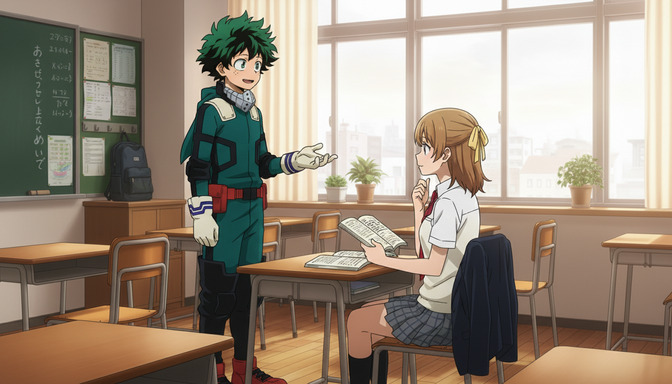
The rule of thirds creates a subject position and empty space in roughly equal proportion. What occupies the empty space is as compositionally important as where the subject is placed. A character in the left third with an undefined right two-thirds produces a composition the model can only half-complete. Describing what fills the open space tells the model what the composition is actually about: the environment, a second character, a visual motif, or deliberate negative space.
The most common mistake in rule-of-thirds prompts is specifying the subject's position clearly and then leaving the rest of the frame description vague. The model fills that space with whatever it defaults to, which is rarely intentional. Describing the remaining two-thirds in the same level of detail as the subject turns the composition from subject-plus-background into a designed frame.
Environment fill: rule of thirds framing, a white-uniformed fighter positioned at the right vertical third of the frame in a low fighting stance, the left two-thirds of the frame occupied by a destroyed bridge in evening fog, the bridge's broken silhouette forming a horizontal lead-in line pointing toward the fighter, warm amber light from the setting sun hitting the fighter's left side.
Negative space fill: rule of thirds composition, a girl in a summer dress positioned at the left power point, the right two-thirds of the frame pure deep blue ocean and sky with no other figures, the negative space communicating isolation and scale, the ocean's horizon at the lower horizontal third.
Two-character frame: rule of thirds scene, a tall blond fighter at the left vertical third and a shorter dark-haired fighter at the right vertical third, the center third between them a charged empty space through which distant city lights are visible, both characters facing each other, the center's emptiness communicating the distance between them despite their closeness in the frame.
If you're using AutoWeeb to generate scenes with a saved character, describe your character's position in the frame first, then describe the remaining space as its own visual element. The character's placement anchors the composition; the environment description completes it.

Step 4: Use lead-in lines to pull the eye toward the power point.
The rule of thirds describes where the subject sits in the frame. Lead-in lines describe how the viewer's eye gets there. A lead-in line is any visual element in the frame that points toward the subject: a road, a corridor, the angle of a roofline, a beam of light, a row of lanterns, the trajectory of a thrown object. When a lead-in line is aimed at the power point where your subject stands, the composition does double work — the position holds the eye, and the line delivers it there.
In anime, lead-in lines are often architectural: hallways, bridges, fence rows, staircases. In outdoor scenes, converging roads, rows of trees, or the diagonal line of a hillside all function as leads. In action scenes, the path of a weapon or the arc of a jump can be the lead line. Specifying both the subject's position on the grid and the line that leads to it produces compositions that feel like they were storyboarded rather than generated.
Architectural lead: rule of thirds composition, a long corridor stretching from the lower left of the frame and converging toward the upper right, a dark-haired girl standing at the upper-right power point where the corridor's perspective lines converge, the corridor's perspective creating a strong lead-in to her position, warm light from a window behind her at the end of the hall.
Diagonal lead: rule of thirds framing, a stone bridge crossing from the lower left corner of the frame to the center right, a cloaked figure standing at the right vertical third where the bridge meets the far side, the bridge's diagonal acting as a lead-in line that draws the eye from the lower left directly to the figure, storm clouds above and a rushing river below.
Action lead: rule of thirds scene, a lightning bolt or energy projectile fired from the lower-right of the frame arcing toward the upper-left power point, a fighter at the upper-left power point bracing to deflect it, the projectile's arc functioning as a diagonal lead-in that directs attention to the fighter, the impact point at the exact power point intersection.
Step 5: Direct motion along the thirds grid in video prompts.
For Seedance 2 video prompts, the rule of thirds governs not just the starting frame but the motion within it. A character who begins at the left third and moves toward the right third over the clip's duration is crossing the frame along the horizontal grid — the movement itself has compositional logic. A camera that slowly drifts from a centered starting position to a rule-of-thirds framing over the clip produces a reframing effect: the composition tightens as the camera settles into its intended geometry.
The most reliable rule-of-thirds motion prompts for video are: a subject entering from the frame edge and arriving at a power point, a camera pan that moves the subject from center to thirds, or a two-subject scene where the camera pulls back to reveal both subjects in their respective thirds simultaneously. All three use the grid as a destination for the motion rather than a static starting condition.
Subject enters to power point: rule of thirds video composition, a silver-haired girl enters the frame from the left edge at mid-clip speed and walks to the left vertical third, coming to a stop at the upper-left power point by the end of the clip, the camera static throughout, the right two-thirds of the frame occupied by a rain-wet street stretching into the distance, the girl's arrival at the power point the visual endpoint of the clip.
Camera settles into thirds: video prompt, rule of thirds reframing, camera begins centered on a boy standing in the middle of the frame and slowly pans right over the clip duration until the boy is positioned at the left vertical third of the final frame, the pan revealing additional environment to the right as it completes, the composition arriving at an intentional rule-of-thirds balance by the clip's end.
Two-subject reveal: rule of thirds video composition, camera slowly zooms out from a close-up starting frame to a wide shot over the full clip duration, beginning with only one character visible and ending with both visible — one at the left third and one at the right third — the zoom-out revealing the second character progressively and arriving at the two-subject rule-of-thirds split at the final frame.
For shorter clips, motion within the frame rather than camera motion produces cleaner rule-of-thirds results. A character who stands at the right vertical third while something moves across the left two-thirds — wind through grass, a crowd passing, light shifting — keeps the composition anchored while the scene remains alive. For more on directing camera movement in AI anime video, the guide on bird's-eye view shots in AI anime covers aerial motion structures that pair naturally with overhead rule-of-thirds framing.
👉 Start Generating Rule-of-Thirds AI Anime Compositions on AutoWeebFrequently asked questions about the rule of thirds in AI anime composition.
What is the rule of thirds and why does it matter for AI anime prompts?
The rule of thirds divides the frame into a three-by-three grid. The four points where the grid lines intersect — called power points — are the positions where a subject's placement creates the most natural visual tension and balance. In AI anime prompts, it matters because models default to centering subjects when no positional guidance is given. A centered subject in a centered environment is balanced but static. A subject at a power point with deliberate environment filling the remaining space creates a composition that reads as intentionally framed, not generated. The rule of thirds is the most direct instruction for moving from random-feeling outputs to something that looks storyboarded.
How do I describe rule-of-thirds placement in a prompt without sounding technical?
You don't have to use the phrase "rule of thirds" if you prefer not to. Describing position in the frame directly achieves the same result. Phrases like "positioned in the left third of the frame," "standing at the lower-right corner of the composition," "the subject occupies the right side of the frame with the left two-thirds open," or "the horizon line falls in the lower quarter of the frame" all communicate compositional intent to the model without requiring grid terminology. The most important thing is that the model receives an explicit position instruction rather than leaving placement to default. Whether you call it the rule of thirds or describe the position directly, the prompt is doing the same work.
Can I use the rule of thirds with two subjects in the same frame?
Yes, and two-subject rule-of-thirds compositions are among the most effective in anime. Place one character at the left vertical third and one at the right vertical third, with the center third between them as a charged visual gap. The gap can be filled with negative space, background environment, or a visual element that relates to both characters: a weapon mid-swing, a piece of food on a table between them, a window letting in light. The most important thing is that the center doesn't get claimed by either subject — it belongs to the tension between them. When prompting two-subject splits, describe each character's position explicitly and describe the center third as its own element. "A tray of sushi between them" or "a corridor stretching behind them into the distance" gives the model a center composition rather than leaving it to fill the gap arbitrarily.
What's the difference between the rule of thirds and symmetrical composition in anime?
Symmetrical composition places the subject at the exact center of the frame, often with matching environment on both sides. It creates stillness, formality, and a sense of confrontation or declaration — think of the shots in anime where a villain reveals themselves, standing dead center in a framed doorway, or a final confrontation where two characters face each other with the camera perfectly between them. The rule of thirds creates asymmetry, movement, and tension. The off-center subject implies that something exists beyond the frame edge, that the world is larger than what the camera is showing. Both are intentional choices. Use symmetry for moments of declaration, finality, or confrontation. Use the rule of thirds for moments of uncertainty, transition, relationship, or when you want the environment to carry as much weight as the character.
How does the rule of thirds interact with camera angles like low angle or bird's-eye view?
Camera angle and compositional grid are independent variables that combine multiplicatively. A low angle shot can be centered or rule-of-thirds framed. A bird's-eye view can be centered or rule-of-thirds framed. The camera angle determines where the camera is positioned relative to the subject. The rule of thirds determines where within the resulting frame the subject appears. In practice, combining a strong camera angle with a rule-of-thirds placement produces significantly more intentional-feeling compositions than either technique alone. A low angle shot of a character at the left vertical third, looking up and to the right into open sky, uses both the power of the elevated camera angle and the tension of the off-center subject. Prompt both independently: first name the camera angle, then specify the rule-of-thirds position. The guide on low angle shots in AI anime covers the camera angle side; this guide covers the compositional grid.
Does the rule of thirds work for indoor scenes in AI anime?
Fully. Indoor scenes often produce stronger rule-of-thirds results than outdoor ones because architectural elements naturally create vertical and horizontal lines that align with the grid. A character standing at the right vertical third of a room, with a window at the left vertical third behind another character, uses the room's architecture as a compositional scaffold. A hallway receding from the lower left to the upper right power point, with a figure at the far end, uses the architecture as both a lead-in line and a rule-of-thirds composition simultaneously. Describe the room's dominant architectural lines — the direction a hallway runs, where windows are positioned, the angle of furniture — and place your subject explicitly within the grid those lines create. Indoor rule-of-thirds compositions also tend to have cleaner depth of field, because the background is finite rather than atmospheric.
Should I combine the rule of thirds with depth of field in my prompts?
Combining them sharpens both effects. A subject placed at a power point with shallow depth of field behind them stands even more clearly in the frame because the blurred background pushes all attention toward the in-focus subject at the power point. The most effective structure is: subject at power point, shallow depth of field blurring the background, the blurred background still compositionally described (so the model renders the bokeh against a coherent environment rather than noise). The depth-of-field blur removes texture from the surrounding two-thirds without eliminating the sense of environment. For detailed close-up framing combined with this technique, the guide on close-up shots in AI anime covers how depth of field operates at close focal distances.
The rule of thirds is foundational, but it's one layer of composition among many. Once you have subject placement and horizon line under control, combining it with deliberate shot type, camera angle, and lead-in lines produces outputs that feel designed from the first frame. For the complete toolkit of shot types and angles to pair with rule-of-thirds framing, the guides on extreme long shots and bird's-eye view shots cover the compositional logic of scale and elevation — both pair directly with rule-of-thirds placement to produce scenes that look like they came from a storyboard, not a prompt box.
Related Blog Posts
How to Turn an Idea into an AI Anime Video
From premise to storyboard to finished short — a step-by-step guide to transforming a raw story idea into a structured AI anime video using scene prompts, pacing, and AutoWeeb's storyboarding feature.
Learn how to turn a story idea into an AI anime video with scene prompts, pacing, and AutoWeeb's storyboard tool. Step-by-step guide with examples and FAQ.
Best Camera Movements to Use in AI Anime Video Prompts
Dolly, pan, tilt, tracking shot, zoom, overhead, close-up — how to use cinematic camera language to direct AI anime videos like a professional cinematographer.
Learn how to use camera movement language like dolly in, pan, tilt, tracking shot, zoom, overhead shot, and close-up in AI anime video prompts for cinematic results.

How to Make AI Anime Fight Scenes Look Professional
Choreography, camera angles, speed, impact effects, and emotional stakes — the complete prompting guide for AI anime fight scenes that hit like the real thing.
Learn how to prompt AI anime fight scenes with choreography, camera angles, speed lines, impact effects, and emotional weight. Includes AutoWeeb prompt analysis tips.
AutoWeeb Is the AI Anime Video Maker for Beginners: No Drawing or Editing Skills Needed
You don't need to sketch a single frame or touch a timeline editor — AutoWeeb handles the creative production so you can focus on the story.
AutoWeeb is the AI anime video maker for beginners with no drawing or editing skills needed. Upload a photo, pick a style, and generate anime videos in minutes.
Explore AutoWeeb
Jump into the tool that fits your creative step.
AI Anime Video Generator
Animate storyboard shots into cinematic clips with Seedance 2 and consistent characters.
Anime Character Creator
Design original characters with consistent sheets across every scene.
AI Anime Image Generator
Generate cinematic anime stills anchored to your character library.
Turn Photo Into Anime
Upload any photo and watch AI turn it into stunning anime art in seconds.
AI Anime Location Generator
Create a location set once, then generate reference images from every angle.
AI Anime Storyboarding
Describe your idea, pick your characters, and let AI draft the script and scenes.
AI Anime Prompt Agent
Turn a rough idea into a cinematic Seedance 2 prompt with the AI Director.