How to Write a Script With AutoWeeb's AI Story Agent
The script is not a step you skip on the way to the storyboard. It is the map that makes every panel in the storyboard necessary.

Every anime storyboard that runs out of momentum at panel five has the same origin story: someone started with a visual and skipped the script. The visual looked good. The next visual had no reason to follow it. The third visual contradicted the second, and the whole thing stopped making sense. A storyboard script is not a formality before the real work. It is the structural decision that makes every panel in the storyboard necessary rather than optional. AutoWeeb's AI Story Agent is built specifically to take a creator from raw idea to a complete, scene-by-scene script, and from that script directly into storyboard panels, without requiring any screenwriting experience to get there. This guide walks through the full workflow and explains the reasoning behind each step, so every choice you make along the way is intentional.
US creators looking for an AI script writer that understands anime structure, not just generic story templates, will find that the agent handles the craft layer: genre logic, trope architecture, character arc mechanics, and scene-level dialogue. You bring the idea. The agent builds the machine that delivers it.
Why scripting always comes before storyboarding.
A storyboard is a sequence of decisions: shot distance, character positioning, what is in the background, how long the panel holds before the next one. Each of those decisions has a correct answer if you know what the scene is supposed to accomplish. It has no answer, only preference, if you do not. The script is the document that answers "what does this scene need to do" before you ever ask "what should this scene look like."
The structural reason is simpler than most creators expect. A script establishes cause and effect between scenes. Scene A creates a condition that scene B responds to, which creates the condition that scene C resolves. A storyboard built without that causal chain is a series of images that feel unrelated even when they look beautiful. The visual throughline, the thing that makes a viewer lean forward rather than lean back, is the script's job. The storyboard's job is to deliver what the script has already earned. Reversing that order produces visuals that have no earned weight.
In practical terms: a storyboard built from a script takes a fraction of the time to generate because every prompt has a clear purpose. A storyboard built without a script generates twice as many panels because half of them are corrections to panels that were pointing in the wrong direction.
Common challenges writers face before the first line of script.
The most common challenge is not a lack of ideas. Most creators who want to write an AI screenplay have more ideas than they know what to do with. The problem is that ideas are not stories. An idea is a premise: "a girl who can stop time, but every time she uses the ability she ages a year." That is a strong premise. It is not a script. The gap between premise and script is where most creators stall, and it is a specific kind of gap, not a general one.
Writer's block at the script stage almost always comes from one of three sources. The first is not knowing what the story is actually about internally, meaning the character's want, their deeper need, and the gap between them. Without those two things named, every scene feels equally possible, which is the same as every scene feeling equally impossible. The second source is not having a genre container. Genre is not a style. It is a set of structural rules that determine what the audience expects and when. Without genre, you cannot know whether the fight scene belongs in act one or act three. The third source is not knowing which tropes the story is using. Tropes are the tested structural shapes inside genre. They provide the beat sequence that turns a premise into a scene list.
The reason these three obstacles cluster together is that they are all the same problem: the creator is trying to make every decision at once, in the wrong order. An AI story writer that structures the process into deliberate sequential steps eliminates the paralysis by making each decision small and contained before moving to the next.

How AI helps overcome writer's block at every stage.
An AI script generator does not replace the creative decisions. It removes the friction that keeps creators from making them. The friction at the idea stage is that a premise does not know what it wants to be. The AI surfaces the structural options already latent in the premise: this premise naturally fits a tragedy arc, or a redemption arc, or a flat arc in which the protagonist changes the world rather than being changed. That is not invention. That is diagnosis, and it converts a vague feeling into a concrete direction.
At the trope selection stage, the friction is not knowing which structural shapes exist or which ones fit the premise. An AI story agent has the full library of anime narrative shapes available: rivals-to-allies, the reluctant mentor, the power-sealed protagonist, the found family, the cost-of-victory. It can propose two or three that fit the premise's genre and emotional register and explain what storyboard demands each one makes. That converts an overwhelming menu of options into a specific set of three.
At the scripting stage itself, the friction is the blank page. Most creators know roughly what a scene needs to do but cannot find the first line of dialogue. An AI screenplay generator can draft the scene from the beat description, producing a starting point that the creator then refines. That is a fundamentally different cognitive task than generating from nothing: editing a draft is easier than originating, and the result is usually better because the creator's revision instincts engage more reliably than their origination instincts.
How AutoWeeb's AI Story Agent works.
AutoWeeb's AI Story Agent is a structured, sequential creative collaborator built specifically for anime storytelling. It does not generate a random story from a keyword. It walks you through the decisions that a professional anime writer would make in the correct order, from premise through genre through tropes through character through arc through scene, and it does so with enough anime structural knowledge to give each decision its genre-specific shape.
The agent understands the difference between shonen pacing and slice-of-life pacing. It knows which tropes produce which panel sequences. It can identify when a character's want and need are too similar to generate genuine arc pressure, and it can propose adjustments that create the gap. When you reach the script generation step, it produces scene-by-scene dialogue and action that maps directly onto storyboard panels, not abstract prose that you then have to figure out how to visualize. Every script output is written in storyboard-adjacent language: who is in the frame, what they are doing, what the emotional register of the moment is, what the next beat needs to accomplish.
Once the script is confirmed, the agent converts each scene into a generation-ready storyboard prompt. If you have built your protagonist in AutoWeeb's anime character creator, the character's visual identity carries forward into every panel, ensuring the visual consistency that makes a storyboard feel like a film rather than a mood board.
The complete workflow: from story idea to storyboard panels.
What follows is the full eight-step process that AutoWeeb's AI Story Agent uses to take a creator from a raw premise to a complete, panel-by-panel storyboard. Each step produces a specific output that feeds directly into the next one.
Step 1: Enter a story idea.
Start with a single sentence. It does not need to be polished. It does not need to include genre, character names, or arc structure. It just needs to carry the seed of a premise: a situation, a tension, or a question. For example: "A student who can hear the final regret of every object she touches starts finding regrets that do not belong to objects that should be able to have them." That is enough. The agent reads the premise and identifies what kind of story it naturally wants to be before asking any follow-up questions. You are not locked into that reading, but having a starting point makes the first genre decision immediate rather than open-ended.
Step 2: Choose a genre.
Genre is the structural container that governs everything downstream. It determines pacing, tone, the emotional register of the climax, and which tropes are structurally available. AutoWeeb's agent presents the two or three genres that best fit the premise and explains what each one demands from the storyboard. The premise above fits supernatural mystery, psychological thriller, and quiet horror. The agent explains: supernatural mystery expects a reveal that recontextualizes earlier panels; psychological thriller wants escalating internal pressure that makes the protagonist's perception unreliable; quiet horror earns its weight through what it withholds from the frame. Choosing between them is a creative decision only the creator can make, but the agent makes it an informed one. For a deeper look at how genre shapes panel decisions, the guide on choosing the right genre before an AI storyboard covers the full decision framework.
Step 3: Select story tropes.
Tropes are the structural shapes inside genre that provide the beat sequence for individual scenes. Once genre is locked, the agent presents the tropes that fit: for supernatural mystery, options might include "the reluctant witness," "the unreliable gift," and "the truth that costs more than ignorance." Each trope comes with a beat map: what happens first, what pressure escalates in the middle, what the resolution moment looks like. The beat map is the skeleton of the script. The guide on picking anime story tropes for storyboards covers the full selection framework and how tropes shape concrete shot decisions.
Step 4: Build characters.
Characters built at this stage feed into both the script and the visual generation. For each main character, the agent asks: what is their role in the trope structure, what do they look like (visual attributes that will carry into panel prompts), what do they sound like in dialogue (speech patterns, cadence, what they avoid saying), and what is their relationship to the story's central conflict. A character built with this level of specificity produces dialogue that sounds like an individual rather than a function. Visual attributes entered here carry forward into AutoWeeb's character creator, so the character you describe in text becomes the character whose face appears consistently across every storyboard panel.
Step 5: Define character arcs.
Every character who drives scenes needs an arc: a measurable internal change, or deliberate non-change, that the external plot delivers. The agent identifies the arc type most consistent with the premise and tropes already selected, then asks two questions: what does the protagonist believe at the start, and what will they be forced to believe, or choose to keep believing, by the end. The gap between those two positions is the arc. Every scene in the script is then accountable to that gap: it either builds pressure against the beginning belief, delivers a beat that makes the beginning belief unsustainable, or registers the shift toward the end belief. The guide on creating a character arc before storyboarding covers the full arc architecture and how each type maps onto storyboard panel sequences.
Step 6: Generate a script.
With genre, tropes, characters, and arcs confirmed, the agent generates a scene-by-scene script. Each scene includes an action line describing what is happening visually, dialogue written in each character's established voice, and a beat note that names what the scene accomplishes in the arc and what emotional state the viewer should carry into the next scene. The script produced at this stage is not a final draft. It is a structured starting point: complete enough to storyboard from, open enough to revise without losing the underlying architecture. For the premise above, a sample scene might read: Scene 4. Classroom, afternoon. HANA holds a cracked phone screen at arm's length, her expression controlled. She reads the screen without touching it. CUT TO: her hands in her lap, still. She knows whose phone this was. She does not want to know what it regrets. Beat: first real evidence the gift is escalating.
Step 7: Refine scenes.
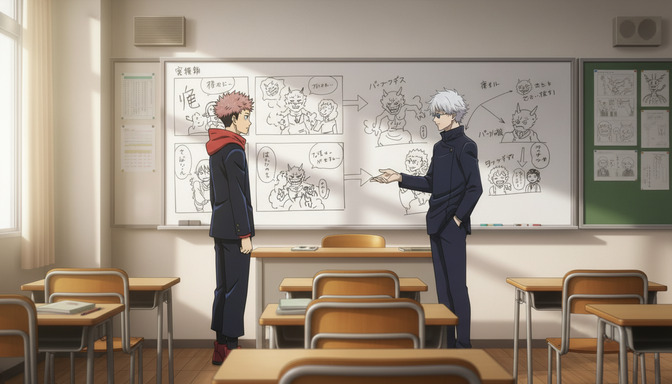
Scene refinement is where the creator's voice asserts itself most directly. The agent's first draft is architecturally sound. It may not be tonally right. A scene may be paced too quickly, a line of dialogue may not sound like the character, a beat note may be accurate but emotionally thin. The refinement interface lets you work scene by scene: adjust the dialogue, reframe the action line, shift the beat note to a different arc position, or ask the agent to redraft the scene with a different emotional emphasis. The agent applies changes without losing the surrounding architecture. A scene that gets slower, for instance, triggers automatic recalculation of pacing in the scenes around it, so the overall rhythm stays coherent.
Step 8: Convert the script into storyboard panels.
Once the script is confirmed, the agent converts each scene into a set of storyboard panel prompts. Each prompt includes shot type (wide, medium, close-up, extreme close-up), character position and expression drawn from the character profile built in step four, environmental context drawn from the scene's action line, lighting direction appropriate to the arc position, and any visual detail that carries the beat note into image form. The result is a generation brief for each panel that knows exactly what arc position it is serving and what emotional work it needs to do. Run each prompt through AutoWeeb's image generator with your character assigned, and the storyboard assembles as a coherent visual sequence rather than a collection of individually good images.
How AutoWeeb's AI Story Agent helps creators discover tropes and convert them into visual storyboards.
Most creators do not start with a trope in mind. They start with an image, a feeling, a premise fragment, or a character they want to write but do not know how to deploy. AutoWeeb's AI Story Agent is designed for exactly that starting point. The agent's trope library covers the full range of anime narrative shapes and is organized by the emotional payoff each one delivers rather than by genre label. A creator who knows they want a story that ends with sacrifice has a different set of tropes available than one who wants a story that ends with earned belonging. The agent surfaces the right options for the payoff the creator is aiming at, not just the premise they typed in.
Once a trope is selected, the agent does not just name it. It maps the trope's beat structure onto the specific premise, character, and arc already defined. "Rivals-to-allies" in a supernatural mystery story set in a contemporary high school produces a different beat map than "rivals-to-allies" in a shonen tournament arc. The agent produces the version that fits the specific combination of elements already established, so the trope feels native to the story rather than imported from another genre.
The storyboard conversion step then takes that beat map and makes it visual. Each beat has a default panel shape in its genre: a confrontation beat in supernatural mystery calls for a medium-wide with both characters in frame but separated by an environmental object; a recognition beat calls for a close-up on the character who has just understood something, held long enough for the viewer to read the shift. The agent produces those panel descriptions as generation-ready prompts, so the leap from script to visual is immediate rather than requiring the creator to translate beat language into image language manually.
The result is a storyboard that is coherent from the first panel to the last, not because the visuals match stylistically, which they will, but because every panel is in the correct structural position in the arc. Each image has been assigned a job before it was generated, and the job matches the beat it was generated to serve. That is the difference between a storyboard that tells a story and a storyboard that illustrates scenes.
Frequently asked questions about AI script writing and anime storyboards.
What is an AI script writer and how is it different from a general AI writing tool?
A general AI writing tool generates text from a prompt without structural knowledge of the form. An AI script writer specialized for anime understands story structure, arc types, genre conventions, trope beat maps, and scene-level dialogue that sounds like a character rather than a summary of what the character is thinking. AutoWeeb's AI Story Agent operates on that second level: it builds the script from the arc out, not from the prompt in, so every scene is structurally accountable to the arc rather than just thematically adjacent to it.
What does an AI screenplay generator actually produce?
An AI screenplay generator in the context of AutoWeeb produces a scene-by-scene script with action lines, dialogue, and beat notes. Each scene describes what is happening visually (action line), what characters say and how (dialogue in their established voice), and what the scene accomplishes in the arc (beat note). The output is in storyboard-adjacent language, meaning it is already partially translated into visual terms. It is not a finished screenplay in the Hollywood format, but it is a complete structural document that maps directly onto storyboard panel prompts.
Do I need writing experience to use AutoWeeb as an AI story writer?
No. The agent asks questions that any creator can answer, starting from premise and emotional landing point. It supplies the structural knowledge (arc types, genre rules, trope beat maps) that a first-time writer would otherwise need years to acquire. The creative decisions remain yours: the premise, the emotional register, the character's voice, the tropes you are drawn to. The agent handles the structural scaffolding that ensures those decisions add up to a coherent story.
What is a storyboard script and how does it differ from a regular script?
A storyboard script is a script written with visual production as its direct output rather than performance. Where a stage script prioritizes dialogue and a film screenplay describes action in camera-neutral language, a storyboard script includes shot-level information: who is in frame, at what distance, with what lighting, in what relationship to other characters or the environment. AutoWeeb's script output is written in storyboard script language by default, so the step from script to panel prompt is a direct conversion rather than a full translation.
Can I use the AI script generator for short-form anime content?
The agent scales to any length. A single-scene script for a five-panel storyboard goes through the same genre, trope, character, and arc decisions as a twelve-scene script, just at shorter depth. Short-form content benefits from the same structural clarity as long-form: a five-panel storyboard with no arc is five unrelated images; a five-panel storyboard built from a one-scene arc has a beginning state, a pressure beat, and a resolution, and those three positions produce a complete emotional experience in under thirty seconds of viewing time.
How does the AI story agent handle genre-specific story conventions?
The agent carries genre-specific knowledge into every step after genre selection. In a shonen premise, it defaults to arc structures that reward persistence and escalating mastery. In a slice-of-life premise, it defaults to arcs that reward attention to small moments and relational shifts rather than external stakes. In a psychological thriller, it applies unreliable-narrator conventions to scene construction and adjusts what the storyboard withholds versus shows. Genre selection at step two is not a label. It is a set of structural rules that the agent applies automatically from that point forward.
What happens if I change my mind about a genre or trope mid-process?
The agent supports revision at any step without losing the surrounding work. A genre change after tropes are selected triggers a re-evaluation of which tropes are still viable and which need replacement. A trope change after characters are built triggers a re-evaluation of which character functions need adjustment. The arc and character work that does not conflict with the new selection is preserved. The agent treats revisions as structural decisions, not restarts, so mid-process changes are refinements rather than full rebuilds.
How long does it take to go from idea to storyboard with AutoWeeb?
A complete eight-step workflow for a short-form anime story, six to twelve panels, takes most creators thirty to sixty minutes on a first pass, including refinement. The longest step is usually scene refinement, where the creator is making voice and tone decisions about dialogue that are inherently slower than structural decisions. Panel generation after the script is confirmed is fast: each prompt is pre-built by the agent, and generation typically takes seconds per panel. The total time from idea to a complete visual storyboard is shorter than most creators expect because the structural decisions are made sequentially and without the paralysis that comes from trying to make all of them at once.
An AI script writer that understands anime structure removes the friction between the story you can imagine and the storyboard you can generate. AutoWeeb's AI Story Agent handles the architecture so the creative decisions stay where they belong: with you. For the trope layer that sits inside your genre and determines which scenes are structurally possible, the guide on picking anime story tropes for storyboards covers the full selection framework. For the genre decision that contains those tropes, the post on choosing the right genre before an AI storyboard walks through every genre option and its storyboard demands. For the character arc that gives every panel its emotional assignment, the guide on creating a character arc before storyboarding covers the full arc architecture.