How to Pick Anime Story Tropes That Make Your Storyboard More Engaging
The story tropes that do not just decorate your script — they dictate every panel order, shot distance, and emotional beat on the storyboard.
Most storyboards stall at panel three. Not because the creator ran out of ideas, but because they skipped the step that makes panels inevitable rather than arbitrary. That step is choosing the right story tropes. Tropes are not clichés waiting to be avoided. They are the tested narrative contracts that tell your audience what register they are in and what emotional payoff to expect. Every storyboard that holds together from the establishing shot to the final close-up is built on at least one structural trope, whether the creator named it or not.
This guide is for US creators ready to move past vague story ideas into a storyboard that executes. It covers how anime tropes shape concrete storyboarding decisions, which character tropes produce the clearest panel sequences, and a step-by-step framework for selecting writing tropes before you touch a generation tool. It ends with how AutoWeeb's AI Story Agent helps you identify the right tropes for your premise and turn them directly into visual storyboard beats.
Why story tropes are the architecture of your storyboard, not decoration.
A storyboard is a sequence of decisions. Shot distance, who is in frame, what the environment communicates, when the camera holds and when it cuts. Every one of those decisions has a default answer inside the trope you chose, if you chose deliberately. Storytelling tropes carry inherited visual grammar built up across hundreds of anime productions. When you pick "rivals-to-friends," your audience already expects wide establishing shots for confrontations, close-ups for the moment of mutual recognition, and a final medium-wide that puts both characters in the same frame as equals. The trope does not write the storyboard for you. It removes the guessing.
Without a named trope, panels are independent images. With one, panels are a sequence with implicit cause and effect. The post on choosing story genre before an AI storyboard covers the macro container. Tropes live one level deeper: they are the specific structural shape inside the genre that makes individual scenes feel satisfying rather than arbitrary.
The six core anime tropes and how each one shapes your storyboard decisions.
These are not the only anime tropes worth using. They are the six that produce the clearest, most storyboard-ready visual grammar for short-form AI projects. Each one comes with default shot sequences any creator can borrow before refining.
1. The unlikely hero / chosen one.
The protagonist has power they did not ask for, cannot fully control, and is not sure they deserve. Every beat measures the gap between potential and readiness. Storyboard implications are immediate: wide establishing shots make the world large and the character small; close-ups on hands, eyes, or a signature object anchor the internal struggle; training sequences use repeating medium shots to show incremental growth. The emotional climax needs a full-body wide shot at the moment the power finally lands cleanly, so the viewer can feel the scale shift. If your storyboard has no wide-to-close escalation pattern, this trope will feel flat.
2. Rivals-to-friends (and the reverse).
Two characters defined by opposition who accumulate enough shared context to shift the relationship. This is one of the most storyboard-efficient character tropes because the visual grammar is structural: confrontation panels use parallel framing with space between characters; recognition panels close that distance; resolution panels put both characters in the same plane. The moment the dynamic shifts needs a mid-shot held long enough for the audience to register it. Do not cut too fast. The pause is the beat.
3. Slow-burn romance.
Emotional stakes escalate through proximity, near-misses, and the things characters almost say. Storyboard decisions are dictated by restraint: hold on the hand that does not reach; cut away before eye contact becomes declaration; use background characters to measure how isolated the two leads are in a crowd. The reveal moment needs tighter framing and softer lighting than every panel before it. If every panel looks the same, the slow burn has no burn. Vary framing distance intentionally. Pair this trope with the anime romance story creation guide when you want to develop the arc beyond a single short.
4. The mentor and the student.
Knowledge transfers across a power differential, and both characters are changed by the end. Storyboard grammar here is about vertical and horizontal composition: early panels put the mentor above or ahead of the student in frame; later panels bring them level; the final panels sometimes reverse positions entirely. Insert shots of demonstrated technique and close-ups of the student observing carry enormous weight. If your storyboard never shifts the compositional relationship between the two characters, the trope's core transformation goes unregistered.
5. The redemption arc.
A character who caused harm works through consequences and earns back trust or self-respect. This is one of the most storyboard-intensive writing tropes because it requires visual contrast between who the character was and who they become. Shadow-heavy lighting or isolated framing in early scenes; neutral or warm lighting with another character present in late scenes. The storyboard has to do character time, not just plot time. A redemption arc with no lighting or framing shift reads as a character who apologized, not a character who changed.
6. Fish out of water / isekai displacement.
A character from one world navigates another, and everything ordinary in the new world is extraordinary to them. Storyboard decisions are driven by contrast and reaction shots: wide shots establish the unfamiliar environment at scale; immediate cut to close-up of the character's face registers the gap between expectation and reality. This trope lives or dies on reaction panel timing. The wide shot needs to be wide enough to be overwhelming; the reaction close-up needs to follow without any transition beat to dilute the impact.
Step-by-step framework: how to select story tropes before building a storyboard.
The following five steps convert a raw story idea into a trope-anchored storyboard plan. Work through them in order. Each step narrows the decision space until storyboard panel generation is assignment work rather than invention from scratch.
Step 1: Name the emotional landing first.
Before naming any trope, decide what the viewer should feel when the final panel holds. Breathless and proud? Quietly devastated? Warm and seen? That emotion is the filter for every trope selection that follows. Storytelling tropes are delivery mechanisms for specific emotional payoffs. If you want quiet devastation, the slow-burn romance or redemption arc delivers it better than the chosen-one arc, which defaults to exhilaration. If you want breathless pride, the unlikely hero or rivals-to-friends landing is built for it. Start with the feeling. The trope is the path.
Step 2: Choose the primary character trope and write the core tension in one sentence.
Every character trope carries a built-in tension: the unlikely hero cannot control the power; the rival cannot admit respect; the student has not yet earned what the mentor sees in them. Write the core tension as a single sentence before scripting anything. Example: "A girl who has always watched from the sidelines discovers she is the only one who can see the enemy, but using that sight costs her the ability to remember the people she is protecting." That sentence contains the unlikely hero trope, locks the internal conflict, and already suggests close-up panels of fading memory and action panels of isolated battle. One sentence, full storyboard direction.
Step 3: Assign a trope beat to every scene, not just the climax.
A common mistake in short-form storyboards is saving the trope for the final panel. The trope should be present in every beat, not as repeated content but as consistent logic. In a slow-burn romance, beat one is already charged with unexpressed feeling, not just two characters standing near each other. In a rivals-to-friends arc, beat one establishes the exact nature of the opposition so the audience knows what closing that gap costs. For each planned scene, ask: what does this trope demand be present in this beat? Answer that question, and the panel description writes itself.
Step 4: Map the trope's visual grammar onto your shot list.
Take the panel grammar from the trope section above and map it directly onto your planned shots. Rivals-to-friends: does your storyboard have parallel framing in early confrontation panels and shared frame in late resolution panels? Mentor-student: does the compositional relationship between characters shift across the arc? Redemption: does lighting change between early and late panels? This mapping step is where most storyboard quality is won or lost. You are not deciding what looks good. You are deciding what is structurally required by the trope you already chose.
Step 5: Test the trope against a three-beat prototype before generating all panels.
Before committing to a full storyboard session, generate three panels: the setup beat, the midpoint tension beat, and the resolution beat. These three panels should demonstrate the trope's core visual grammar without requiring the full sequence. If the three-panel prototype does not feel like a complete mini-arc, the trope is either wrong for the premise or the tension sentence from Step 2 needs sharpening. Fix it at three panels, not after generating twenty.
How trope combinations create richer story ideas without complicating the storyboard.
Most compelling anime shorts use two tropes in tension with each other. The key is hierarchy: one primary trope drives the scene structure, one secondary trope adds complication. A rivals-to-friends arc with an underlying slow-burn romance is a well-worn combination for good reason: the rivalry provides external conflict structure, the romance provides internal hesitation that makes every confrontation panel carry two simultaneous readings. The storyboard serves the primary trope's panel grammar (confrontation, parallel framing, shared frame), while the secondary trope adds detail to expression close-ups and held pauses.
The mistake is giving both tropes equal structural weight. Two equally dominant tropes produce a storyboard with confused pacing: panels that do not know whether to cut hard or hold soft. Decide which trope wins when the two conflict. In the rivals-romance example, the rivals structure wins: the shared-frame resolution panel is earned through the rivalry closing, not the romance admitting itself directly. The romance is confirmed by proximity in the final panel, not declared aloud. Each trope does what it is built for; neither asks the other to do its job.
How AutoWeeb's AI Story Agent helps you discover tropes and convert them into visual storyboards.
AutoWeeb's AI Story Agent is built for the step between story idea and storyboard panel. You bring the premise and the emotional landing you named in Step 1; the agent identifies the tropes already latent in your idea, surfaces the ones you might not have named, and drafts beat-by-beat scene descriptions that map directly to storyboard panel prompts.
The workflow is specific. Tell the agent something like: "High school rivals, one secretly protecting the other for a year without being recognized, reconciliation in a gymnasium after practice." The agent identifies the rivals-to-friends trope as primary and the unrequited sacrifice variant as the secondary complication. It returns structured beats: wide gymnasium establishing shot with both characters on opposite sides, medium on the protective gesture being recalled, close-up on the moment of recognition, medium-wide resolution with narrowed distance. Each beat description is already in storyboard-ready language.
The agent also flags trope mismatches before you generate. If your premise is emotionally suited to slow-burn romance but your beat descriptions keep defaulting to action pacing, the agent surfaces the mismatch and offers adjusted beats that serve the emotional register you chose. This catches the genre-vs-trope collision that usually only shows up after twenty panels have been generated and the sequence still does not feel right.
Once beats are approved, the storyboard planning tool in AutoWeeb takes each beat description and turns it into a generation-ready panel. Assign your saved character from the anime character creator before generating so faces stay consistent across the trope's arc. The post on choosing anime art style for AI generations covers the visual layer that sits on top of the trope structure once beats are locked.
Frequently asked questions about anime story tropes and storyboard planning.
What are story tropes and how are they different from clichés?
A trope is a recurring narrative structure with proven emotional mechanics: the rivals-to-friends arc, the mentor-student power transfer, the slow-burn confession. A cliché is a trope deployed without intention, usually because it was the first option that came to mind. The difference is not the structure itself but the specificity of execution. The rivals-to-friends trope becomes a cliché when the tension is never actually defined and the reconciliation arrives without cost. It stays a living structure when the core tension sentence (Step 2 above) is sharp enough that every beat earns the final shared frame.
How many tropes should a short anime storyboard use?
One primary trope, optionally one secondary. Three-beat to twelve-panel shorts do not have enough space to develop three tropes without each one feeling underdeveloped. The most common failure in beginner storyboards is trope overloading: chosen-one arc plus redemption arc plus slow-burn romance in an eight-panel sequence. None of the three gets the visual grammar it needs. Pick the trope whose emotional payoff matters most. The others become future projects.
Can writing tropes work in non-action anime shorts?
Yes, and they often work better. Slice-of-life and romance shorts benefit most from conscious trope selection because those genres have less external plot to carry pacing. The slow-burn romance trope structures every small interaction into a beat that accumulates toward the payoff. Without it, slice-of-life panels are pleasant but inert. Writing tropes are not genre-specific. They are emotional delivery mechanisms that work across action, romance, mystery, and comedy equally.
How do character tropes affect which shots I need?
Directly. Each character trope carries default shot grammar because it carries default emotional beats. The unlikely hero needs wide-to-close escalation to show the character growing into the frame. The rivals-to-friends arc needs compositional shifts from separation to shared space. The mentor-student trope needs vertical-to-horizontal reframing across the arc. If you know the character trope, you know the camera decisions before you open the generation tool.
What if my story idea does not fit a named trope?
Most specific premises map onto one of the core tropes once the emotional landing is named. If yours genuinely does not, work backward from the emotional payoff: what structural shape produces that feeling? You may be using a trope variant, which is valid, or a trope combination where neither maps cleanly alone. Tell the AI Story Agent the premise and emotional landing and ask it to identify the structural shape. It can name the trope you are working inside even when the surface content seems unusual.
Are anime tropes different from Western storytelling tropes?
Some anime tropes have strong visual traditions with no close Western equivalent: the tournament arc's escalating reveal structure, the beach episode's emotional decompression function, the cultural festival arc as a deadline for unspoken confession. Others overlap closely with Western structures (the mentor-student arc, the redemption arc). For AI storyboards targeting anime aesthetics, the anime-specific trope conventions matter because they carry visual grammar that matches the art style. Using Western thriller pacing with anime romance aesthetics produces panels that look right but feel wrong to anyone who knows the genre.
How does the AI Story Agent handle trope selection for unfamiliar genres?
Describe the emotional landing and the basic premise. The agent identifies available tropes and explains what each one demands from the storyboard. You do not need to arrive with a trope already named. The agent's value in unfamiliar genres is surfacing the structural options and showing what each one costs in terms of required beats, so you can choose based on what your project actually has space for.
Where does trope selection fit in the full storyboard workflow?
After genre, before scripting. The workflow is: name the emotional landing, choose genre, select the primary trope, write the core tension sentence, draft beats with the AI Story Agent, map panel grammar from the trope, generate the three-panel prototype, then build the full storyboard. Trope selection is the second decision after genre, not an afterthought. The post on choosing the right genre before an AI storyboard covers the decision immediately upstream of trope selection.
Choosing the right story tropes before building a storyboard is the difference between a sequence that reads as directed and a collection of panels that never add up to a story. Name the emotional landing, pick the trope that delivers it, map its visual grammar onto your shots, and let AutoWeeb's AI Story Agent turn the whole structure into generation-ready beats. For the visual layer on top of the trope structure, the guide on AI anime lighting prompts shows how lighting language reinforces the emotional register each trope demands. When you are ready to move from storyboard panels to motion, the post on writing prompts for Seedance 2 anime videos picks up from the last panel.
Related Blog Posts
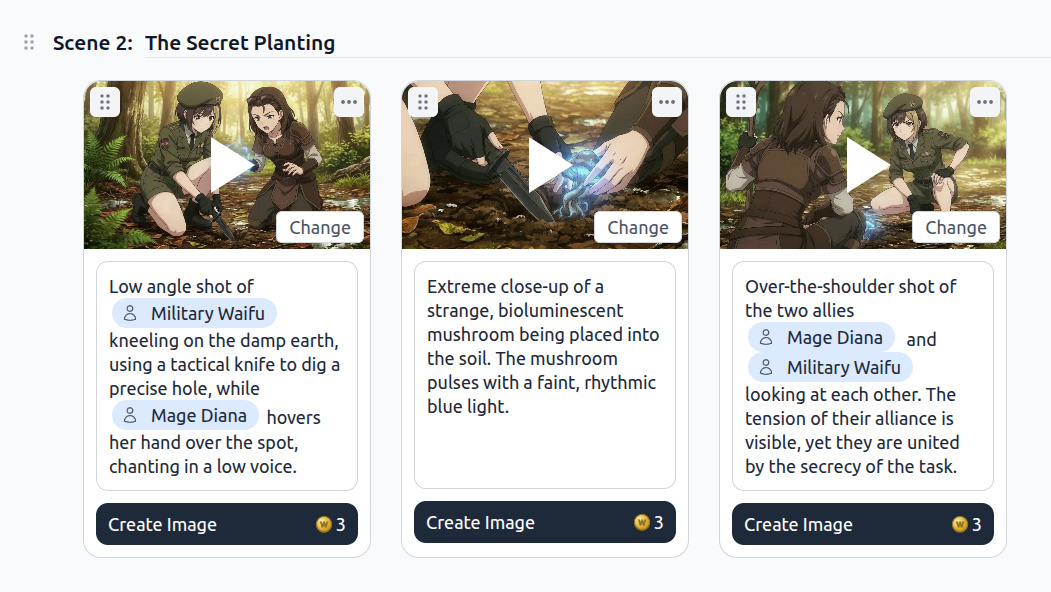
Introducing the Anime Storyboard Creator
Write your anime script and bring every scene to life with AI-generated images and videos.
AutoWeeb's new storyboard feature lets you write an anime script and generate images and videos for every scene. Meet the anime storyboard creator.
AI Anime Land Beats and Cliffhangers for YouTube Shorts
The last three seconds earn the next upload. Storyboard the land, generate one hold, and end on a question viewers cannot scroll past.
Design AI anime land beats and cliffhanger endings for YouTube Shorts: payoff panels, one-action holds, honest thumbnails, and prompts that lock your saved OC before EP02.
AI Anime Turn Beats for YouTube Shorts
The middle seconds deepen the hook without stealing the land. Storyboard one escalation, generate one action, and hand off to the cliffhanger on purpose.
Design AI anime turn beats for YouTube Shorts: middle-beat storyboard rows, one-action escalation prompts, b-roll handoffs, and saved OC locks before the land hold.
Creating an Anime Series with AI in 2026
A single-cour production grid for YouTube creators: twelve beats, one locked protagonist, and a still-to-motion chain that ships like a show.
Creating an anime series with AI in 2026 means a twelve-episode grid, locked protagonists, and Shorts-ready motion. A production workflow for YouTube video creators.
Explore AutoWeeb
Jump into the tool that fits your creative step.
AI Anime Video Generator
Animate storyboard shots into cinematic clips with Seedance 2 and consistent characters.
Anime Character Creator
Design original characters with consistent sheets across every scene.
AI Anime Image Generator
Generate cinematic anime stills anchored to your character library.
Turn Photo Into Anime
Upload any photo and watch AI turn it into stunning anime art in seconds.
AI Anime Location Generator
Create a location set once, then generate reference images from every angle.
AI Anime Storyboarding
Describe your idea, pick your characters, and let AI draft the script and scenes.
AI Anime Prompt Agent
Turn a rough idea into a cinematic Seedance 2 prompt with the AI Director.