How to Create an Original Tennis Anime with AutoWeeb
A step-by-step guide to building an original tennis anime, from protagonist and rival design through tournament circuits, signature play styles, training arcs, and AI-storyboarded championship matches.
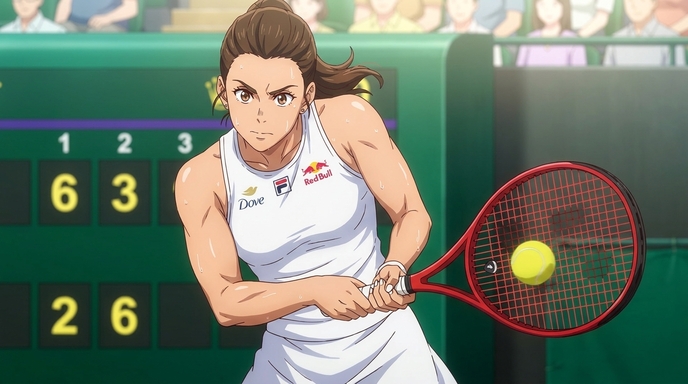
Tennis anime operates on a different structural logic than team sports anime. There is no bench to fall back on, no captain to absorb half the responsibility, no tactical substitution that changes the shape of the game. When a player walks onto the court, everything that happens from the first serve to the final point is entirely between two people, and the audience feels that compression in a way that almost no other sports format can replicate. The Prince of Tennis understood this and built an entire genre around it. If you have been developing a tennis anime concept, whether it is a gritty grand slam circuit story or a high school prodigy arc, this guide is the complete production pipeline that takes it from premise through storyboarded match climax.
This guide covers every stage of building an original tennis anime in AutoWeeb: protagonist and rival design, coach archetypes, signature play styles, tournament circuit structure, court and venue environments, training arc scripting, match storyboarding, and AI animation for the moments that carry the most kinetic weight. The character sheets built in step two are the same visual references powering the championship final storyboard panels generated in step five. Nothing gets reconstructed between sessions.
Step 1: Design Your Protagonist, Tournament Circuit, and Series Premise
Tennis anime protagonists work best when their play style is an expression of something specific about who they are, not just a technical attribute. Before designing a single character, define the central dramatic question your series is built around. A protagonist who wins through relentless baseline aggression is making a different argument about what tennis requires than a protagonist who survives through touch, placement, and the ability to read every opponent two shots ahead. That argument is your series' spine.
Choose a tournament circuit that fits the scale of story you are building. A single high school prefectural tournament creates a compressed, intense arc where every opponent is a specific test designed to strip away the protagonist's assumptions about their own game. A full professional grand slam circuit allows for a multi-season structure where the protagonist faces the same top-ranked rivals across multiple surfaces, each surface reframing the rivalry. The circuit is not backdrop. It is the set of rules that makes the dramatic situations possible.
Build your series premise as a single concrete sentence that contains both a specific clock and a specific cost. Not "a young player tries to become the best," but something like: "A technically gifted baseline player who has never won a tiebreak under pressure has one final junior circuit season to prove they belong in the professional draw." The clock is the junior circuit season. The cost is the specific failure that has defined them. Everything else in the series is an argument about whether that cost is permanent.
In AutoWeeb's writing workspace, save the tournament bracket or circuit structure as a project document before designing any characters. The structure tells you which opponents the protagonist needs, which rounds carry which emotional weight, and how many rivals require full character sheets versus named appearances only.
Step 2: Design Your Protagonist, Rivals, and Coaches
Tennis anime character design needs to communicate play style visually before a single ball is struck. A serve-and-volley player who never lets a rally develop into a baseline exchange has a different physical presence than a counter-puncher who absorbs everything and redirects it. Design the protagonist's silhouette, build, and court posture to match their game before choosing visual details like hair and uniform.
Example protagonist prompt: "Female tennis player, late teens, lean and compact build with precise athletic posture, dark hair pulled back in a tight bun with a few strands loose at the temples, sharp focused eyes with a slight intensity behind the calm. Wearing a white sleeveless tennis dress with a thin orange stripe at the hem and collar, holding a red-framed racket across her body at rest. Expression is controlled and slightly unreadable, like someone who processes pressure internally. Standing at the baseline, weight slightly forward. Anime style, shonen energy, grass court backdrop at golden hour."
Rivals in tennis anime carry more structural weight than in team sports because every match is one-on-one. Each rival should represent a specific answer to the question the protagonist cannot yet answer. A rival whose power game exposes the protagonist's lack of physical dominance creates a different crisis than a rival whose tactical precision dismantles every pattern the protagonist has built their game around. Design the contrast in play style before designing any visual details, because the visual design should express the contrast.
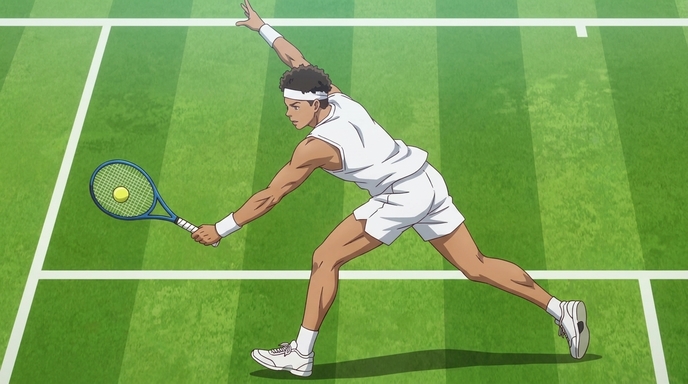
Example rival prompt: "Male tennis player, early twenties, tall and physically imposing, close-cropped curly hair, calm expression that reads as complete baseline confidence. Wearing a white Wimbledon kit, standing at the ad court baseline mid-swing on a backhand follow-through, full extension, body rotating through the shot. The kind of player whose shot quality is visible in the preparation, not just the contact. Anime style, professional circuit energy, indoor arena court with overhead lighting."
Coaches deserve as much design attention as rivals. The coach who taught the protagonist everything they know and is now facing the limitation of that knowledge, the former top-ten player who retired injured and sees in the protagonist the match they never finished, the methodical tactician who communicates entirely through data and has never learned to address what the data cannot explain: each coach archetype creates a different kind of tension with the protagonist that feeds directly into the match storylines. Design the coach's visual contrast with the protagonist deliberately. The visual relationship between them should communicate something about the nature of their dynamic before either character speaks.
Step 3: Build Signature Play Styles, Courts, and Tournament Venues
Signature techniques are the vocabulary of tennis anime storytelling. Every named technique should be visually distinctive enough to read at a glance in a storyboard panel and specific enough to express something about the character who uses it. A serve with a distinctive ball toss and a specific wind-up tells the audience more about the server than the technical description of what the ball does. Build each named technique as a visual moment first, then write the tactical explanation the commentator delivers when it appears.
For play style consistency across episodes, save AutoWeeb character sheets that include both the character's court posture and their two or three signature shot positions. The protagonist in a baseline rally, the protagonist at the net, the protagonist mid-serve: these three reference positions mean every match sequence drawn from the same project library maintains the visual consistency that makes a signature style recognizable across dozens of panels.
Court and venue design carry as much narrative weight as character design in tennis anime. Surfaces change everything: the slow red clay of a grand slam clay court that extends rallies and exposes the physical limitations of serve-dominant games, the fast grass of Wimbledon that rewards precision and rewards the player who gets to the net first, the medium-paced hard court of the US Open that plays almost neutrally and makes the rivalry purely about shot quality rather than surface advantage. Build a distinct visual reference for each surface your tournament arc uses.
Example clay court venue prompt: "Wide angle, major tennis stadium, clay court surface, afternoon. The rust-red clay visible in contrast to the white lines, stadium seating rising steeply on all four sides, a packed crowd in the upper tiers. Warm late-afternoon light casting long shadows across the court. The net posts and baseline visible in a single frame, the scale of the stadium making the empty court look enormous before play begins. Anime style, cinematic grand slam atmosphere."
Tournament bracket venues should escalate in visual scale and atmosphere. The early-round match in a smaller outer court where only a few hundred spectators are present reads completely differently from a quarterfinal on the main stadium court with 15,000 people watching. The protagonist's first time walking out onto a main court should be a distinct visual beat that communicates scale. Build the outer court reference first, then the main court reference, and design the visual contrast deliberately.
Step 4: Write Training Arcs and Match Scripts
Training arcs in tennis anime serve a different structural function than tournament matches. The match asks whether the protagonist can execute. The training arc asks whether the protagonist is willing to change. Those are different questions, and the best training arcs make the distinction explicit: the protagonist has to give something up, not just add something new. A player who has always relied on their forehand dominance learning to construct points from the backhand side is not just adding a shot. They are accepting that their existing game has a ceiling.
Structure training arcs around a specific failure from the previous tournament that the training is designed to address. The failure should be precise: not "they lost," but "they lost the third set of the quarterfinal because they could not hold serve at 5-4 under pressure, and it happened exactly the same way it happened in the semifinal two years earlier." That specificity makes the training scenes legible as progress rather than activity. Every drill scene should map to the specific failure being repaired.
Scripting Intense One-on-One Match Sequences
Tennis match scripts run on two simultaneous tracks. The technical track covers what each player is trying to do tactically: the server's pattern of play, the returner's adjustment at the changeover, the moment in the second set when one player stops doing what was working and the other player notices. The emotional track covers what the match is asking of each player as a person: whether the protagonist trusts the game they have built, whether the rival is playing to win or playing not to lose, whether the coach on the sideline is seeing what the player cannot.
Plan each match in three beats: the opening phase where each player establishes their game and the tactical situation becomes clear, the crisis point where the protagonist's weakness is exposed and the match turns against them, and the resolution phase where the protagonist either adapts or does not. The resolution does not have to be a victory. Some of the best match episodes in sports anime end with a loss that has changed the protagonist more than a win would have.
For scripting in AutoWeeb's writing workspace, draft each match in parallel columns: the point-by-point tactical arc, the five storyboard-priority action beats, and the emotional through-line that determines what the episode is actually about. If the emotional through-line is not specific enough to be answered by the end of the episode, rewrite it before generating any storyboard panels.
Step 5: Storyboard Dramatic Match Moments and Championship Arcs
Tennis anime generates its most distinctive visual moments from the geometry of the sport: the straight-line trajectory of a serve, the cross-court angle of a passing shot, the overhead smash in the center of the court with the stadium rising on all sides. These moments are built for storyboard panels because the composition practically writes itself. The challenge is not finding the dramatic visual. It is sequencing the panels so that the dramatic visual lands at the right moment in the narrative arc rather than just being spectacular on its own terms.
Slow-motion serves are the signature visual set piece of the genre. Design them as three-panel sequences: the wind-up and ball toss (the moment before commitment), the contact (the moment of commitment, where everything the player has is compressed into one frame), and the follow-through with the ball trajectory already established (the moment after, where the server is already reading the return). The middle panel should carry enough visual information that it would work as a standalone image even without the sequence around it.
Example slow-motion serve storyboard prompt: "Tennis serve sequence, slow motion panel. Player in white kit, right arm at full extension overhead, racket making contact with a yellow ball at the peak of the toss. Ball slightly compressed from impact, visible spin blur on the seams. Left arm counterbalancing below. Court surface in the lower frame, net visible in the middle distance. Stadium crowd out of focus in the background, bright arena lighting. Camera angle slightly below the contact point looking up, making the player and the stadium frame visible in a single image. Anime style, impact frame energy, speed lines radiating from contact point."
Comeback sequences require a specific storyboard structure: the moment of maximum deficit (the score, the protagonist's expression, the crowd's response), the single shift where something changes in the protagonist's approach or mindset, and then the compressed rally sequence where the comeback takes shape. The shift scene is the most important panel in the comeback arc. It should be still, quiet, and composed in deliberate contrast to the kinetic panels around it.
Championship storylines need an additional layer of storyboard planning: the convergence of every character's arc into the final match. The coach who has never won a grand slam as a coach. The rival who has never lost a final. The protagonist who has never won a tiebreak under pressure. The championship storyboard is not just the match. It is the simultaneous resolution of every question the series has been building toward, and the panels should carry all of that weight without the need for additional dialogue to explain it.
Step 6: Generate Consistent Character Art and Animate Key Match Moments
With character sheets saved for the protagonist, every named rival, the coach, and the primary venue environments, AutoWeeb draws from a consistent visual library across the entire production. The protagonist at the baseline in the first-round match and the protagonist at the baseline in the championship final are visually the same player in the same kit under the same kind of pressure, not two approximations of the same description generated fresh for each session. That consistency is the operational difference between a storyboard production and a collection of well-executed individual images.
For AI animation, identify the moments per episode that carry the most inherent motion and will lose their primary meaning as still images: the serve from wind-up through contact to first bounce, the full extension reach for a wide backhand that the player does not know yet whether they will get to, the overhead smash mid-court with the crowd's energy visible in the composition. Write motion descriptions for each priority panel before moving to video generation.
Example tennis animation prompt: "Tennis serve animation, six seconds. Player in white kit visible from the right side of the frame. Wind-up begins at zero seconds, ball toss at two seconds, arm at full extension overhead. Contact at three and a half seconds, camera cuts to ball-level tracking shot as the serve crosses the net at four seconds, first bounce visible at five seconds. The trajectory line from racket to bounce is the visual spine of the clip. Crowd noise implied by composition scale. Anime style, slow motion on contact frame, speed lines on ball trajectory."
The complete AutoWeeb workflow from concept to animated sequence means the circuit structure defined in step one, the cast designed in step two, the play styles and venues built in step three, the training arcs scripted in step four, and the match storyboards planned in step five are all active resources in the project library when you generate championship animation in step six. Nothing gets rebuilt. The production carries forward.
AI-assisted storyboarding makes tennis anime pre-production achievable for solo creators and small teams in ways that traditional production timelines do not allow. Maintaining consistent character art across a full tournament arc with multiple opponents, multiple courts, and dozens of match scenes requires either a full character design team or constant manual reference management. AutoWeeb's character sheet system collapses that management overhead. The creative decisions remain yours. The infrastructure that executes them does not require a studio.
Frequently Asked Questions
Why does tennis work so well as a format for anime storytelling?
The one-on-one structure removes every variable except the two players. There is no teammate to share the burden, no tactical substitution to change the dynamic, no crowd momentum that belongs to a collective. When a tennis player is losing in the third set of a grand slam match, the entire situation is about whether one person can change something within themselves while the opponent is actively preventing exactly that. That degree of isolation and psychological pressure is extremely legible as drama, which is why the genre has produced such consistently intense matches even in series that are not primarily about realism.
How many rivals should I design for a tennis anime?
A first season works with three to four rivals who each represent a distinct test for the protagonist: one who outpowers them, one who outthinks them, one who plays an entirely different style that the protagonist has no established response to, and one returning rival from before the series began whose history with the protagonist carries emotional weight the new opponents cannot. Build full character sheets for the top-seeded rival and the final opponent before scripting the tournament bracket. Secondary opponents can be designed closer to the episodes where they appear, with less extensive character sheet development.
How do I make each court surface feel visually distinct?
Build a dedicated venue reference for each surface in AutoWeeb before generating any match panels. Clay courts need the rust-red surface color, the distinctive scuff marks left by sliding footwork, and the heavier baseline-oriented atmosphere of the Roland Garros-style arena. Grass courts need the saturated green surface, the sharp court lines, and the Wimbledon-specific visual language of white uniforms against green. Hard courts carry a different neutrality: the surface color can vary and the stadium architecture is less historically coded, which gives you more design freedom. Save each surface reference with a named note in the project library and use it consistently for every match on that surface.
How do I write a training arc that does not slow the series down?
The training arc slows down when it is about adding capability without cost. The training arc accelerates when it is about the protagonist giving something up in order to become something different. Tie every training arc directly to a specific failure from the previous tournament: identify the exact point where the protagonist's current game stopped being enough, and design the training arc as a direct response to that exact moment. The audience will track progress because they know precisely what is being repaired. Side-step the tendency to show the protagonist getting better in general. Show them getting better at the one specific thing that beat them last time.
How do I design a championship storyline that feels earned?
A championship storyline feels earned when the final match is the natural convergence of every character arc that has been running through the series, not a match with higher stakes than the previous ones. The protagonist facing their final opponent should be a situation where every unresolved question from the series is on the court at the same time. The coach's personal history with the opponent, the protagonist's specific failure that the training arc addressed, the rival's one vulnerability that the protagonist discovered in a previous match and has been waiting to use: all of it should be active in the final. If the final can only be understood as a tennis match and not as a resolution of the series' central dramatic question, the preceding episodes did not build toward it specifically enough.
Can I animate serve sequences and rally exchanges in AutoWeeb?
AutoWeeb supports both storyboard panel generation and AI video generation. For tennis anime, the moments that carry the most value as animation are the ones with a clear physical arc and a defined start and end point: the serve from wind-up through ball contact to first bounce, the full-extension reach for a passing shot, the overhead smash from the jump to the ball contact. Still panels work efficiently for the tactical and emotional beats: the changeover conversation, the coach's expression mid-match, the close-up of a player's grip adjusting before a big point. Writing motion descriptions as part of the storyboarding step means animation prompts are ready to execute the moment you move to video generation.
How does AutoWeeb maintain character consistency across a full tournament arc?
The character sheet system in AutoWeeb means the visual reference built when you first design the protagonist, including their court posture, kit details, racket frame, and signature shot positions, is the same reference active when you generate storyboard panels for the championship final six sessions later. The protagonist in round one and the protagonist in the final are visually the same person because both panels draw from the same saved reference rather than from a new description approximating the original. For a tournament arc with multiple opponents across multiple surfaces, that consistency eliminates the revision cycle that typically dominates the middle phase of solo pre-production.
For the broader framework of building any sports anime series from concept through production pipeline, the guide on how to create your own sports anime series with AutoWeeb covers sport selection, rival structures, training arc design, and tournament construction in detail. If you are planning the match climax storyboards and want to sharpen your composition and shot sequencing, how to storyboard epic AI anime fight scenes like a director covers impact frames, camera angles, and pacing techniques that apply directly to intense tennis match sequences.
Related Blog Posts
The Ultimate AI Anime Pre-Production Checklist for Creators
A phase-by-phase production checklist covering everything from story development to final editing, built for creators using AI tools to produce original anime.
Complete AI anime pre-production checklist for creators. Covers story development, character design, storyboarding, image generation, and video production with AutoWeeb.
Turn Manga Panels Into an AI Anime Storyboard in Minutes
Converting manga storytelling into animation-ready sequences requires rethinking pacing, camera movement, and scene structure. Here's how to do it in AutoWeeb.
Learn how to convert manga panels into an AI anime storyboard using AutoWeeb. Step-by-step tutorial covering scene planning, camera angles, character setup, and video prep.
How to Storyboard Epic AI Anime Fight Scenes Like a Director
A director-level guide to planning, composing, and pacing anime fight scenes for AI animation, covering shot types, fight choreography, impact frames, and the complete storyboarding workflow in AutoWeeb.
Learn how to storyboard AI anime fight scenes like a professional director. Master shot composition, fight choreography, pacing, and impact frames for shonen, martial arts, fantasy, and sci-fi styles.
From Idea to Anime: Why AutoWeeb Is the Best AI Anime Pre-Production Studio
AutoWeeb replaces the entire traditional anime pre-production pipeline with a single AI-powered workspace, so solo creators and small teams can take a story from concept to production-ready storyboard without switching tools.
AutoWeeb is the best AI anime pre-production studio for solo creators. Cover script writing, character sheets, storyboards, and video generation in one AI anime workflow.
Explore AutoWeeb
Jump into the tool that fits your creative step.
AI Anime Video Generator
Animate storyboard shots into cinematic clips with Seedance 2 and consistent characters.
Anime Character Creator
Design original characters with consistent sheets across every scene.
AI Anime Image Generator
Generate cinematic anime stills anchored to your character library.
Turn Photo Into Anime
Upload any photo and watch AI turn it into stunning anime art in seconds.
AI Anime Location Generator
Create a location set once, then generate reference images from every angle.
AI Anime Storyboarding
Describe your idea, pick your characters, and let AI draft the script and scenes.
AI Anime Prompt Agent
Turn a rough idea into a cinematic Seedance 2 prompt with the AI Director.