How to Write Better AI Anime Image Prompts for Consistent Results
The gap between a vague output and a character that looks the same every time almost always lives in how the prompt was written.
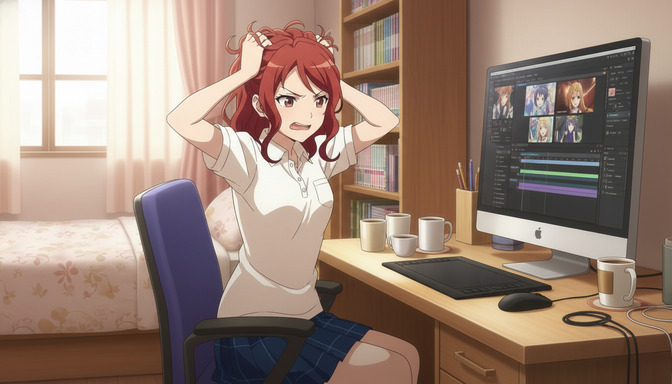
Every AI anime image prompt starts with words and ends with a picture. The frustrating part, for most beginners, is the distance between the picture in your head and the picture on the screen. You type "anime girl with red hair" and get something that does not match what you imagined: the hair color is wrong, the expression is off, the background is whatever the model chose. That gap is not a model problem. It is a specificity problem. This guide covers every element that separates a vague prompt from one that produces consistent anime character art, with before-and-after examples throughout and a framework you can apply immediately.
Why specificity matters more than length.
A long prompt is not the same as a specific prompt. You can write two hundred words of mood adjectives and still leave every visual decision up to the model. Specificity means naming the exact thing you want, not the feeling the thing should produce. "Striking eyes" is a feeling. "Upturned amber eyes with a thin black limbal ring" is a visual instruction. The model generates what it is told, and when it is told something vague, it fills in the gap with whatever version of that vague thing appears most often in its training data.
This is why two people can use the same short, atmospheric prompt and get completely different results. The model is not being inconsistent. It is answering an underspecified question with the statistically most likely answer, and that answer varies by generation. The fix is not to fight the model's defaults but to replace them with your own instructions. Specific colors, specific proportions, specific expressions, specific clothing, specific light sources. Every detail you name is a decision the model does not have to make on your behalf.
Specificity also compounds. A prompt with five precise details produces more consistent results across generations than a prompt with fifteen vague ones. Start with the elements that matter most to you, describe them with precision, and add detail in layers rather than all at once.
How to write a character description that actually generates what you imagined.
Character description is where most beginners both start and stop. They name the hair color and eye color, then move on. That is two attributes out of dozens that define what a character looks like. A complete character description covers physical features, expression, and the relationship between them.
Physical features.
Hair needs a color, a length, and a style. "Long red hair" produces wildly different results than "waist-length crimson hair worn in a loose side braid with flyaways." Eyes need a color, a shape descriptor, and an emotional register: "wide steel-gray eyes with long lashes and a slightly downcast angle" reads differently than "narrow jade eyes, half-lidded, with a calm directness." Skin tone should be named specifically, not relatively. Face shape, jaw line, and build matter for stylistic consistency across multiple generations of the same character.
Named colors consistently outperform generic ones. "Honey-gold eyes" beats "yellow eyes." "Ash-brown hair" beats "dark hair." The model has more training context for named color-object pairings and generates them with higher fidelity.
Expression and pose.
Expression should be written as physical state, not emotional label. "Happy" produces a smile. But which smile: a wide open grin, a soft closed-mouth smile, a smirk, a smile that does not reach the eyes? "A faint, knowing smile, eyes slightly narrowed, one brow lifted" produces a readable, specific expression that the model can generate consistently. Pose follows the same rule: not "confident stance" but "arms crossed at the chest, weight shifted to the right hip, chin lifted slightly."
Clothing and accessories: the details most beginners skip.
Clothing is where anime character design lives. Two characters with identical face descriptions read as completely different people when you change their outfits. Describing clothing well means naming the garment type, the color, and any distinctive material or construction detail. "A white school uniform" is a start. "A white long-sleeve collared shirt with a dark navy sailor collar and a matching navy pleated skirt, knee-length, with a red ribbon tie at the collar" is a character.

Accessories should be listed individually. A single earring, a bracelet, a hair clip, a keychain on a bag strap, each of these reads as a distinct visual element and contributes to the character's uniqueness. The model handles lists of small accessories well when they are named specifically. "A thin silver chain bracelet on the left wrist" is something the model can place. "Some accessories" is not.
Layering matters too. "A dark hoodie over a white t-shirt" is two pieces of clothing that interact with each other. The collar of the t-shirt visible above the hoodie neckline is a detail that makes the clothing read as real and lived-in rather than painted on. Seasonal layering, a coat worn open over a school uniform in autumn, a cropped jacket over a dress, adds depth and specificity to the character's look across generations.
Lighting and atmosphere: how a scene feels before anything moves.
Lighting is the single most powerful variable in setting the emotional register of an anime image, and it is the element most beginners leave entirely to the model. A character description can be identical across two prompts; change the lighting and you change whether the result reads as warm, threatening, melancholy, or triumphant.
Name the light source and its position. "Golden late-afternoon sunlight from the right, casting long shadows across the ground" gives the model a specific physical setup. "Dramatic lighting" is a response to a result, not an instruction for how to create one. Common light sources that produce reliably different atmospheres: late afternoon sun (warm, long shadows), blue-hour dusk (cool, soft, transitional), overcast noon (flat, neutral, melancholy), firelight (orange, flickering, intimate), and moonlight (cold, directional, high-contrast).
Atmosphere adds the environmental layer on top of light. Cherry blossoms falling, light rain on a window, morning fog at ground level, dust motes in a beam of light through curtains. Each of these is a named particle or weather system that the model can render consistently. Atmospheric detail is not decoration. It is context that tells the model how to set the entire scene, including how the light interacts with the environment.
Camera angles and composition: what the viewer sees and how.
Camera angle is a compositing decision that most image prompt beginners forget to make. The same character, in the same setting, with the same lighting, reads entirely differently depending on where the imaginary camera is placed.
Shot types to name: close-up (face and shoulders only), medium shot (waist up), three-quarter shot (mid-thigh up), and full body (head to feet). Each has a different relationship to the character and a different emotional effect. Close-ups read as intimate or intense. Full body shots read as establishing or revealing. Camera height changes the power dynamic: a low angle looking up at a character produces authority and scale; an overhead angle looking down produces vulnerability or surveillance.
Framing decisions also include background relationship. "Character centered against a blurred background" is a composition choice. "Character in the lower-left third of the frame, the full background in sharp focus behind her" is a different composition choice that produces a completely different image. Rule-of-thirds placement, negative space, foreground elements that frame the subject: these are all nameable decisions that change what the image looks like and what it communicates.
Choosing an art style: the shortcut that sets everything else.
Naming a specific anime art style is the single highest-leverage instruction in an image prompt. It sets the linework, the color palette, the proportion conventions, the shading style, and the overall visual register in one phrase. "Ghibli style" invokes soft linework, muted naturalistic colors, and round proportional faces. "Demon Slayer style" invokes bold black outlines, high-contrast dramatic lighting, and detailed pattern work on clothing. "Slice of life anime style" invokes lighter line weights, warm pastel palettes, and naturalistic proportions.
You can also describe style components directly if you want something more original: "clean precise linework, muted earth-tone palette, slightly realistic proportions, flat cel-shading with minimal shadow gradients." That description assembles a style without referencing a specific series, which is useful when building an original character identity rather than placing a character within an existing aesthetic.
AutoWeeb's art style library gives you direct access to specific anime aesthetics without needing to describe them from scratch, which is useful when you have a clear reference in mind and want consistent results. If you are still exploring which styles suit your character, the guide on choosing the right genre before storyboarding covers the visual logic behind major anime genres and how they map to character design choices.
Common prompting mistakes and what they produce.
Writing mood instead of detail.
"Mysterious," "ethereal," "epic," "stunning" — these are descriptions of a viewer's reaction to an image, not instructions for generating one. The model treats them as weak genre signals and fills in the visual specifics from its own defaults. Replace every mood adjective with a concrete visual detail. What does "mysterious" look like? Probably: a shadowed face, a partial view obscured by a doorframe, eyes that are visible but a mouth that is not. Write those things.
Contradictory elements.
A prompt that asks for "intense direct sunlight" and "soft diffused lighting" in the same image produces an incoherent light setup. A character described as "shy and withdrawn" posed in a "bold, powerful heroic stance" creates a tension the model resolves by averaging, producing something that reads as neither. Contradictions in the prompt produce visual averaging, not creative compromise. Audit your prompt for conflicting instructions before generating.
Stacking quality keywords instead of visual instructions.
"Masterpiece, best quality, ultra-detailed, 8K, highly detailed, sharp, vivid, professional" — these tokens are a habit borrowed from older static-image-generation workflows and they eat prompt space that should be occupied by visual instructions. They rarely improve output quality in modern models and they dilute the specificity of everything else in the prompt. Cut them, and use the space for one more precise detail about the character, the lighting, or the background.
Ignoring the background entirely.
A character generated without a background instruction floats in whatever the model default-selects, which is usually a gradient or a blurred generic environment. The background is half the image. It tells the viewer where the character is, what time of day it is, and what the character's world looks like. Even a simple background instruction, "standing in a sunlit school courtyard, stone tiles, a cherry tree visible in the background," produces a much more coherent and consistent image than a character on a neutral backdrop.
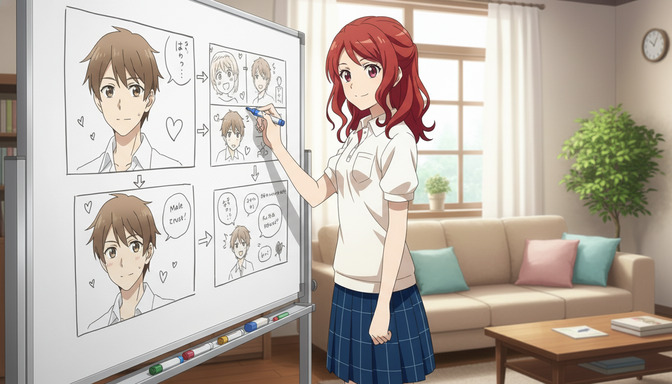
Before and after: weak prompts versus strong ones.
Reading the gap between a weak and a strong prompt in context is more useful than describing the gap in theory. These examples cover the most common image types beginners attempt.
Character portrait.
Weak: "Anime girl with red hair, pretty, sad, beautiful eyes."
Why it fails: "Pretty," "sad," and "beautiful" are viewer-reaction words. Hair color is named but length, style, and shade are not. Eyes are described by reaction rather than by appearance. The model generates the statistically most common "sad anime girl" and the result looks like dozens of other outputs.
Strong: "Bust-up portrait of a teenage girl, waist-length deep crimson hair with soft waves and loose strands framing the face, pale skin, wide downcast rose-pink eyes with long lower lashes, lips slightly parted, expression of quiet resignation. Soft overcast daylight from the left. Blurred rain-streaked window in the background. Slice-of-life anime style, clean linework, muted cool palette."
Why it works: every significant visual decision is made. Hair color, length, and movement. Eye color, shape, and direction. Expression described as a physical state. Light source named and placed. Background adds context without competing with the subject. Art style sets proportions, linework, and palette.
Action character.
Weak: "Cool anime warrior, epic pose, dramatic, powerful, fantasy setting."
Why it fails: "Cool," "epic," "dramatic," and "powerful" are reactions. "Fantasy setting" is a genre, not a location. The model produces a generic armored figure in a generic fantasy background with generic dramatic lighting. Nothing about it is distinctive.
Strong: "Full-body illustration of a young woman in layered dark leather armor with silver pauldrons and bracers, short-cropped silver hair windswept to the right, sharp golden eyes narrowed in focus. Standing with sword held low at her right side, weight forward on her left foot, about to move. Low-angle camera looking upward at her. Crumbling stone fortress wall behind her, late afternoon sun from behind and above casting her face into partial shadow. Demon Slayer art style, bold outlines, high contrast."
Why it works: armor, proportions, hair, and eyes are all specific. The pose describes a physical state the model can render. Camera angle is named and positioned. Background gives a location with specific architectural detail. Light source interacts with the character's face in a described way. Art style locks the visual register.
Scene with two characters.
Weak: "Two anime friends sitting together, cute, happy, school setting."
Why it fails: no physical description for either character, no spatial relationship, no background specifics. The model invents two generic characters in a generic classroom. Nothing distinguishes them or the setting.
Strong: "Two girls sitting side by side on a school rooftop railing at sunset. Left: short black bob with blunt bangs, dark brown eyes, laughing with eyes crinkled shut, in a gray uniform blazer. Right: long strawberry-blonde twin tails, green eyes, smiling softly with a bento box on her lap. Orange-gold sunset light from the left, city skyline blurred in the background. Medium wide shot, eye level. Slice-of-life anime style."
Why it works: each character has distinct physical descriptions. Their expressions are written as physical states. Spatial relationship and setting are defined. Light source and background are both placed. Camera framing is named.
Environmental scene without characters.
Weak: "Beautiful anime forest, magical, mysterious, ethereal light."
Why it fails: "Beautiful," "magical," "mysterious," and "ethereal" are all reactions. There are no specific visual elements, no light source, no weather, no ground cover. The model produces the generic "glowing forest" result.
Strong: "A narrow forest path through tall cedar trees with thick moss-covered roots spreading across the ground. Morning light filters down in distinct shafts through a high canopy, catching floating dust motes. A shallow stream runs alongside the path on the left, reflecting the canopy light. No characters. Muted green and gold palette, soft diffused light. Ghibli art style."
Why it works: path, trees, roots, stream, and canopy are all named elements. Light source and direction are specific. The reflective surface (stream) gives the model a light-interaction instruction. Color palette and art style are named.
For building the character whose portrait you are prompting, the guide on creating your own anime character covers the design decisions that translate directly into prompt language. If you are working toward a full visual narrative rather than individual images, the guide on generating story ideas before storyboarding shows how consistent character descriptions anchor an entire visual series.
Frequently asked questions about AI anime image prompts.
How long should an AI anime image prompt be?
Long enough to cover the decisions that matter most to you, and no longer. Most effective prompts run between forty and one hundred words. Under forty usually means key decisions are left to the model. Over one hundred usually means there are quality modifiers or repeated descriptors taking up space. If you had to cut your prompt to sixty words, what would you keep? Those are your essential elements.
How do I get the same character to look consistent across multiple generations?
Write a fixed character description block, the same physical features in the same order, and use it as the foundation of every prompt. Vary the pose, lighting, expression, and background across generations but keep the character description identical. Consistency in the prompt produces consistency in the output. If a specific detail, like a distinctive eye shape or a particular hair color shade, keeps varying, name it more specifically. "Crimson" is more stable than "red." "Slightly upturned almond-shaped eyes" is more stable than "pretty eyes."
Should I name a specific anime series as my art style reference?
Yes, when you have a clear visual target. Naming a specific series sets linework, proportion conventions, shading style, and color palette in one phrase. If you want something original and not tied to an existing aesthetic, describe the style components directly: line weight, shading method, color palette mood, proportion style. Both approaches work. Referencing a specific series is faster when the match is right. Building from components is more flexible when you are creating something new.
What is the most common mistake beginners make with anime image prompts?
Writing reactions instead of instructions. Words like "beautiful," "dramatic," "epic," and "mysterious" describe how a viewer feels about an image, not what the image contains. The model cannot generate a feeling. It can generate a specific face, a specific light source, a specific location, a specific expression. Replace every mood word in your prompt with the visual detail that produces that mood, and your results will immediately become more consistent.
Do I need to describe the background in every prompt?
If you leave the background unspecified, the model selects one. Sometimes that selection is fine. More often, the default background has nothing to do with your character's world and produces an image that feels internally inconsistent. A one-sentence background description, a location, a light source, and one environmental detail, is usually enough to produce a coherent scene. It also helps with consistency: a character always generated in the same described environment reads as belonging to that world rather than floating in a random backdrop.
Can I describe a character's personality in the prompt?
Indirectly, yes, but personality labels will not generate personality directly. The way to capture personality in an image is through physical state: posture, expression, the direction of the eyes, the set of the mouth, what the hands are doing. A character described as "confident and slightly guarded" needs a physical translation: "chin level, eye contact direct, arms loosely crossed, a faint skeptical narrowing of the eyes." The model generates the physical state. The viewer reads the personality from it.
How do I prompt for a specific emotion without it looking generic?
Break the emotion into its physical components. Sadness is not one expression: it can be a flat mouth and averted eyes, a trembling lower lip, a wet cheek, a distant gaze that does not focus on anything. Choose the variant of the emotion that fits your scene and describe the specific physical indicators. Two or three physical details produce a readable, specific emotional state far more reliably than the emotion label alone. The more granular the physical description, the more the expression reads as that particular character in that particular moment rather than a stock sad-face template.
Does AutoWeeb's anime character creator help with consistent prompting?
Yes. AutoWeeb's anime character creator builds a visual reference for your character that the AI uses to maintain consistency across generations without requiring you to re-describe every physical feature each time. Instead of writing a full character description in every prompt, you can build the character once and then focus the prompt on pose, expression, lighting, and scene. It is the most efficient path to consistent results for characters you intend to use across multiple images.
Related Blog Posts
Generate Story Ideas With AI Before Building Your Anime Storyboard
The storyboard cannot tell a story the idea never finished building. Start with inspiration, not panels.
Learn how to generate AI story ideas before you storyboard. Genre-first, character-first, world-first methods with examples for romance, action, horror, and more.
How to Create a Character Arc Before Storyboarding Your Anime Story
The character arc is not something you add after the storyboard. It is the decision that makes every panel in the storyboard necessary.
Learn how to create a character arc before storyboarding your anime story. Covers positive, negative, and flat arcs, internal vs external conflict, and character wants vs needs.
How to Pick Anime Story Tropes That Make Your Storyboard More Engaging
The story tropes that do not just decorate your script — they dictate every panel order, shot distance, and emotional beat on the storyboard.
Learn how to pick anime story tropes that strengthen your storyboard. A step-by-step framework covering character tropes, writing tropes, and story ideas with AutoWeeb.
How to Write a Script With AutoWeeb's AI Story Agent
The script is not a step you skip on the way to the storyboard. It is the map that makes every panel in the storyboard necessary.
Learn how to write a script with AutoWeeb's AI story agent. Complete workflow: story idea, genre, tropes, characters, script generation, scene refinement, and storyboard panels.
Explore AutoWeeb
Jump into the tool that fits your creative step.
AI Anime Video Generator
Animate storyboard shots into cinematic clips with Seedance 2 and consistent characters.
Anime Character Creator
Design original characters with consistent sheets across every scene.
AI Anime Image Generator
Generate cinematic anime stills anchored to your character library.
Turn Photo Into Anime
Upload any photo and watch AI turn it into stunning anime art in seconds.
AI Anime Location Generator
Create a location set once, then generate reference images from every angle.
AI Anime Storyboarding
Describe your idea, pick your characters, and let AI draft the script and scenes.
AI Anime Prompt Agent
Turn a rough idea into a cinematic Seedance 2 prompt with the AI Director.