Generate Story Ideas With AI Before Building Your Anime Storyboard
The storyboard cannot tell a story the idea never finished building. Start with inspiration, not panels.
Every storyboard that loses momentum at panel three has the same diagnosis: the story idea was never finished. A creator opened a blank canvas, generated something that looked visually interesting, and then discovered they had no idea what came next, because the idea had never answered what the story was actually about. Generating AI story ideas before you storyboard is not a preliminary step you get through to reach the real work. It is the real work. The storyboard's job is to deliver what the idea has already earned, and if the idea never earned anything, no amount of visual polish will compensate. This guide covers every method for generating cinematic-quality story ideas using AI, with concrete examples across every major genre, and shows how AutoWeeb's AI Story Agent converts those ideas directly into visual storyboard panels.
Why most creators struggle with blank-page syndrome.
Blank-page syndrome is not a creativity problem. It is an order-of-operations problem. Most creators who sit down to storyboard an anime short have more ideas than they know what to do with. The difficulty is that ideas arrive as impressions: a feeling, a character silhouette, a setting bathed in a particular kind of light. Those impressions are real creative material. They are not yet stories. The gap between "I have a feeling I want to capture" and "I know what this story is about" is the gap where blank-page syndrome lives.
The paralysis compounds because most creators try to cross that gap by generating more impressions, which is the wrong direction. More ideas do not solve the problem of not knowing what to do with the ones you already have. What actually dissolves the blank page is a structured decision about where the idea comes from: genre, character, world, theme, or trope. Each of those five entry points gives the impression a structural home, and a structural home tells you what the story needs next. Writing inspiration AI is most effective not when it replaces the creative instinct, but when it gives that instinct the framework to move.
The second cause of blank-page syndrome is trying to make every decision simultaneously. A creator who tries to choose genre, protagonist, setting, stakes, and visual tone in a single sitting before they have a working idea will stall every time, not because they are not creative enough, but because those decisions have a correct sequence and they are violating it. An AI story generator that separates those decisions into discrete steps eliminates the paralysis because it makes each choice small, specific, and bounded.
Why inspiration must come before storyboarding.
A storyboard is a sequence of answers to one question: what does this moment look like? But that question only has a correct answer if a prior question has already been settled: what does this moment need to accomplish? The storyboard answers the visual question. The story idea answers the functional question. Running them in the wrong order produces storyboards that look coherent panel by panel and fall apart as a sequence, because each panel was answered visually without knowing what it was supposed to do narratively.
In practical terms: a storyboard built from a finished idea takes a fraction of the time to generate, because every panel prompt has a clear purpose. A storyboard built without an idea generates twice as many panels, because half of them are corrections to panels that were pointing in a direction the story never intended. The investment in idea generation before storyboarding is not creative overhead. It is efficiency, built into the front of the process rather than the back.
There is also a cinematic quality difference. A storyboard built from a complete idea produces visuals that feel inevitable, each panel logically following from the last because it was assigned a job before it was generated. A storyboard built from a vague impression produces visuals that feel decorative, individually beautiful but collectively incoherent. Creative writing AI bridges that gap precisely because it can take a vague impression and help a creator arrive at a complete, actionable idea before a single panel is generated.
Five methods for generating story ideas with AI.
There is no single correct entry point for a story idea. The five methods below each start from a different anchor and use story prompts AI to build outward from that anchor into a complete, storyboard-ready premise. Use whichever method matches the impression you already have.
Genre-first.
Start with the emotional experience you want the audience to have: the heart-rate spike of action, the slow warmth of romance, the dread of horror. Genre is a structural container, not just a label. It tells you the pacing rules, the emotional register of the climax, and which story shapes are available to you. Once genre is locked, an AI story generator can surface the three to five premises that most naturally live inside it. This method works best when you know what you want the audience to feel but do not yet know what situation will produce that feeling.
Character-first.
Start with a person, or a function. A girl who inherits a debt she did not incur. A boy whose honesty is so absolute it reads as cruelty. A retired soldier who cannot stop calculating exit routes from every room she enters. Character-first idea generation uses the character's defining contradiction, the gap between what they want and what they need, as the engine that drives the plot. A creative writing AI given a character contradiction will generate the situations that pressure that contradiction until it breaks or resolves. This method produces the most psychologically specific stories, and psychological specificity is what separates anime that viewers remember from anime they finish once and forget.
World-first.
Start with a rule the world has that ours does not. Or a rule ours has that this world violates. Every world has a most interesting person in it, and every most interesting person has a problem only that world can produce. World-first idea generation uses the setting's defining constraint as the premise engine: what does this world make inevitable? What does it make impossible? A city where memories are taxable property. A school where students age backward during exam season. A country where apologies have legal standing but apologies made in writing are void. Give that world to an AI story generator and ask what kind of person would be most in conflict with its central rule. That person is your protagonist.
Theme-first.
Start with the question the story is asking, not answering. Theme is a question, not a moral. "Is loyalty a virtue when the person you are loyal to is wrong?" is a theme. "Loyalty is complicated" is not. Theme-first idea generation uses writing inspiration AI to surface the situation, character, and genre that make the question unavoidable. The question should be one the creator genuinely does not know the answer to, because a story that already knows its conclusion is not generating dramatic pressure from the theme but illustrating a conclusion the creator reached before the first panel.
Trope-first.
Tropes are tested structural shapes inside genre. They are not clichés. A cliché is a trope deployed without awareness of what it demands. A trope used with structural intention is the fastest path from premise to beat map, because the beat map is already embedded in the trope. Rivals-to-allies. The power-sealed protagonist. The reluctant witness. The cost-of-victory. Each of these has a known opening position, a known escalation shape, and a known resolution beat. Trope-first idea generation starts from the structural shape and uses story prompts AI to generate the specific premise that fills it with the most dramatic potential. For a full framework on trope selection, the guide on picking anime story tropes for storyboards covers the complete library.
AI-generated story ideas across seven genres.
What follows are complete, storyboard-ready story ideas generated using AI story ideas methodology across the seven major anime genres. Each example includes the entry method, the premise, and the core dramatic tension that gives the storyboard its through-line.
Romance.
Entry method: character-first. Premise: A girl who has spent four years writing anonymous letters to a classmate who she is certain will never notice her discovers, the morning of graduation, that he has been writing anonymous letters to someone he describes exactly as she would describe herself. Dramatic tension: she must decide whether to claim the identity before the moment closes, knowing that claiming it means admitting four years of hiding. Core storyboard beat: the letter in her hand, the clock, his silhouette at the school gate.
Fantasy.
Entry method: world-first. Premise: In a kingdom where magic is powered by personal cost, the most powerful mage in the country has already spent everything except the memory of one person, which she is saving as her last resort. The story begins the day that last resort becomes necessary. Dramatic tension: using the final memory means she will no longer know why she spent everything else. Core storyboard beat: her face before she speaks the name, and after.
Action.
Entry method: trope-first (power-sealed protagonist). Premise: A former tournament champion who voluntarily had his abilities sealed as a condition of his release from prison must protect a town under siege using only the fraction of strength that leaks through the seal when he is not paying attention to it. Dramatic tension: every tactical decision is a choice between controlling the leak and surviving the fight. Core storyboard beat: the moment the seal cracks visibly on screen, framed so the audience knows it before the character does.
Comedy.
Entry method: character-first. Premise: A student with an uncontrollable ability to narrate whatever she is observing as if reading from a dramatic novel is assigned as study partner to the most aggressively ordinary person in school, whose life she cannot stop making sound like the climax of an epic. Dramatic tension: the longer she narrates him, the more she begins to suspect he actually is one. Core storyboard beat: her narration appearing as visible text in the frame while he eats a sandwich with complete composure.
Horror.
Entry method: theme-first. Question: what does it cost to be the person who notices? Premise: A girl who can see the moment a person has decided something irreversible follows a classmate through three days after noticing the mark on him, trying to identify what the decision was before it executes. Dramatic tension: the closer she gets, the less certain she is the decision is his. Core storyboard beat: the mark appearing on someone she did not expect, in the final panel.
Slice-of-life.
Entry method: world-first. Premise: A small repair shop at the edge of a university district that fixes objects with emotional damage rather than physical damage, run by a third-year student who has become accidentally good at understanding what broken things were for, through a series of customers who do not know how to explain what they have lost. Dramatic tension: the student who fixes everyone else's broken things has one of her own she has not been able to open. Core storyboard beat: the shop at closing, a specific object on the shelf she has never touched.
Sci-fi.
Entry method: genre-first. Premise: A junior analyst at a company that sells synthetic memories discovers that one of the product library's bestselling memories, "first snow, age seven, genuine," belongs to a real person, still alive, who has no recollection of it. Dramatic tension: tracing the memory back means understanding how it was extracted without the owner's knowledge, which means understanding what else was taken. Core storyboard beat: the analyst watching the memory play back in the preview room, the real person's face on screen, a face she has seen before.
A framework for evaluating whether an idea is worth storyboarding.
Not every idea that feels interesting in the moment is ready to storyboard. The following four tests identify whether a premise has enough structural integrity to support a complete panel sequence. An idea that fails two or more of these tests is not a bad idea. It is an incomplete one, which means it needs more generation work before it becomes storyboard material.
The stakes test. What does the protagonist lose if the story goes wrong? "She fails to confess" is a stake. "He does not figure it out in time" is a stake only if you can specify in time for what and what happens when the time expires. A stake that cannot be made specific is a feeling, not a structural element. If you cannot name the loss, the story has not earned its tension yet. A story prompts AI asked to specify the stakes on a vague premise will surface two or three concrete options that turn the feeling into a mechanism.
The opposition test. What is working against the protagonist? It does not need to be a villain. It can be a misunderstanding, a physical limitation, a social structure, a prior decision, another character's legitimate competing interest. If the answer to "what is working against the protagonist" is "nothing, they just need to find the courage," the story has no engine. Courage without opposition is not drama. It is a monologue.
The change test. What is different at the end of the story compared to the beginning? The change can be internal: the protagonist now believes something they did not believe at the start, or no longer believes something they once held as certain. It can be external: a relationship is different, a situation is resolved, an irreversible thing has happened. If you cannot specify the change, the story is not a story yet. It is a scene, possibly a beautiful one, but not a complete arc.
The visual test. Can you describe three moments from this idea that would produce distinct, non-interchangeable images? A romance where two people talk in a classroom for six panels has failed the visual test. A romance where the first panel is a letter slid under a door, the third is two people realizing simultaneously from opposite ends of a hallway, and the sixth is a held hand at the edge of frame has passed it. AI story ideas that pass the visual test are those where the emotional content of the story has been distributed across physical, stageable moments, not stored entirely in internal states that have no visual equivalent.
How AutoWeeb's AI Story Agent helps creators discover tropes and convert them into visual storyboards.
AutoWeeb's AI Story Agent is built for the exact sequence this guide describes: from raw impression to storyboard-ready idea to panel-by-panel visual output, without requiring any prior screenwriting or storyboarding experience. The agent is not a general-purpose AI story generator. It is a structured creative collaborator that understands anime narrative architecture specifically: the difference between shonen pacing and slice-of-life pacing, the emotional grammar of specific tropes, and the visual demands of each genre at each arc position.
At the idea generation stage, the agent accepts any of the five entry methods described above. Type a character contradiction and it returns the genre containers and tropes that best fit that contradiction. Type a world rule and it identifies the protagonist most likely to be in conflict with it. Type a genre and it surfaces the premises with the most inherent dramatic pressure for that genre's structural demands. The agent is not generating randomly from a keyword. It is running the structural logic of anime storytelling forward from whatever entry point you provide.
Once an idea passes the four evaluation tests, the agent builds the trope map. Each trope it recommends comes with a beat sequence: what happens first, what escalates, what the resolution moment looks like, and what each of those beats demands from the storyboard visually. A confrontation beat in a supernatural thriller calls for different framing than a confrontation beat in a comedy. The agent produces those visual specifications as part of the trope map, so the leap from story idea to panel prompt is immediate rather than requiring manual translation.
The storyboard conversion step takes each beat in the trope map and generates a panel description that knows its arc position. Shot distance, character placement, lighting direction, environmental detail, and emotional register are all specified before the panel is generated, producing a storyboard where every image was assigned a job before it existed. The result is coherent not because the panels match stylistically, though they will, but because each panel is serving the beat it was generated to serve. For the full workflow from story idea through script to storyboard panels, the guide on writing a script with AutoWeeb's AI Story Agent covers the complete eight-step process. For the genre decision that shapes which ideas are structurally available to you, the post on choosing the right genre before an AI storyboard walks through every genre and its panel demands.
Frequently asked questions about generating anime story ideas with AI.
What is an AI story generator and how does it work for anime?
An AI story generator for anime is a tool that takes a starting point, a genre, a character, a world rule, a theme, or a trope, and produces a structurally complete story premise with dramatic tension, opposition, and a specified arc. Unlike general-purpose AI writing tools, an anime-specific story generator applies genre logic: it knows which premise shapes work inside which genre containers, which tropes produce which beat sequences, and what the visual demands of each arc position are. AutoWeeb's AI Story Agent operates at this level, producing premises that are ready to evaluate against the four-test framework and convert directly into storyboard panel prompts.
What are story prompts AI and how do they differ from regular writing prompts?
Regular writing prompts give you a starting situation: "write a story about a girl who discovers a hidden door." Story prompts AI gives you a structurally complete premise: the situation, the protagonist's defining contradiction, the opposition, the stakes, and the specific change the story delivers. The difference is the difference between a seed and a seedling. A seed requires everything; a seedling has already done the first structural work. An AI story agent generates story prompts at the seedling level, so the creator's effort begins at evaluation and refinement rather than at raw generation.
How do I know if my AI story idea is ready to storyboard?
Run it through the four-test framework: the stakes test (what does the protagonist lose if it goes wrong), the opposition test (what is actively working against them), the change test (what is measurably different at the end), and the visual test (can you name three distinct, non-interchangeable images the idea requires). An idea that passes all four tests is storyboard-ready. An idea that fails one or two tests needs more generation work, not more inspiration. Ask your AI story generator to specify the failing element: "what are the stakes if she does not succeed" or "what changes for her by the final scene."
Can I use writing inspiration AI if I already have a visual in mind but no story?
Yes, and this is one of the most effective use cases. Describe the visual: the mood, the color temperature, the character's posture, the environment. A writing inspiration AI reads that description and identifies what kind of moment it is structurally: a revelation, a confrontation, a quiet before a climax, an aftermath. From that structural identification, it can generate the story backward and forward from that moment, producing the idea that the visual was instinctively reaching for. The visual becomes the anchor for the idea rather than a substitute for it.
Which story generation method works best for short-form anime storyboards?
Trope-first is the most efficient method for short-form content, specifically for storyboards of six to twelve panels. A trope's beat sequence is already compressed to its essential moments, which maps directly onto the panel count available in a short. Rivals-to-allies in six panels requires one confrontation panel, one forced cooperation panel, one turning-point panel, and one alignment panel. The trope does the structural work; the creator makes the visual and character-specific decisions within each beat. For short-form content where every panel has to carry weight, starting from a trope eliminates the risk of spending panels on setup that a longer format could afford and a short cannot.
Does creative writing AI replace the creator's voice in the story?
No. Creative writing AI handles the structural layer: genre logic, trope architecture, beat sequencing, arc shape. The creative decisions that carry a creator's voice live in the specific layer: what the protagonist sounds like in dialogue, which detail the story lingers on, which moment gets a close-up and which gets a wide, what the ending image feels like in the body rather than on the page. Those decisions remain entirely with the creator. The AI ensures the structure is sound so the creator's voice has something worth expressing itself through. A structurally unsound story does not give the creator's voice room to work. A sound structure does.
How does AutoWeeb convert a story idea into storyboard panels?
Once an idea has been developed through genre selection, trope mapping, character building, and arc definition, AutoWeeb's AI Story Agent generates a scene-by-scene script with action lines, dialogue, and beat notes. Each beat note names what the scene accomplishes in the arc and what the viewer should feel entering the next scene. The agent then converts each beat into a storyboard panel prompt: shot distance, character placement and expression, lighting direction, environmental context, and emotional register, all specified before the image is generated. Run those prompts through AutoWeeb's image generator with your character assigned, and each panel is already in its correct arc position. The storyboard assembles as a coherent sequence rather than a collection of individually generated images.
Related Blog Posts
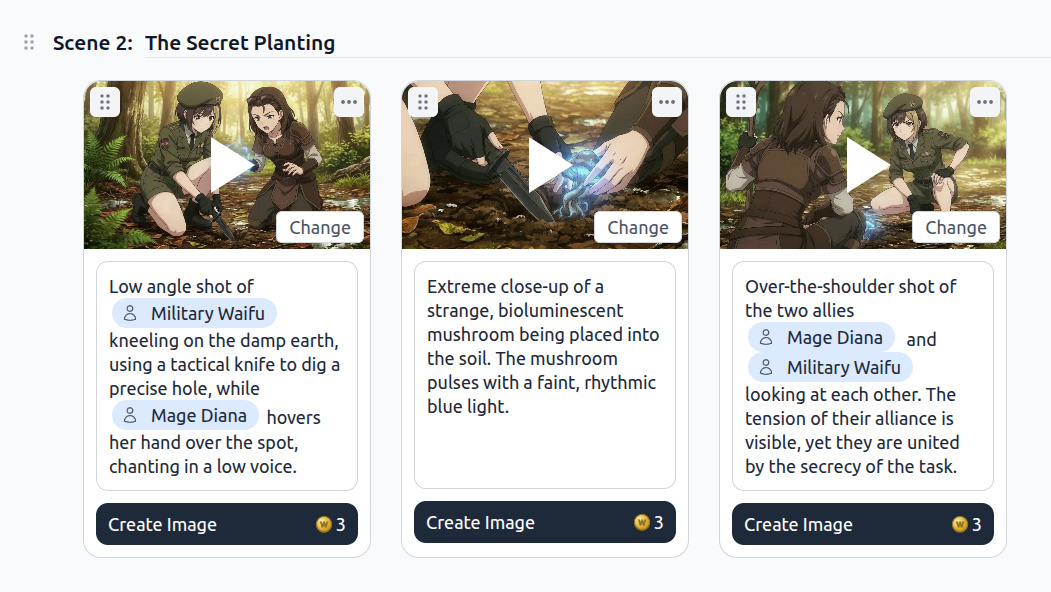
Introducing the Anime Storyboard Creator
Write your anime script and bring every scene to life with AI-generated images and videos.
AutoWeeb's new storyboard feature lets you write an anime script and generate images and videos for every scene. Meet the anime storyboard creator.
AI Anime Land Beats and Cliffhangers for YouTube Shorts
The last three seconds earn the next upload. Storyboard the land, generate one hold, and end on a question viewers cannot scroll past.
Design AI anime land beats and cliffhanger endings for YouTube Shorts: payoff panels, one-action holds, honest thumbnails, and prompts that lock your saved OC before EP02.
AI Anime Turn Beats for YouTube Shorts
The middle seconds deepen the hook without stealing the land. Storyboard one escalation, generate one action, and hand off to the cliffhanger on purpose.
Design AI anime turn beats for YouTube Shorts: middle-beat storyboard rows, one-action escalation prompts, b-roll handoffs, and saved OC locks before the land hold.
Creating an Anime Series with AI in 2026
A single-cour production grid for YouTube creators: twelve beats, one locked protagonist, and a still-to-motion chain that ships like a show.
Creating an anime series with AI in 2026 means a twelve-episode grid, locked protagonists, and Shorts-ready motion. A production workflow for YouTube video creators.
Explore AutoWeeb
Jump into the tool that fits your creative step.
AI Anime Video Generator
Animate storyboard shots into cinematic clips with Seedance 2 and consistent characters.
Anime Character Creator
Design original characters with consistent sheets across every scene.
AI Anime Image Generator
Generate cinematic anime stills anchored to your character library.
Turn Photo Into Anime
Upload any photo and watch AI turn it into stunning anime art in seconds.
AI Anime Location Generator
Create a location set once, then generate reference images from every angle.
AI Anime Storyboarding
Describe your idea, pick your characters, and let AI draft the script and scenes.
AI Anime Prompt Agent
Turn a rough idea into a cinematic Seedance 2 prompt with the AI Director.