How to Create Fan-Made Anime with AI (Without an Animation Studio)
A complete guide to planning, designing, storyboarding, and animating your own fan anime using AI tools, while respecting the rights of the creators you love.
Fan-made anime has existed for as long as anime has had fans. Doujinshi artists spent weekends drawing continuation stories for series that ended too soon. AMV editors built entire emotional narratives out of borrowed footage. Cosplayers staged their own scenes. The creative impulse has always been there. What has changed in 2026 is that a solo fan, with no drawing skills and no animation background, can now produce original visual anime content, not just illustrations or edits, but storyboarded scenes with consistent characters, generated anime artwork, and animated sequences that move.
This guide covers how to create fan-made anime with AI from concept to animated episode, including the legal framework that keeps fan work in a healthy relationship with the source material, and why AutoWeeb is the most complete workflow available for fans who want to build something that actually looks like anime.
What Is Fan-Made Anime?
Fan-made anime is original visual content created by fans of an existing series, using the world, characters, aesthetic, or lore of that series as a creative foundation. It is distinct from official productions in every legal and creative sense: it carries no endorsement from the rights holders, it does not replace or reproduce official content, and it exists as an expression of fan creativity rather than a commercial product.
Fan anime covers a wide creative spectrum. An original story set in the world of a beloved franchise, using characters who resemble the established cast but are distinct enough to be fan interpretations. A "what if" episode that picks up where a series left off. A crossover placing characters from two separate universes into a shared scene. Original characters inserted into a canonical setting. All of these are forms of fan anime, and all of them trace back to the same impulse: a fan who knows a fictional world deeply enough to want to build inside it.
What distinguishes quality fan anime from simple screenshots or edits is production intentionality. Character consistency across scenes. Locations that match the visual language of the source world. Storyboards that honor the pacing and framing conventions of the genre. Fan anime at its best is not an imitation of official content. It is a creative response to it, carrying the fingerprints of someone who understood the original well enough to extend it thoughtfully.
Why Fan Anime Has Become So Popular
The modern anime audience is the most production-literate fan base in entertainment history. Viewers who grew up watching anime know the genre's visual grammar fluently: they understand shot types, they recognize pacing conventions, they can identify an opening sequence structure or a sakuga cut from the first seconds. That literacy creates an extremely capable creative audience, people who can imagine exactly what a fan-made episode should look like and who have always had the imagination but not the means to produce it.
Social platforms have also created distribution infrastructure that fan anime never had before. A well-produced fan episode shared on YouTube or distributed through fan communities can reach the exact audience of devoted viewers who will appreciate every reference and understand every visual choice. Fan creators are not making content for a general audience. They are making it for the most engaged possible viewers, people who will notice if the character designs are off, and who will genuinely feel something when a scene lands the way it should.
AI image generation and video generation have collapsed the production barrier that kept fan anime in the imagination for most fans. The question is no longer whether production is possible. It is how to do it with the quality and consistency that the source material deserves.
Legal Considerations and Respecting Intellectual Property
Fan-made anime exists in a legally gray area in most jurisdictions, and approaching it responsibly requires understanding what that means in practice. The characters, worlds, and visual styles of established anime series are protected intellectual property. Creating fan work does not grant any license to that IP. What fan creators generally rely on is a combination of fair use principles and the practical tolerance that most rights holders have extended to non-commercial fan creativity over decades.
The rules that keep fan anime in that tolerated space are not complicated, but they matter. The work must be non-commercial: no selling it, no paywalling it, no monetizing the content in ways that generate revenue from someone else's IP. The work should be clearly identifiable as fan-made, not as official or authorized content. It should not reproduce substantial portions of original animation, dialogue, or music. It should not damage the commercial interests of the rights holders or substitute for official content.
Beyond the legal framework, there is a creative ethic worth observing. The fan creators who have earned the genuine respect of the anime industry are the ones who made work that honored the source material, who acknowledged the original creators, and who built communities around appreciation rather than appropriation. Fan anime at its best is a love letter, not a product. That distinction matters both legally and culturally.
The cleanest path through all of this, and the most creatively rewarding one, is to let your love of a series inspire original work rather than reproduce it. Characters who are your interpretations of archetypes from a beloved series rather than direct copies of copyrighted designs. Worlds built in the visual spirit of a franchise rather than its exact locations. Stories that could live in that universe but that are genuinely yours. That is the version of fan anime that creates something new from something loved, and it is the version this guide is built around.
Planning Your Fan Anime Adaptation
Before generating a single image, your fan anime needs a clear creative brief. That brief has four components: the source inspiration, the creative premise, the character roster, and the location set.
The source inspiration is the series whose world, aesthetic, or emotional register you are drawing from. Be specific about what you are borrowing and what you are reimagining. If you are inspired by a sci-fi bounty hunter series, specify whether you want the grimy jazz-inflected aesthetic of the original, the episodic monster-of-the-week structure, the specific type of found-family dynamic. The more precisely you can articulate what the source material gives you to work with, the more intentional your creative choices will be.
The creative premise is the story you are telling within that inspiration. A good premise for fan anime is typically a "what if" scenario, a missing piece the official series never showed, or an original adventure that could plausibly have happened in that world. It should have a clear beginning, middle, and end, even if the episode is only five or ten minutes of content. Vague premises produce vague storyboards. A premise tight enough to summarize in two sentences is tight enough to produce a coherent episode.
Your character roster should be established before any production begins. For a short fan episode, three to five characters is the right range: a protagonist or pair, one antagonist or complicating figure, and one or two supporting presences. Each character needs a visual reference detailed enough to generate consistently. Your location set should cover the three or four spaces where your episode takes place, specified at the same level of visual detail.
Designing Consistent Versions of Existing Characters
The central challenge of fan anime production is character consistency. A character who looks different in panel three than in panel nine breaks the viewing experience and signals immediately that the work was generated rather than produced. AutoWeeb's Character Sheet system is the structural solution to this problem.
A Character Sheet in AutoWeeb is not a single generated portrait. It is a saved visual document containing the full description of a character's appearance: proportions, facial features, hair, default costume, and the visual quality that communicates their personality at rest. Once saved, every storyboard panel that includes this character @tags the sheet directly, which means the AI is referencing the same detailed visual brief rather than reconstructing the character from memory.
For fan-inspired characters, write Character Sheets that capture the archetype and visual spirit of the source character without reproducing their exact design. The stoic ex-military bounty hunter in a battered blue suit with green hair who moves like someone conserving effort is an interpretation, not a copy. "Tall, lean build, green hair worn loose and uncombed, heavy-lidded eyes with a distant quality, wearing a worn navy suit with one button missing, hands in pockets, posture that is simultaneously relaxed and coiled" is a character description that evokes an archetype while being specifically yours.
Example Character Sheet prompt for a fan-inspired sci-fi protagonist: "Male, late twenties, lean athletic build with the easy posture of someone who has stopped caring about appearances without losing physical confidence. Green hair worn loose, slightly too long, falling across the forehead. Eyes are a muted olive brown, expression default is half-lidded and faintly ironic, the look of someone who has seen enough that very little surprises them. Wearing a blue suit jacket over a pale shirt, open collar, the jacket worn slightly soft at the lapels. Carries a cigarette more than he smokes it. Anime style, clean detailed linework, muted but precise color palette, mid-late nineties aesthetic. Proportions slightly elongated, the visual language of someone who takes up space without trying."
Build a Character Sheet for every named character before generating a single production panel. This is the single most important discipline in fan anime production. Without it, the first thing viewers will notice is the consistency problem, and no amount of quality in individual panels will compensate for it.
Creating Original Scenes Inspired by Favorite Franchises
The goal in designing fan anime scenes is not to recreate moments from the source material. It is to create new moments that feel as though they could belong to the same world, scenes that the original series might have told if it had more episodes, more budget, or a different angle on its own story.
Study the source material's scene grammar before designing your own. What is the standard shot progression during a tense conversation in this series? How does the background art change when the emotional stakes rise? How does the series handle silence, what types of shots carry the pauses, and how long does it let a reaction breathe before cutting? Understanding these conventions allows you to honor them deliberately rather than reproduce them accidentally.
Then build your original scenes using the same grammar for original content. An original chase scene through a location that feels like it belongs in the source world. A first meeting between characters who did not exist in the original. A quiet aftermath scene that handles the emotional fallout from an event in the canon in the way you always thought the series should have handled it. These are the scenes that make fan anime genuinely satisfying to watch.
The AutoWeeb AI Director is the production tool that handles this creative translation. Give it your premise, your character roster with @tags, your location set with @tags, and the specific scene you want to build. Ask it to generate the scene in the visual grammar of the source genre, specifying shot types, character positions, and the emotional beat you are landing. The output is a production-ready scene brief that you can then take through image generation and video animation.
Building Locations and Environments
Locations in anime do not simply provide setting. They carry genre identity. The grimy back-alley of a noir-inflected sci-fi series communicates world information in the same visual stroke that the composition communicates narrative information. Building locations that feel like they belong to the source world's visual language, while being original constructions rather than reproductions of copyrighted backgrounds, requires the same interpretive precision as character design.
AutoWeeb's Locations feature works the same way as Character Sheets: you write a detailed visual reference for each recurring environment, save it, and then @tag it in every storyboard panel where it appears. The system generates the location consistently across different shots, different times of day, and different emotional registers, which is what makes a series of scenes feel like they are set in the same physical world.
Example Location reference for a fan sci-fi interior: "A cramped living quarters section of a mid-size spacecraft. Metal walls with surface texture that suggests decades of use, minor dents and scratched paint, nothing that affects function but nothing cosmetic either. A built-in bunk visible at the far wall, a porthole window at the right showing a star field. Low-angle utility lighting supplemented by a single warm desk lamp in the corner. The floor has a worn quality without being dirty. The space is lived-in by someone who owns little and does not place much weight on comfort. Anime style, detailed background with mid-nineties sci-fi aesthetic, muted industrial palette, cold whites and warm amber light source contrast."
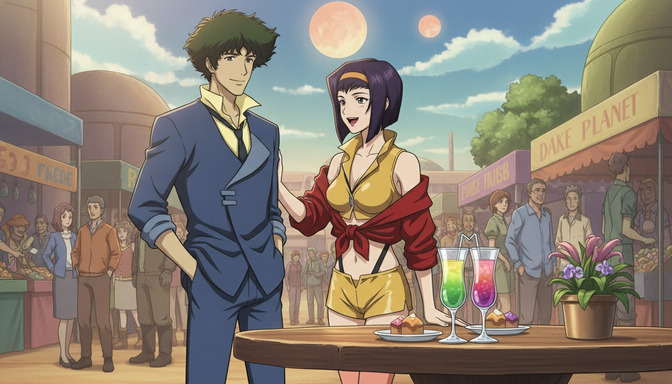
Example Location reference for an alien marketplace exterior: "An open-air marketplace on a terraformed planet, mid-afternoon light with two visible moons low in the pale sky. Vendor stalls with hand-painted signs in various languages, merchandise ranging from mechanical parts to fresh produce to items without obvious purpose. Crowds of figures with a variety of species and aesthetic, mostly humanoid but with enough variation to signal clearly that this is not Earth. Stone paving worn smooth underfoot, a fountain in the center that is currently not running. The visual temperature is warm but slightly dusty. Anime style, detailed atmospheric background, slightly desaturated palette with warm sunlight."
Storyboarding Every Scene
A storyboard converts a scene brief into a specific visual plan: a sequence of panels, each with a defined shot type, character positions, emotional beat, and camera movement. The storyboard is the production document that tells AutoWeeb's image generator exactly what to produce for each panel in the sequence.
AutoWeeb's Storyboard feature, combined with the AI Director, generates complete scene storyboards from a premise description. The workflow is: give the AI Director your scene brief and asset @tags, ask it to break the scene into individual storyboard panels with shot type, character positions, location, time of day, and emotional beat specified for each. Review the output against your creative brief. Then generate each panel in sequence using those specifications, with @tags referencing your Character Sheets and Locations.
Example AI Director prompt for a fan anime storyboard: "I'm making a fan anime set in a world inspired by classic bounty hunter sci-fi. The two main characters are @Spike-type and @Faye-type. This is a scene where they're sitting in the ship's cockpit after a job that didn't pay well. Neither of them is speaking. The tension isn't anger, it's something more tired. @Spike-type is piloting, barely. @Faye-type is looking at the viewscreen. Use @cockpit-location. Break this into eight to ten storyboard panels. Include shot type, character positions, what each character is doing with their face and hands, and the specific emotional quality of each panel. The scene should end with @Faye-type saying one line that lands differently than either of them expected."
Storyboard discipline is what separates a fan anime that coheres as a viewing experience from one that feels like a collection of images. Every scene needs a clear beginning, middle, and end at the storyboard level before a single panel is generated.
Generating Anime Artwork
With Character Sheets saved, Locations saved, and a storyboard panel sequence in hand, the image generation phase is primarily an execution task. For each panel in the storyboard sequence, write a generation prompt that references your saved assets via @tags and specifies the panel's compositional details: shot type, character positions and expressions, location, time of day, and the specific visual quality the panel needs to carry its emotional beat.
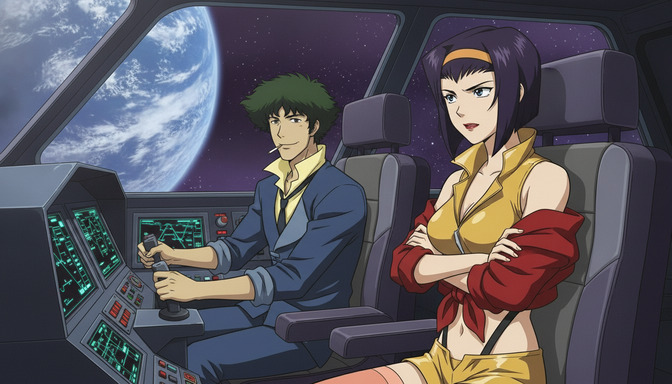
The quality gap between prompts that say "show the characters talking in the cockpit" and prompts that specify everything is substantial. "Medium two-shot, @Spike-type in the pilot seat at left, three-quarter profile facing the viewscreen, cigarette unlit at the corner of his mouth, one hand on the controls but with minimal tension, expression that reads as processing something unpleasant while deciding not to acknowledge it. @Faye-type at right, arms folded, gaze directed at the viewscreen rather than at him, the particular quality of someone being deliberately quiet. @cockpit-location, night, the planet surface visible outside the viewscreen in the distance. Anime style, mid-nineties sci-fi aesthetic, precise linework, muted color palette" is a prompt that produces a specific image rather than an approximation.
Generate panels in storyboard sequence and review each one against the panel description before moving forward. Catching consistency drift at the panel level is straightforward. Trying to correct it after twenty panels have been generated is not.
Turning Artwork into Animated Sequences
Not every panel in a fan anime needs to move. The format uses motion strategically: for action, for the specific moment when a character's expression shifts, for environmental elements like rain or drifting smoke that carry emotional information through movement. Still panels with careful sequencing carry the dialogue, the pauses, and the aftermath scenes. Motion is reserved for the beats where movement is the content.
AutoWeeb's image-to-video pipeline takes a generated panel and animates it from a motion prompt. The motion prompt for fan anime should specify what moves, how it moves, what remains still, and the duration. The goal is controlled motion that serves the scene's purpose rather than movement for its own sake.
Example motion prompt for a sci-fi fan anime action scene: "@Spike-type in medium shot, @corridor-location. He turns from a standing position into a running start in the first two seconds, the camera following the turn with a slight pan. The movement is athletic and economical, not dramatic: someone who runs toward trouble the same way they do everything else. Fluorescent corridor lights pass overhead at an accelerating pace as he picks up speed. Duration four seconds. Anime style, crisp action linework, mid-nineties sci-fi palette."
Example motion prompt for a quiet character moment: "Close-up on @Faye-type's face, @cockpit-location at night. She is looking at something off-screen. In the first two seconds her expression is held, neutral, the practiced nothing. Then something shifts in the area around her eyes, not much, the smallest concession. The motion is only in her face. The rest of the frame is still except for the faint movement of stars through the viewscreen behind her. Duration three seconds. Anime style, careful linework, the movement is everything the dialogue was not."
Editing Together a Complete Fan-Made Episode
Once you have a set of generated panels and animated clips, the editing phase assembles them into a coherent viewing experience. The editing structure for a fan anime short typically follows the same rhythm as the source genre: an establishing shot, a series of scene-building panels, the emotional peak with motion, and an ending panel or brief clip that closes the scene.
Still panels are held for long enough to be read, typically two to four seconds per panel for dialogue scenes, slightly shorter for action sequences. Animated clips play through their full duration. Transitions between panels in the same scene are typically cuts. Transitions between scenes can use a brief fade to black if the emotional register is shifting significantly.
Audio carries fan anime across the line from "collection of images" to "actual episode." Fan-created music, royalty-free tracks that match the source world's sonic identity, or original compositions add the layer that still images and clips alone cannot fully deliver. The pacing of visual editing should account for the audio track: the cut at the end of a musical phrase, the silence before the line that lands, the ambient sound design that makes a space feel inhabited.
Tips for Improving Quality
The quality ceiling for fan anime produced with AI tools is determined almost entirely by the quality of the production inputs: the specificity of Character Sheets, the visual coherence of Location references, the precision of storyboard panel descriptions, and the discipline of building assets before generating any production panels.
Study the visual grammar of your source series before you start generating. Watch several episodes with your attention on shot composition rather than story. What is the average shot duration in a dialogue scene? How close does the series get to faces during emotional peaks? How does the background art handle negative space? These are the conventions your fan anime should honor, and understanding them at a technical level produces better prompts and better storyboards.
Regenerate panels that are close but not right rather than settling for them. The time investment in getting a key character moment to land correctly in still image form pays back when you animate it: a strong source panel produces a strong animated clip, and the reverse is equally true.
Maintain a production document separate from the AutoWeeb project: a text file tracking each saved Character Sheet name, each saved Location name, the episode storyboard sequence, and the generation status of each panel. Fan anime production involves enough individual elements that without a tracking system, regeneration and consistency management become genuinely difficult.
Common Mistakes Beginners Make
The most common mistake is starting production without saved Character Sheets and Locations. Generating character images directly from text descriptions without saving reference documents produces characters who look different in every panel. The first episode of a fan anime where the protagonist has slightly different features in ten different scenes is not a fan anime. It is a collection of images of similar characters.
The second most common mistake is treating fan anime as a reproduction rather than an interpretation. Fans who try to generate scenes that exactly match official key frames are working against the grain of what AI anime generation does well. The tools are built for original visual content generation, not for reproduction. The fan anime that succeeds is the one that captures the spirit and visual language of the source world while building something that is genuinely its own.
Third: skipping the storyboard and generating panels from direct scene descriptions. Without a storyboard, there is no visual plan for the scene, no specified sequence of shot types, no planned emotional arc from panel to panel. The resulting images may all look correct individually but will not read as a coherent scene when assembled in sequence.
Fourth: animating everything. Creators who are excited about the motion generation capability frequently over-animate their fan episodes, applying video generation to panels where stillness would be more effective. The scenes that hit hardest in anime are usually surrounded by stillness, and the motion in them matters precisely because of that contrast. Reserve animation for the moments that require it.
Fifth: producing fan anime with the intention of commercial distribution or without clear attribution as fan work. Beyond the legal considerations, fan anime that is clearly identified as non-commercial fan creativity is the version that gets appreciated, shared, and respected by the community and, in many cases, quietly tolerated by rights holders. The ones that try to monetize someone else's IP do not tend to have long shelf lives.
Why AI Dramatically Speeds Up Anime Production
Traditional fan animation, before AI tools, required skills that almost no fan possessed: drawing ability sufficient to produce consistent character designs across dozens of frames, digital coloring technique, background art skills, compositing knowledge, and the patience to hand-animate even a few seconds of motion. The production pipeline for a five-minute fan episode, done well, was a months-long undertaking even for skilled artists.
AI anime generation has changed every stage of that pipeline. Character design: hours of iteration become minutes. Background art: detailed environment generation from a text description. Image consistency: the Character Sheet and Locations system stores visual references rather than requiring perfect recall across every panel. Animation: image-to-video tools convert still panels into motion clips without frame-by-frame hand animation.
The remaining creative work, story planning, storyboarding, visual judgment, prompt refinement, editing, is all creative decision-making rather than technical execution. That is where the fan's knowledge of the source material, their understanding of the genre's conventions, and their investment in the story they are telling actually matters. AI tools handle the technical execution barrier. The creative barrier was never the problem to begin with.
Why AutoWeeb Is Built for Fan Anime Creation
Most AI image tools are built for single image generation. AutoWeeb is built for series production, which is exactly what fan anime requires. The infrastructure difference is substantial: Character Sheets that maintain visual consistency across a full episode, Locations that regenerate consistently across different shots and atmospheric conditions, the AI Director that handles both story planning and storyboard generation in a single workflow, and an image-to-video pipeline that converts still panels into animated clips without leaving the platform.
For fan anime specifically, the @tag system is the feature that makes the difference. When every storyboard panel references your saved character and location documents directly, the AI has the same detailed visual brief for every generation in the project. That is what produces the consistency that makes a fan anime look like an episode rather than a gallery of images.
The AI Director in AutoWeeb handles the translation from creative premise to production-ready storyboard, which is the step where most fan creators without a production background lose momentum. Give it your premise, your character roster, your tone reference, and your target scene, and it returns a storyboard breakdown with shot types, character positions, and emotional beats specified for every panel. From there, generation is an execution task rather than a creative one.
AutoWeeb is designed for fans who want to create original stories. The most powerful version of the platform is one pointed at original creative work, characters and worlds that are yours, stories that exist because you built them. Fan anime is a meaningful creative tradition, and the legal and creative guidelines in this post are meant to keep it that way. But the workflow that makes fan anime possible in AutoWeeb is the same workflow that makes original anime possible, and original work is where the long-term creative satisfaction lives.
For creators interested in building fully original series, the guide on how to create a shounen anime in 2026 covers the complete production pipeline for action-oriented original series. If you want to build an original cast from the ground up, how to make an anime character goes deep on the character design and character sheet workflow. And for inspiration on what fan-quality visual storytelling looks like in practice, the Attack on Wemby production guide shows how to build a short fan-inspired anime episode from concept to animated clips.
Start Creating
Fan anime is one of the most demanding and most rewarding forms of fan creativity, because it requires you to understand a source world well enough to build inside it. The tools to do that at production quality are available right now. AutoWeeb's Character Sheets, Storyboards, Locations, AI Director, image generation, and image-to-video pipeline give you everything the production pipeline requires, and the only thing it asks of you in return is a clear vision of the story you want to tell.
If that story is a fan-inspired interpretation of a series you love, honor it by building something that takes it seriously. Keep it non-commercial, keep it clearly attributed as fan work, and keep it true to the spirit of what made the original matter to you. If that story is something completely original, the same tools and the same workflow apply, and the result belongs to you in every sense.
Frequently Asked Questions
Is it legal to create fan-made anime?
Fan-made anime occupies a legally gray area in most countries. Rights holders own the characters, worlds, and visual styles of their series, and fan creation does not grant a license to that intellectual property. What fan creators rely on is a combination of fair use principles and the practical tolerance most rights holders extend to non-commercial fan creativity. The key requirements that keep fan work in that tolerated space are: non-commercial production, clear identification as fan work rather than official content, no reproduction of substantial copyrighted material, and no use that damages the commercial interests of the rights holder. Creating original characters and original stories inspired by a series, rather than reproducing copyrighted designs, keeps fan anime on the stronger side of that line.
Do I need drawing skills to create fan anime with AutoWeeb?
No. AutoWeeb generates anime images and animated clips from text descriptions. The skill that matters is descriptive specificity: communicating a character's appearance, a scene's composition, and the emotional beat of a moment in enough detail that the AI produces what you envision. Understanding anime visual conventions well enough to describe them accurately is the relevant skill set. Drawing ability is not required at any stage of the production pipeline.
How do I keep fan anime characters looking consistent across multiple scenes?
Save a Character Sheet for every named character in AutoWeeb before generating any production panels. The Character Sheet stores a detailed visual description of the character's appearance, and the @tag system references that document directly in every storyboard prompt where the character appears. This is what produces visual consistency across ten or twenty panels of the same character, rather than slight drift in features, hair, and costume across the sequence. Without saved Character Sheets, character consistency is impossible to maintain at production scale.
What is the difference between fan anime and original anime?
Fan anime draws on the characters, world, aesthetic, or lore of an existing series as creative raw material. Original anime starts from a blank slate: characters, world, and story that belong entirely to the creator. The production workflow in AutoWeeb is identical for both. The legal and creative distinction is significant: original anime carries none of the IP considerations that apply to fan work, can be monetized without rights clearance concerns, and gives the creator full ownership of everything they produce. Fan anime is a meaningful creative tradition, and AutoWeeb fully supports it within the non-commercial, fan-attributed framework. But original stories are where the platform's full potential lives.
How long does it take to produce a short fan anime episode?
A focused production session in AutoWeeb can produce enough panels and animated clips for a two-to-four-minute fan episode cut. Building all Character Sheets and Location references before generating any production panels significantly compresses the overall timeline. Creators who attempt to build assets during production, rather than before it, spend considerably more time on regeneration and consistency corrections than those who complete the asset library first. A complete short episode, properly planned, is achievable across two or three dedicated production sessions.
Can AutoWeeb recreate a specific anime art style for fan work?
AutoWeeb's image generation handles a wide range of anime visual styles, and you can specify stylistic parameters in your Character Sheet and storyboard prompts to capture the visual language of a genre or era rather than the exact copyrighted style of a specific series. "Mid-nineties sci-fi anime aesthetic, precise linework, muted industrial palette" produces images that carry the visual spirit of that era and genre without reproducing the exact style of any single copyrighted work. The distinction is important both creatively and legally: interpreting a visual genre versus reproducing a specific copyrighted visual identity.
What type of stories work best as fan anime?
The fan anime concepts that tend to produce the most satisfying results are those with a clear, self-contained premise: a missing episode that the source series never showed, a scene that happens between two canonical events, an original adventure involving characters who could plausibly exist in the source world. Concepts that try to reproduce or extend the main plot of the source series are often the hardest to execute well and carry the most IP risk. Original interpretations and gaps-in-canon stories give you the creative freedom to build something genuinely yours while still honoring the universe that inspired it.
Related Blog Posts
How Indie Manga Creators Can Turn Their Manga Into an Anime
A practical guide for independent mangaka, comic creators, and anime enthusiasts who want to adapt their existing manga into a watchable anime, from arc selection and character sheets through storyboards, AI image generation, and video production.
Learn how indie manga creators can turn manga into anime using AI. Select the right arc, build character sheets, storyboard panels, and generate anime scenes and video without a studio.
How to Turn Your Manhwa Into an Anime Using AI
A complete guide for manhwa creators, webcomic artists, and digital storytellers who want to adapt their work into anime, from evaluating your story and building character sheets through storyboards, AI image generation, and video production.
Learn how to turn your manhwa into an anime using AI. Build character sheets, storyboard vertical panels into cinematic scenes, generate anime images, and create video without a studio.
How to Turn Your Wattpad Story Into an Anime Series with AI
A complete guide for Wattpad authors who want to adapt their stories into indie anime, from episode structure and character sheets through storyboards, AI image generation, and video production.
Learn how to turn your Wattpad story into an anime series with AI. Design characters, storyboard scenes, generate anime images, and create anime video episodes without a studio.
How to Turn Your AO3 Fanfiction or Original Story Into an Anime
A practical guide for AO3 writers, fanfiction authors, and original fiction creators who want to adapt their stories into anime, from story selection and character design through storyboards, AI image generation, and video production.
Learn how to turn your AO3 fanfiction or original story into an anime with AI. Design characters, storyboard scenes, generate anime images, and create video without a studio.
Explore AutoWeeb
Jump into the tool that fits your creative step.
AI Anime Video Generator
Animate storyboard shots into cinematic clips with Seedance 2 and consistent characters.
Anime Character Creator
Design original characters with consistent sheets across every scene.
AI Anime Image Generator
Generate cinematic anime stills anchored to your character library.
Anime Filters
Upload any photo and apply AI anime filters to turn it into stunning anime art in seconds.
AI Anime Location Generator
Create a location set once, then generate reference images from every angle.
AI Anime Storyboarding
Describe your idea, pick your characters, and let AI draft the script and scenes.
AI Anime Prompt Agent
Turn a rough idea into a cinematic Seedance 2 prompt with the AI Director.