How to Create War and Military Aesthetic Anime with AI
A detailed guide to the war and military aesthetic in anime: muted palettes, smoky lighting, worn equipment, abandoned cities, industrial environments, tactical vehicles, and emotional cinematography, with AI prompts from concept to finished video.
There is a specific visual language that signals "war anime" before a single line of dialogue is spoken. Muted color palettes. Smoke filtering through broken windows. Uniforms that show wear. Equipment that has been carried too long. Cities that used to be alive. The aesthetic is not realism. Series like 86 -Eighty Six-, Gundam, Violet Evergarden, and Jormungand do not look like news footage. They look like anime that has absorbed the emotional grammar of conflict: restraint in the close-up, scale in the wide shot, and light that does more work than exposition ever could.
This guide explains what the war and military aesthetic actually is, which visual elements define it, and how to produce those visuals consistently with AI in AutoWeeb from concept art through finished video. Build your cast in the anime character creator, generate environments and storyboard panels with a locked style anchor, then animate key sequences in the AI anime video generator. Every section includes copy-paste prompt examples for multiple environments and character types.
What Is the War and Military Aesthetic in Anime?
The war and military aesthetic is a set of visual conventions that communicate conflict, loss, and operational scale without requiring photorealism. It combines three layers: character design that reads as human under pressure, environments that show what the war has done to the world, and lighting that carries emotional information the dialogue does not need to state.
Unlike action anime, which prioritizes kinetic energy, war aesthetic anime prioritizes atmosphere. A charging infantry line and a soldier sitting alone in a ruined building can both belong to the same production if they share the same palette, the same quality of light, and the same level of wear on surfaces and uniforms. Consistency across those elements is what makes a collection of AI generations feel like one anime rather than a folder of unrelated images.
The aesthetic works because viewers already know how to read it. Desaturated colors mean gravity. Smoke means recent violence. Golden hour light means the scene is about to become a memory. Worn gear means this person has been here a while. You are not inventing a new visual language. You are applying a well-established one with deliberate prompt choices.
The Core Visual Elements
Muted Color Palettes
War anime rarely uses saturated primaries except for fire, explosions, and tactical display glow. The base palette is desaturated: olive drab, slate gray, dusty brown, washed-out blue. Skin tones stay natural but slightly muted. Sky colors lean toward overcast gray or pale gold rather than bright blue.
Palette prompt anchor: "Desaturated military color palette, muted olive drab and slate gray tones, warm accents only from fire and sunlight, no saturated primaries, anime cel-shaded rendering."
Lock this palette anchor into every prompt in your production. When one panel drifts toward vivid greens or electric blues, regenerate with the anchor repeated twice.
Smoky Lighting and Atmospheric Haze
Smoke, dust, and haze are compositional tools in war anime, not background noise. They soften distant objects, create depth between foreground and background, and diffuse light into something that feels heavy rather than clean. Industrial smokestacks, battlefield dust, and cathedral dust motes all serve the same function: the air itself carries weight.
Smoky lighting prompt anchor: "Atmospheric haze and floating dust particles visible in light beams, soft diffused lighting filtered through smoke, high contrast between lit and shadow areas, anime cel-shaded, cinematic war anime atmosphere."
Dramatic Sunsets and Golden Hour
Golden hour is the most used lighting condition in war anime for a reason. Warm light on a cold subject creates emotional dissonance: the world is beautiful at the exact moment it is being destroyed. Use golden hour for emotional peaks, pre-battle tension, and aftermath scenes. Use overcast flat light for operational sequences and command center interiors.
Golden hour prompt anchor: "Golden hour sunlight streaming from the left, warm pale yellow light creating long soft shadows, rim light on character silhouettes, anime cel-shaded, cinematic war anime lighting."
Military Uniforms and Worn Equipment
Uniforms in war anime are readable at a distance: camouflage pattern, tactical vest silhouette, helmet shape, boot weight. Wear is communicated through scuffs, dust on fabric, cracked helmet visors, and ammunition crates that have been opened. New-looking gear signals deployment. Worn gear signals the middle of a campaign.
Uniform prompt anchor: "Woodland camouflage military fatigues, tactical plate carrier with magazine pouches, worn combat boots with visible scuffing, anime style clean linework, cel-shaded, gear shows campaign wear not factory freshness."
Abandoned Cities and Ruined Architecture
Ruins in war anime are never generic rubble. They retain the identity of what they were: a cathedral with stained glass fragments still in the rose window, an apartment block with laundry still on a line, a town square with a fountain that no longer runs. The contrast between what the place was and what it is now is the storytelling.
Industrial Environments
Factories, rail yards, smokestacks, shipping containers, and command centers with holographic displays define the industrial military aesthetic. These environments communicate that the war is mechanized, systematic, and impersonal. Cool blue monitor glow against warm exterior light is one of the most recognizable combinations in the genre.
Tactical Vehicles and Aircraft
Vehicles in war anime are stylized but detailed: illustrated panel lines instead of photorealistic metal, cel-shaded surfaces, silhouettes that read clearly at a distance. Tanks, drones, fighter jets, and attack helicopters function as scale markers and threat indicators as much as hardware.
Emotional Cinematography
The war aesthetic is defined as much by stillness as by action. A soldier crying in a ruined cathedral. A commander staring at a tactical display without speaking. A pilot holding a radio while drones patrol a smoke-filled sky. These are the images that stay with viewers. Emotional cinematography in war anime uses close-ups sparingly, wide shots for isolation, and light as the primary emotional instrument.
Building a Style Anchor Before You Generate
Consistency starts with a single style anchor document saved to your AutoWeeb project library. Write it once and paste it into every prompt.
Example style anchor: "Premium war anime aesthetic, anime cel-shaded rendering, clean dramatic linework, desaturated military color palette with warm golden-hour accents, atmospheric haze and dust particles in light beams, no photorealism, no 3D render look. Visual quality of 86 Eighty Six or Violet Evergarden war sequences."
Generate two or three concept panels using this anchor before character work begins. Save the best result as your visual reference. Every subsequent generation should match its palette and lighting quality.
Character Type Prompts
War anime characters fall into a few recurring types. Each needs a saved character sheet in the anime character creator before you generate scenes.
The Exhausted Soldier
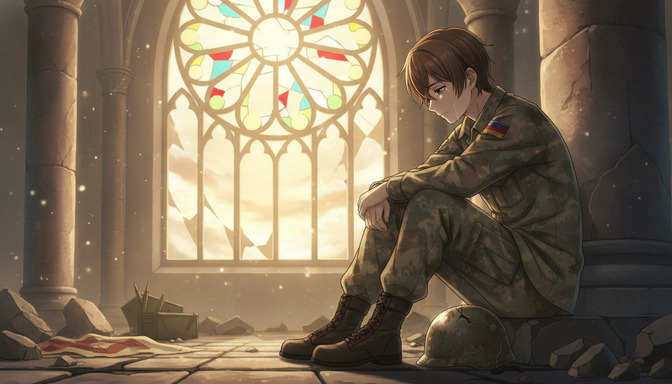
Example prompt: "Young male soldier, early twenties, short brown hair, slender build. Woodland camouflage fatigues with blue-red-yellow flag patch on left shoulder, worn combat boots. Sitting hunched on a stone base, hands clasped between knees, single tear on cheek, eyes downcast. Cracked olive-drab helmet on the ground at his feet. Ruined cathedral interior, broken rose window with stained glass fragments, golden sunlight streaming through creating dust motes in the air. Rubble and ammunition crates in the shadows. Anime style, cel-shaded, emotional war anime cinematography. Medium shot."
The Field Operator
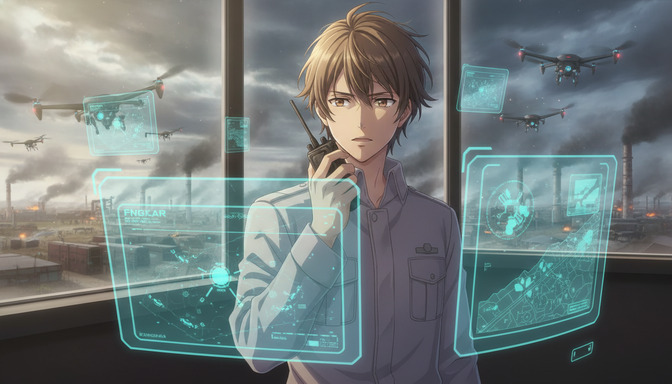
Example prompt: "Young male field operator, messy light brown hair, serious focused expression. Muted grey button-down tactical shirt with shoulder epaulets, holding a black tactical radio to his ear. Standing before a panoramic window overlooking an industrial complex with smokestacks billowing black smoke. Glowing cyan holographic tactical displays floating in the foreground showing maps and drone tracking data. Military drones with red and green navigation lights visible in the overcast sky outside. Anime style, cel-shaded, cool blue-grey palette with cyan UI accents. Medium-wide shot."
The Command Staff
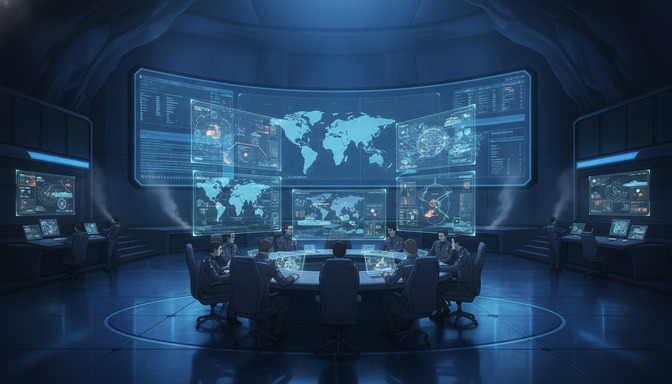
Example prompt: "Group of seven military personnel in dark professional uniforms seated around a large circular command table, facing a massive curved tactical display wall showing a world map with threat markers. Floating holographic screens between the table and the wall showing vehicle schematics and radar data. Cavernous high-tech war room, cool blue and cyan lighting from displays, thin atmospheric smoke trails. Anime style, cel-shaded, symmetrical wide composition, atmosphere of strategic tension."
The Pilot
Example prompt: "Female military pilot, late twenties, dark hair in a tight operational bun, sharp anime features, professional intensity. Flight suit in muted grey-green with harness straps, standing on a rain-slicked tarmac beside a twin-tail fighter jet at dawn. Golden hour light from the right, atmospheric haze, ground crew visible in soft focus behind her. Anime style, cel-shaded, medium shot, low angle conveying readiness."
The Veteran
Example prompt: "Male veteran sergeant, late thirties, weathered anime face, short cropped grey-streaked hair, thousand-yard stare. Dark olive uniform with faded rank insignia, campaign medals on chest, hands resting on a rifle barrel pointed at the ground. Overcast battlefield behind him, smoke on the horizon. Anime style, cel-shaded, desaturated palette, medium close-up, eye level."
Environment Prompts
Ruined Cathedral or Sacred Space
Example prompt: "Interior of a ruined cathedral after bombardment, large circular rose window with broken stained glass fragments in yellow, blue, and red. Thick stone pillars and arches, cracked walls, rubble across the stone floor. Golden sunlight streaming through the window creating visible dust motes and god rays. Abandoned ammunition crates and a tattered flag in the shadows. No characters. Anime style, cel-shaded, desaturated stone tones with warm light accents. Wide establishing shot."
Industrial War Complex
Example prompt: "Grim industrial complex under heavy overcast sky, multiple tall smokestacks billowing thick black smoke. Factory buildings and rail yard with shipping containers in the midground. Military drones patrolling the sky with small red and green navigation lights. Desaturated grey and brown palette, diffused smoky lighting. Viewed from inside a dark control room through large panoramic windows. Anime style, cel-shaded, cinematic war anime industrial aesthetic. Wide shot."
Abandoned Urban Block
Example prompt: "Destroyed city block, collapsed apartment facades with exposed interiors, furniture visible through broken walls. Rubble and twisted rebar across the street, a child's bicycle half-buried in debris. Overcast sky, no active fire, the violence is recent but over. Anime style, cel-shaded, desaturated palette, wide shot, no characters, environmental storytelling only."
Battlefield at Golden Hour
Example prompt: "Wide battlefield at golden hour, churned earth and shell craters across the frame. Destroyed vehicles and scattered equipment in the midground. Dark smoke plumes on the horizon backlit by the setting sun. Single figure silhouette standing at the center, small against the destruction. Anime style, cel-shaded, warm sky tones against desaturated ground, extreme wide shot, aftermath atmosphere."
Military Airfield at Dawn
Example prompt: "Military airfield at dawn, pale golden light across concrete tarmac with yellow taxi lines. Row of parked fighter jets receding into atmospheric haze. Heavy-lift transport helicopters on the left, cargo aircraft near arched-roof hangars in the background. Distant mountains under a pale warm sky. Anime style, cel-shaded, long soft shadows, premium military anime production quality. Wide establishing shot."
Vehicle and Aircraft Prompts
Main Battle Tank
Example prompt: "Olive-drab main battle tank advancing through churned battlefield mud, dust cloud trailing behind treads. Low-angle anime composition, cel-shaded mechanical design with illustrated panel lines. Golden hour rim light on the turret. Smoke and distant fires in the background. Anime style, no photorealistic metal textures."
Military Drone
Example prompt: "Quadcopter military surveillance drone in hover position against an overcast industrial sky, small red and green navigation lights visible. Cel-shaded anime mechanical design. Industrial smokestacks and factory buildings in the soft-focused background. Cool grey palette. Medium shot, anime style."
Fighter Jet
Example prompt: "Twin-tail fighter jet on a rain-slicked runway at dawn, afterburner nozzles dark, cockpit canopy reflecting pale golden sky. Ground crew figure beside the aircraft for scale. Anime style, cel-shaded, detailed but illustrated mechanical design. Wide shot, atmospheric haze in the distance."
Attack Helicopter
Example prompt: "Military attack helicopter in low hover above a smoke-filled battlefield, rotor motion implied through anime-style blur lines. Olive drab and dark grey color scheme, cel-shaded. Orange explosion light reflecting on the fuselage underside. Medium-wide shot, anime style."
Emotional Cinematography Prompts
These are the scenes that define war anime. Generate them with the same style anchor as your battle sequences so they feel like the same production.
Example grief scene prompt: "Medium shot, @exhausted-soldier sitting alone in @ruined-cathedral, hunched forward, tear on cheek, cracked helmet at feet. Golden god rays through the broken rose window, dust motes visible. Ruble and abandoned gear in the shadows. Anime style, cel-shaded, restrained emotional lighting, no action. The stillness is the point."
Example strategic tension prompt: "Wide symmetrical shot, @command-staff seated around the circular table in @war-room, all facing the tactical display wall. Floating holographic screens between table and wall. Cool blue display glow as primary light, thin smoke in the air. Anime style, cel-shaded, atmosphere of controlled urgency before a decision."
Example isolation wide prompt: "Extreme wide shot, single @veteran-sergeant standing on a ridge overlooking a smoke-filled valley, rifle pointed at the ground. Overcast sky, desaturated palette, the figure small against the landscape. Anime style, cel-shaded, emotional war anime scale. No other characters visible."
From Concept to Finished Video: The AI Workflow
Producing war aesthetic anime consistently requires a fixed production order. Skipping steps is how palette and lighting drift between panels.
Step 1: Style Anchor and Concept Art
Write your style anchor. Generate two to three concept panels covering different environment types: a ruined interior, an industrial exterior, and a command center. Save the best as your visual reference.
Step 2: Character Sheets
Build saved character sheets for every named character in the anime character creator. Include at least one emotional-state variation per protagonist: default operational expression and one grief or exhaustion variation.
Step 3: Location References
Save location references for every environment your story visits. Use the environment prompts above as starting points and @tag them in every storyboard shot set in that location.
Step 4: Storyboard and @Tagged Generation
Write storyboard panels in sequence. @tag saved characters and locations in every shot prompt. Paste the style anchor into every prompt. Generate panel by panel, checking each against the reference before continuing.
Step 5: Video for Key Moments
Attach approved stills to the AI anime video generator for scenes where motion carries the beat: the soldier standing and walking through the ruins, drones moving across the industrial sky, the command table scene with holographic displays flickering, the tank advance, the aircraft takeoff.
Example emotional video prompt: "Medium shot, @exhausted-soldier slowly raising his head from a bowed position in @ruined-cathedral, golden light intensifying through the rose window, dust motes drifting. Camera holds static. Anime cel-shaded style, four to five seconds, slow and deliberate movement."
Example command center video prompt: "Wide symmetrical shot, holographic displays on the war room wall flickering with updated tactical data, thin smoke trails drifting across the frame. Personnel remain still, facing the displays. Cool blue light pulse at the two-second mark. Anime style, five to six seconds."
Keeping the Aesthetic Consistent: Common Drift Points
War anime drifts fastest in these areas. Watch for them in every generation:
- Palette saturation: One panel turns vivid green while the rest are desaturated. Regenerate with the palette anchor repeated.
- Lighting direction: Golden hour from the left in panel three, from the right in panel four. Name light direction in every prompt.
- Photorealism creep: Metal surfaces become reflective, skin becomes photographic. Add "no photorealism, anime cel-shaded" to the prompt.
- Gear freshness: Uniforms look factory-new in emotional scenes that should show campaign wear. Specify "worn gear, visible scuffing, dust on fabric."
- Scale inconsistency: Characters change size relative to vehicles between panels. Use ground crew or objects for scale reference in vehicle prompts.
Frequently Asked Questions
What is the difference between war aesthetic anime and military action anime?
Military action anime prioritizes kinetic sequences: charges, dogfights, artillery strikes. War aesthetic anime prioritizes atmosphere and emotional weight: the soldier alone, the ruined city, the command center before the decision. Both can coexist in the same production, but they use different prompt priorities. Action scenes need motion lines and dynamic composition. Aesthetic scenes need stillness, light, and environmental detail.
Which anime series best demonstrate the war and military aesthetic?
86 -Eighty Six- for battlefield scale and emotional restraint. Violet Evergarden for post-war grief and golden-hour lighting. Gundam for industrial military environments and mecha scale. Jormungand for contemporary tactical gear in anime style. Grave of the Fireflies for ruined urban environments and the cost of conflict. Collect screenshots and build a mood board before your first generation.
How do I keep the muted palette from looking flat or boring?
Contrast comes from light, not saturation. Golden hour warmth against cool shadows. Cyan tactical display glow against grey concrete. Orange fire against a desaturated sky. A muted palette with strong light contrast reads as cinematic. A muted palette with flat even lighting reads as unfinished. Always specify light direction and one warm accent source in every prompt.
Do I need separate prompts for emotional scenes and action scenes?
Yes, but they should share the same style anchor. Emotional scenes emphasize stillness, close or medium framing, and light as the primary instrument. Action scenes emphasize motion lines, low angles, and dynamic composition. The palette, linework quality, and cel-shading style stay identical across both.
How many location references do I need for a short war anime?
A five-scene short typically needs three to four saved locations: one interior emotional space (ruined cathedral or bunker), one operational environment (command center or airfield), one exterior conflict zone (battlefield or industrial complex), and optionally one pre-war location for contrast. Save each before generating any scenes set there.
Can I combine the war aesthetic with sci-fi or mecha elements?
Yes. The aesthetic is about palette, lighting, and emotional grammar, not historical period. Holographic tactical displays, military drones, and near-future fighter jets all fit the war aesthetic when rendered in anime cel-shading with desaturated palettes and atmospheric haze. The field operator with cyan UI overlays in this guide is already a sci-fi war aesthetic image.
Which scenes should I prioritize for video generation?
Prioritize the scenes where subtle motion carries emotional or operational weight: the soldier raising his head in the cathedral, drones moving across the industrial sky, holographic displays updating in the command center, the tank advance, the aircraft takeoff. Static emotional close-ups and wide establishing shots work as stills without losing impact.
For a full war anime production workflow including character arcs and battle choreography, see How to Make an Epic War Anime with AI. For military hardware-focused prompting and the Anduril aesthetic, see Recreate Anduril's Military Anime Style: Complete AI Tutorial. Lock your cast in the anime character creator and animate key sequences in the AI anime video generator.
Related Blog Posts
Turn Video Game Characters into Anime Photos and Characters
Reimagine your favorite games. AutoWeeb's photo-to-anime converter brings iconic characters to life in 2D
Turn video game characters into anime photos with AutoWeeb. Upload game screenshots or art, convert to anime style, then build a character sheet and place them in new scenes.
The Best AI Anime Page on TikTok
AutoWeeb's TikTok is where AI anime creators get short-form inspiration, prompt breakdowns, and clips worth recreating.
Looking for the best AI anime page on TikTok? Follow @autoweeb_ for AI anime video clips, prompt ideas, character showcases, and creator tips from the AutoWeeb team.
How to Create Anime Videos with Google Omni Flash
Google's new multimodal video model handles scene cuts, reference images, and natural motion differently from anything else on the market
Learn how to create anime videos with Google Gemini Omni Flash. Starting images, IMAGE_REF tags, scene cuts, dialogue prompts, and what to expect from the preview model.
Seedance 2 vs Omni Flash: Which Should You Use for Anime?
Two leading AI video models, different tagging systems, different motion languages, and side-by-side examples across slice-of-life, action, and sports
Seedance 2 vs Google Omni Flash for anime video: compare frame rate feel, image tagging, scene cuts, audio behavior, sports motion, and content filters with side-by-side clips.
Explore AutoWeeb
Jump into the tool that fits your creative step.
AI Anime Video Generator
Animate storyboard shots into cinematic clips with Seedance 2 and consistent characters.
Anime Character Creator
Design original characters with consistent sheets across every scene.
AI Anime Image Generator
Generate cinematic anime stills anchored to your character library.
Turn Photo Into Anime
Upload any photo and watch AI turn it into stunning anime art in seconds.
AI Anime Location Generator
Create a location set once, then generate reference images from every angle.
AI Anime Storyboarding
Describe your idea, pick your characters, and let AI draft the script and scenes.
AI Anime Prompt Agent
Turn a rough idea into a cinematic Seedance 2 prompt with the AI Director.